
The one-sentence answer
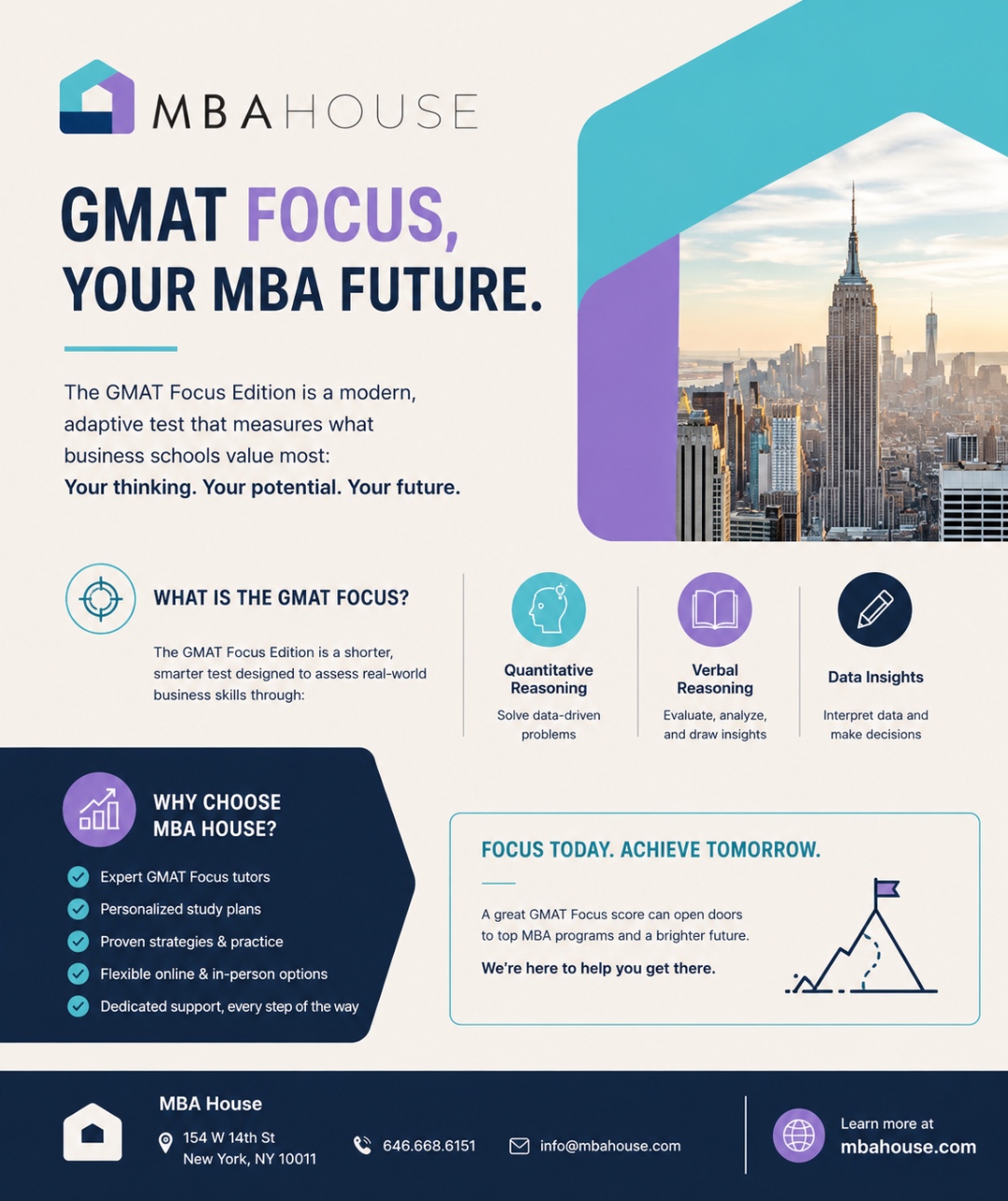
GMAT Focus is the commonly used name for the current GMAT Exam format: a shorter, 2 hour 15 minute MBA admissions test with three sections: Quantitative Reasoning, Verbal Reasoning, and Data Insights. The official GMAT site describes the exam as a more focused assessment of problem solving, critical thinking, and data analysis, and says it is trusted by more than 7,700 programs and 2,400 business schools worldwide (official GMAT overview).
If you are applying to business school now, the practical point is simple: every GMAT resource you use should be designed for the current Focus-style test. At MBA House, that means preparing for the actual three-section exam, not wasting time on legacy material that no longer reflects how MBA applicants are evaluated today.
The GMAT Focus changed what you study, how you pace the exam, how your score is interpreted, and how schools read the result. If your study plan is still built around Sentence Correction, AWA essays, old Integrated Reasoning, or 3-hour test-day pacing, you are spending time on the wrong exam.
Why people still call it “GMAT Focus”
Officially, GMAC now calls the test the GMAT Exam. Students, tutors, admissions consultants, and search engines still use “GMAT Focus,” “GMAT Focus Edition,” and “new GMAT” because those phrases explain what changed from the old version. For SEO and student clarity, MBA House uses “GMAT Focus” because that is the phrase many applicants type when they are confused by old GMAT resources.
The naming matters less than the substance. The current GMAT is shorter, has three equally important sections, includes Data Insights in the total score, removes the essay, removes Sentence Correction, and uses a 205 to 805 total score scale. In other words, it is not just a cosmetic rebrand. It is a different strategic test.
Old GMAT vs GMAT Focus: what changed?
The old GMAT was longer and included four major components: Quant, Verbal, Integrated Reasoning, and Analytical Writing Assessment. The current GMAT Focus format has three 45-minute sections and no essay. Data Insights replaced the old Integrated Reasoning section and now counts directly in the total score, which makes data literacy much more important for MBA applicants.
| Aspect | Old GMAT classic | Current GMAT Focus format |
|---|---|---|
| Sections | Quant, Verbal, Integrated Reasoning, Analytical Writing Assessment | Quantitative Reasoning, Verbal Reasoning, Data Insights |
| Testing time | About 3 hours 7 minutes | 2 hours 15 minutes, with three 45-minute sections (official GMAT exam structure) |
| Essay | AWA essay required | AWA removed |
| Integrated Reasoning | Separate score, not part of the 200-800 total | Replaced by Data Insights, which counts in the total score |
| Verbal content | Reading Comprehension, Critical Reasoning, Sentence Correction | Reading Comprehension and Critical Reasoning; MBA House no longer builds current GMAT prep around Sentence Correction drills. |
| Quant content | Problem Solving, Data Sufficiency, arithmetic, algebra, geometry | Problem Solving with arithmetic, algebra, and statistics; MBA House focuses Quant prep on the skills that matter for the current exam. |
| Total score | 200 to 800 | 205 to 805, in 10-point increments, with every total score ending in 5 (official GMAT scores guide) |
| Status | Retired January 31, 2024 | The current GMAT format used for test takers today |
GMAT Focus format and sections
The GMAT Focus has three sections: Quantitative Reasoning, Verbal Reasoning, and Data Insights. Each section is 45 minutes, so the total testing time is 2 hours and 15 minutes. The official GMAT exam structure page lists 64 total questions: 21 Quantitative Reasoning questions, 23 Verbal Reasoning questions, and 20 Data Insights questions (official GMAT exam structure).
The biggest mistake applicants make is assuming “shorter” means “easier.” Shorter can actually mean less margin for drift. You have fewer sections, no essay, and a cleaner structure, but every part of the test now carries more strategic weight. Quant, Verbal, and Data Insights all contribute to the total score, so there is less room to ignore a weak section.
Quantitative Reasoning
Quantitative Reasoning tests problem solving, numerical reasoning, algebraic thinking, arithmetic, rates, ratios, statistics, and other core math skills. MBA House trains Quant for the current exam by emphasizing the patterns students actually need: clean setup, efficient calculation, strong algebra, and fast recognition of what the question is really asking.
For MBA House students, Quant prep starts with diagnosis. A student who misses questions because of algebra weakness needs a different plan from a student who understands the math but loses time translating the question. GMAT Focus Quant is not just about knowing formulas. It rewards speed, clean setup, flexible reasoning, and the ability to decide when a question is taking too long.
Verbal Reasoning
Verbal Reasoning now focuses on Reading Comprehension and Critical Reasoning. That means MBA House Verbal prep emphasizes argument structure, inference, passage strategy, and answer-choice elimination instead of legacy grammar drills.
This does not make Verbal easy. It changes the kind of difficulty. You need to understand argument structure, assumptions, logical gaps, inference, passage organization, and the difference between an answer that sounds attractive and an answer that actually follows from the text. For non-native English speakers and busy professionals, this section often improves when students learn repeatable logic patterns instead of simply reading more passages.
Data Insights
Data Insights is the section that most clearly shows why the current GMAT matters for business school. It measures how well you interpret, evaluate, and combine information from tables, charts, passages, and quantitative statements. MBA House treats Data Insights as a core scoring section, not a side topic to leave until the end.
Question types can include Data Sufficiency, Multi-Source Reasoning, Table Analysis, Graphics Interpretation, and Two-Part Analysis. For many students, Data Insights feels unfamiliar because it blends math, verbal reasoning, and business-style interpretation. It is not enough to be “good at math.” You also need to decide what data matters, what data is irrelevant, and what conclusion is supported.
GMAT Focus scoring explained
The current GMAT total score range is 205 to 805 in 10-point increments, and every total score ends in 5. The official score page states that the total score is based on performance across all three sections, with Quantitative Reasoning, Verbal Reasoning, and Data Insights weighted equally (official GMAT scores guide). If you are coming from a GRE score and want to understand how the scales compare, see our GRE to GMAT Focus score conversion guide.
Each section is scored from 60 to 90 in 1-point intervals. The total score is not a simple addition of the section scores. It reflects question difficulty, correct and incorrect responses, and unanswered questions. The official score page also notes that there is a penalty for not completing a section, so MBA House treats pacing as part of the score strategy, not a side issue (official GMAT scores guide).
One of the most common student questions is whether a 655 on GMAT Focus is “the new 700.” The best answer is: roughly, in many admissions conversations, a mid-600s Focus score can correspond to a strong classic-GMAT score, but you should not compare the two scales casually. The official GMAT score page explicitly warns that comparing a current GMAT score directly to a score on the GMAT Exam 10th Edition is not an accurate comparison (official GMAT scores guide).
What is a good GMAT Focus score?
A good GMAT Focus score depends on your school list, demographic context, academic record, work experience, and scholarship goals. The score that is “good enough” for one applicant may be too low for another candidate applying to the same school if the rest of the profile sends different signals. This is why MBA House does not treat score targets as generic numbers.
For a candidate targeting Columbia, NYU Stern, Wharton, Harvard, Stanford, MIT Sloan, or other top programs, the score goal should be connected to the whole application. If your GPA is low, your quantitative transcript is weak, or your school list is very competitive, the GMAT may need to do more work. If your transcript and career profile are strong, the score may only need to clear a credibility threshold while the application story does the rest.
The right score target also changes if scholarships are part of the strategy. A score that is sufficient for admission may not be equally strong for merit money. If you are applying from New York with a demanding job, you also have to weigh the opportunity cost of chasing marginal score gains against the time needed for essays, recommendations, interviews, and school research.
Why GMAC redesigned the GMAT
The exam was redesigned to make it more focused, shorter, and better aligned with business-school skills. The official GMAT page says the exam is meant to showcase problem solving, critical thinking, and data analysis, and includes admissions leader commentary describing the redesign as more focused, more accessible, and less daunting (official GMAT overview).
For MBA House students, the redesign changes the prep plan. The strongest candidates do not just memorize content. They learn how to reason under pressure, interpret data quickly, and connect the score target to a real MBA admissions strategy.
This matters for applicants because the test is now closer to the kind of decision-making MBA programs want to see. You are not being rewarded for writing an essay under timed conditions or spotting obscure grammar rules. You are being tested on whether you can reason clearly, interpret data, and make decisions under time pressure.
Key GMAT Focus features you will notice on test day
The current format gives students a useful review feature. The official exam structure page explains that you can bookmark questions, review questions at the end of a section if time remains, and edit up to three answers per section (official GMAT exam structure).
- You can choose section order. This lets you start with the section that best fits your energy and confidence pattern.
- You can flag questions. This helps you manage pacing without pretending every question deserves the same amount of time.
- You can change up to three answers per section. This is useful for catching mistakes, but it should not become a habit of second-guessing every response.
- There is no essay. The exam is fully multiple choice, which makes prep more targeted and timing more predictable.
- Score reporting is more focused. The official score page explains that schools receive the total score, section scores, percentiles, date, delivery format, and basic registration information when you choose to send a score (official GMAT scores guide).
How to prepare for the GMAT Focus
The best GMAT Focus preparation starts with the current test, not old GMAT habits. At MBA House, we do not build a prep plan around Sentence Correction, AWA essays, or old 3-hour pacing. We build around the current exam: Quantitative Reasoning, Verbal Reasoning, Data Insights, modern timing, and the score your target schools need to see.
At MBA House, GMAT Focus prep starts with a diagnostic audit. We look at your current score, section balance, target programs, timeline, weekly schedule, and admissions goals. Then we build a plan around the score you actually need, not a generic promise to “study harder.”
For Quant, that means rebuilding the math foundations that matter and training faster question recognition. For Verbal, it means learning argument logic and passage strategy. For Data Insights, it means practicing charts, tables, multi-source reasoning, Data Sufficiency, and business-style analysis until the section feels structured instead of chaotic.
Timing is also different now. The current exam is 2 hours and 15 minutes, not the old 3-hour-plus experience. Students need modern pacing plans: when to move, when to flag, when to use review time, and when to protect mental energy for a later section. A student who prepares for the old GMAT rhythm may feel rushed or misallocate time on test day.
GMAT Focus prep for New York MBA applicants
New York applicants often have a specific challenge: they are trying to study while working demanding jobs in finance, consulting, tech, healthcare, family businesses, startups, or other high-pressure environments. They may be applying to Columbia, NYU Stern, Wharton, Harvard, MIT Sloan, London Business School, INSEAD, or a mix of U.S. and international programs. The GMAT plan has to fit the application plan.
That is why MBA House connects GMAT prep with MBA admissions strategy. A score target is not just a test-prep number. It affects school selection, round choice, scholarship positioning, waiver decisions, and how much time remains for essays and interviews. For some students, the right move is aggressive GMAT improvement. For others, the right move is a sufficient score plus stronger application execution.
Our GMATNY approach includes live 90-minute classes, private tutoring support, realistic timing strategy, and admissions-aware score planning. The goal is not to make you study every possible GMAT topic. The goal is to identify what the current exam rewards, what your target schools need to see, and how to use your time wisely.
Is the GMAT Focus right for you?
If you are applying to MBA programs, the GMAT Focus may be right for you if a score can strengthen your academic readiness, offset transcript concerns, improve scholarship odds, or help you stand out in a competitive applicant pool. It may also be the right test if your strengths line up better with quantitative reasoning, critical reasoning, and data analysis than with GRE vocabulary or other test formats.
However, not every applicant should automatically choose the GMAT. Some candidates should compare the GMAT, GRE, Executive Assessment, and test waiver options. The right choice depends on your schools, your timeline, your diagnostic scores, your academic profile, and what the rest of your application needs to prove. If you are unsure, read our GMAT, GRE, Executive Assessment, or waiver guide or book a strategy call.
How MBA House helps with GMAT Focus
MBA House helps students prepare for the GMAT Focus by combining updated content, live structure, private support, and application context. We teach the specific math, reasoning, and data skills tested on the current exam. We include Data Insights practice instead of treating it as an afterthought. We use modern timing strategy for a 2 hour 15 minute exam, not old pacing rules from the classic GMAT.
Most importantly, we connect test prep to admissions. If your target score is tied to Columbia, NYU Stern, Harvard, Wharton, MIT Sloan, London Business School, or INSEAD, the GMAT plan should reflect that. Your school list, round, scholarship goals, and essay timeline should shape how much time you spend chasing a higher score.
That is the MBA House difference: we are not just explaining the GMAT Focus in isolation. We are helping you decide how the exam fits into the whole MBA application, from diagnostic score to study schedule, from school list to interview preparation, and from test-day pacing to the final admissions strategy.
If you want a clear next step, start with a free GMAT Focus strategy call. Bring your target schools, score history, transcript, work schedule, and application timeline. We will help you decide whether you need a class, private tutoring, a diagnostic, admissions consulting, or a combined plan.
Book a free strategy call if you want a realistic GMAT Focus plan for your school list, timeline, and application goals. We will help you decide what score matters, what section needs the most work, and how to build the prep plan without losing your admissions timeline.
GMAT Focus FAQs
Is the GMAT Focus the same as the GMAT?
Yes. “GMAT Focus” is the phrase many students still use for the current GMAT format. Officially, GMAC now calls it the GMAT Exam, but the current exam is the shorter Focus-style version with Quantitative Reasoning, Verbal Reasoning, and Data Insights.
Does every business school accept GMAT Focus?
The current GMAT is the standard GMAT format for current test takers. The official GMAT page says the exam is trusted by more than 7,700 programs and 2,400 business schools worldwide (official GMAT overview). Always check each school’s admissions page for current cycle details, especially if you are also considering GRE, Executive Assessment, or a test waiver.
How long is GMAT Focus?
The exam is 2 hours and 15 minutes of testing time, divided into three 45-minute sections. The official exam structure page lists 64 total questions and one optional 10-minute break (official GMAT exam structure).
What sections are on GMAT Focus?
The three sections are Quantitative Reasoning, Verbal Reasoning, and Data Insights. Quant focuses on problem solving and core math. Verbal focuses on Reading Comprehension and Critical Reasoning. Data Insights tests how you interpret and combine data from multiple formats.
Is there geometry on GMAT Focus?
MBA House does not build current GMAT Quant prep around old geometry-heavy study plans. We focus on the arithmetic, algebra, statistics, setup, and reasoning patterns students need for the current test.
Is Sentence Correction on GMAT Focus?
No. Sentence Correction was removed from the current GMAT. Verbal Reasoning now focuses on Reading Comprehension and Critical Reasoning.
What is the GMAT Focus score range?
The total score range is 205 to 805. Section scores for Quantitative Reasoning, Verbal Reasoning, and Data Insights range from 60 to 90. The total score uses 10-point intervals, and every total score ends in 5 (official GMAT scores guide).
Can I change answers on GMAT Focus?
Yes. You can flag questions and change up to three answers per section before section time runs out. This is useful for timing control, but it should not become a reason to second-guess every question.
Should I use old GMAT books?
Old GMAT books can still help for some question types, especially Critical Reasoning, Reading Comprehension, and Problem Solving. But you should skip Sentence Correction and AWA essay material, and you should make sure your Data Insights practice reflects the current exam.
How should I start studying?
Start with a diagnostic, identify your section imbalance, set a target score based on your actual school list, and build a weekly plan that protects time for both test prep and applications. If you want help, MBA House can audit your score history, target schools, and timeline before recommending a GMAT Focus class or tutoring plan.