
The short answer
The best MBA candidates do not wing the process anymore because the application is no longer just a resume, a test score, and a few essays. A strong application needs career positioning, school selection strategy, GMAT or GRE planning, essay architecture, resume refinement, recommendations, interview preparation, and scholarship strategy working together.
That is especially true for applicants searching for MBA admissions consulting NYC. New York candidates often have strong professional backgrounds, but they also face crowded applicant pools, demanding jobs, and limited time to turn scattered achievements into a clear admissions narrative. If you are still defining your goals, it helps to revisit what an MBA actually is and what it is worth before you build the plan.
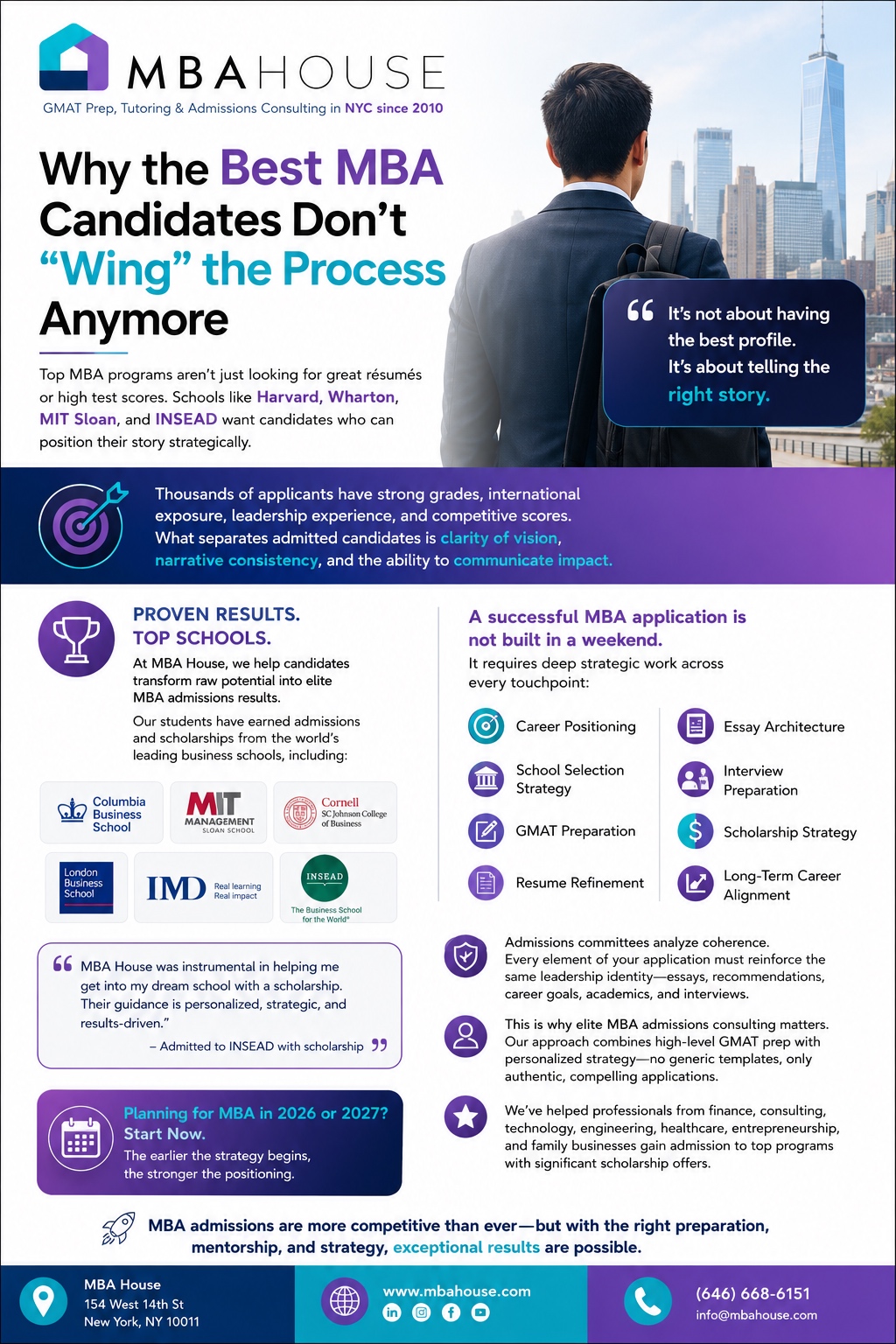
It is not about having the “perfect” profile. It is about showing the admissions committee the right story, the right school fit, and the right evidence at every touchpoint.
MBA admissions are competitive, but not random
Graduate business applications in the United States increased 8.1% for the 2024-25 academic year, and 72% of schools offering two-year MBA programs reported application growth, according to a Higher Ed Dive summary of Graduate Management Admission Council survey data (Higher Ed Dive).
More applications do not mean admissions committees are guessing. They are looking for coherence. They want to understand where you have been, where you are going, why the MBA is necessary, why now, and why each school is the right environment for that next step.
What top candidates get wrong
Many strong candidates underestimate how much strategy the process requires. They assume that a recognizable employer, a high GPA, or a strong GMAT score will carry the application by itself. Those elements matter, but they do not automatically explain leadership potential, school fit, career direction, or personal motivation.
The common mistake is treating each part of the application separately. The resume says one thing, the essays say another, the recommendations emphasize a different strength, and the interview introduces a new story that was not supported anywhere else. That lack of narrative consistency makes even strong profiles feel less compelling.
What an MBA application strategy should include
A serious MBA application plan should begin before the first essay draft. At MBA House, the strategy starts with an audit of your goals, score history, transcript, work experience, school list, timeline, and risk points. From there, each part of the application has a job.
- Career positioning: clarify your short-term and long-term goals so the MBA feels necessary, not decorative.
- School selection strategy: choose programs where your goals, academic profile, culture fit, and scholarship potential make sense.
- GMAT preparation: decide whether a score, retake, waiver, GRE, or Executive Assessment strengthens the full candidacy.
- Essay architecture: build essays around one clear narrative instead of disconnected achievements.
- Resume refinement: translate work experience into leadership, impact, progression, and analytical readiness.
- Recommendations: help recommenders reinforce the same leadership identity your essays and resume present.
- Interview preparation: turn the written application into a confident spoken story.
- Scholarship strategy: position the candidate not only for admission, but also for the strongest possible scholarship outcomes.
Why “winging it” hurts strong applicants
Winging the process usually does not mean doing no work. It means doing work in the wrong order. Candidates write essays before they know the positioning, pick schools before they understand the score strategy, or ask for recommendations before defining what those recommendations need to prove.
That creates wasted drafts, rushed test decisions, weak school lists, generic essays, and interviews that feel improvised. A successful MBA application is not built in a weekend. It requires strategic work across every touchpoint.
How MBA House helps New York applicants build the right story
MBA House combines GMAT prep, tutoring, and admissions consulting in NYC so candidates can make the test plan and application plan work together. That matters because a target score, a scholarship strategy, and a school list should not be treated as separate decisions.
Our approach is personalized, strategic, and results-driven. We help applicants transform strong raw material into applications that show leadership, clarity, school fit, and long-term direction. For candidates planning an MBA in 2026 or 2027, the earlier the strategy begins, the stronger the positioning can become. New York applicants weighing local help can also read what to look for in an MBA admissions consultant in NYC.
When to start
If you are planning for Round 1, Round 2, or a future application cycle, the best time to start is before the process feels urgent. Early planning gives you room to improve the GMAT, refine your school list, strengthen your resume, choose recommenders carefully, and build essays around a story that actually fits your goals.
If you are unsure where to begin, start with an application audit. Bring your resume, score history, transcript concerns, target schools, career goals, and timeline. We will help you identify whether the next move should be GMAT prep, admissions consulting, school selection, essays, interview training, or a combined plan.