
The one-sentence answer
To improve your chances of getting MBA scholarships, build a stronger admissions profile, target schools where you are highly competitive, apply early when possible, submit a polished application, and use the GMAT strategically when a score can strengthen your academic or merit-aid case.
MBA House treats scholarship strategy as part of the application from the beginning. If merit aid matters, your school list, score target, essays, recommendation strategy, and interview preparation should all support that goal.
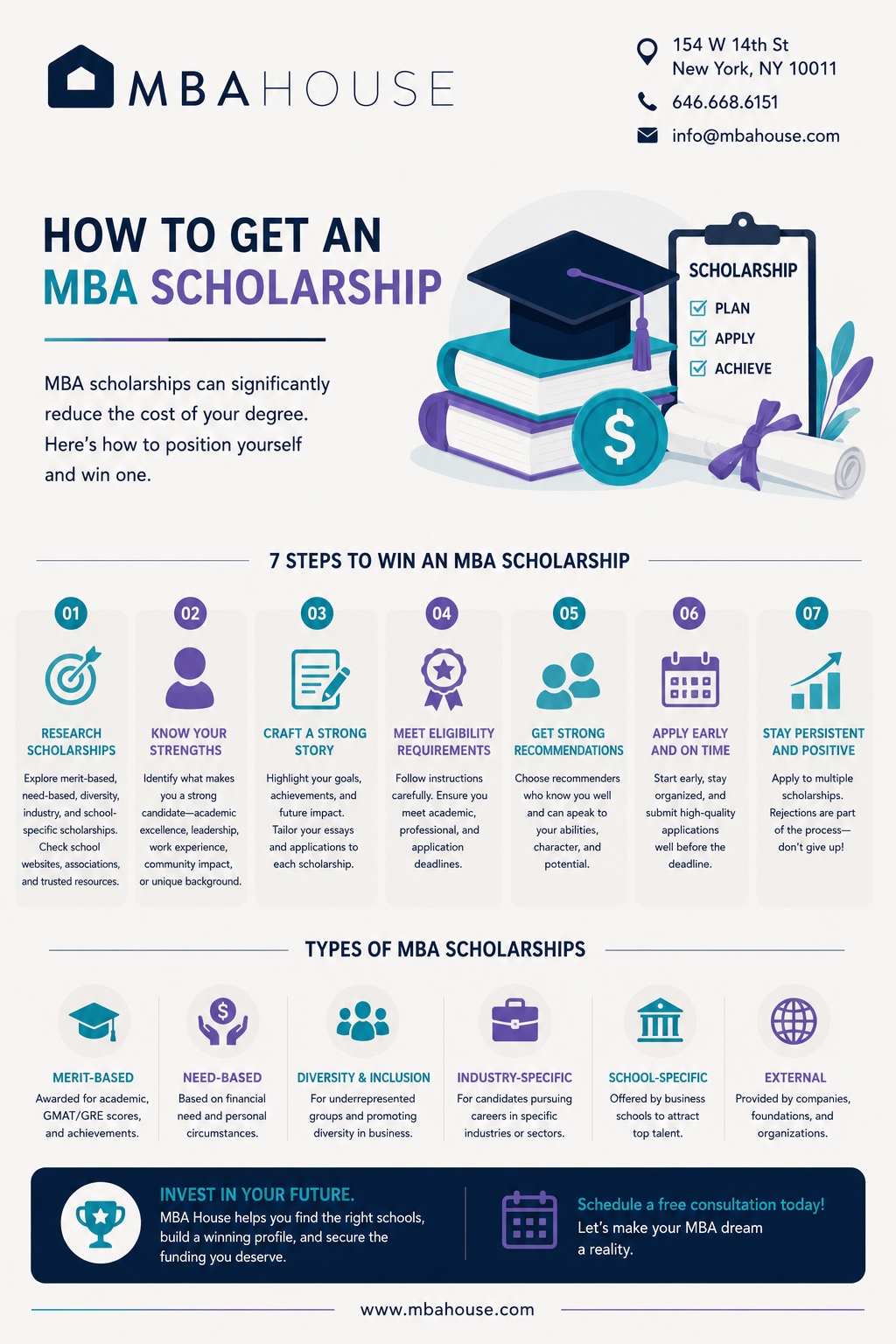
Understand the main types of MBA scholarships
MBA funding can include merit scholarships, need-based scholarships, fellowships, diversity scholarships, employer sponsorship, external scholarships, and school-specific awards. Harvard Business School describes generous aid that includes need-based tuition assistance, summer fellowships, and career support (HBS financial aid).
Stanford GSB explains that its need-based fellowships are gifts from the Stanford community, do not have to be repaid, and are awarded based solely on demonstrated financial need (Stanford GSB types of aid).
Know the difference between merit and need-based aid
Merit aid is usually tied to how much a school wants to attract you. It may reflect academic strength, GMAT or GRE score, leadership, career trajectory, background, community impact, or fit with the school’s priorities. Need-based aid is tied to demonstrated financial circumstances.
This distinction matters because the strategy is different. For merit aid, you may improve your odds by applying to schools where you are above the average profile and by presenting a clear leadership and career case. For need-based aid, you need to understand each school’s financial-aid process and documentation requirements.
Use the GMAT strategically
The GMAT can matter for scholarships because it is one of the clearest academic signals in the application. The official GMAT site says the exam showcases problem solving, critical thinking, and data analysis and is trusted by more than 7,700 programs and 2,400 business schools worldwide (official GMAT overview).
MBA House does not tell every applicant to chase the highest possible score at any cost. We ask a more useful question: will a higher score change your scholarship odds, school options, or academic-readiness signal enough to justify the time? If yes, the GMAT plan becomes part of the scholarship plan.
Choose schools where you can win
Scholarship strategy is partly school-list strategy. If every school is a reach, you may still be admitted, but scholarship leverage may be lower. If you include programs where your profile is especially strong, you may create more merit-aid possibilities.
That does not mean you should avoid ambitious schools. It means your list should have a purpose. MBA House helps applicants build a portfolio of dream, target, and scholarship-sensitive schools so the final choice is not simply “admit or deny.”
Make the application scholarship-worthy
A scholarship-worthy application is specific. The resume shows measurable impact. The essays explain goals clearly. The recommendations reinforce leadership and growth. The interview confirms judgment, maturity, and fit.
Wharton’s application guide says its Admissions Committee looks at what applicants will achieve and contribute in the classroom, community, and post-MBA career, and that every component of the application provides insight into those questions (Wharton MBA application guide).
Do not ignore external scholarships
External scholarships can reduce debt, but they often require separate essays, deadlines, or eligibility criteria. Stanford GSB encourages students to research sources outside the school to reduce debt load and explains how external scholarships may interact with Stanford fellowship calculations (Stanford GSB types of aid).
MBA House recommends creating a scholarship calendar alongside the MBA application calendar. If you wait until after admission, you may miss external deadlines or submit weaker scholarship materials.
What GMAT score do I need for an MBA scholarship? Most top MBA programs consider applicants for merit scholarships automatically as part of admissions. A GMAT Focus Edition score of about 655 or higher (roughly the 90th percentile) is typically needed to be competitive for merit awards at top-ranked programs, because a score above a school's median gives the program a reason to invest in attracting you.
The MBA scholarship landscape: what to know first
Cost is not a side issue for applicants — GMAC research cited on mba.com finds financial considerations are a top criterion for roughly 30 percent of prospective students (mba.com on GMAT scholarships). The encouraging news is that most merit scholarships at top US programs are awarded as part of the admissions decision, with no separate application required. That means your scholarship outcome is largely decided by the same materials that decide admission. Three levers move it: maximize your GMAT score, build a genuinely strong application, and negotiate offers where there is room. With federal borrowing tightening for 2026, that free money matters more than ever — see how it fits the bigger picture in our guide to financing an MBA.
Types of MBA scholarships and fellowships
Funding comes in several distinct forms, and the strategy differs for each.
| Scholarship type | Based on | Typical amount | Separate application? |
|---|---|---|---|
| Merit / excellence | GMAT, GPA, leadership | 25%–100% tuition | Usually no |
| Need-based | Financial circumstances | Varies widely | Yes (FAFSA / institutional form) |
| Diversity / identity | Background, gender, community | $5K–$90K | Yes |
| Employer fellowship | Employment sponsorship | Up to full tuition | Through employer |
| Named school fellowship | Donor criteria, holistic fit | $10K–full tuition | Sometimes |
Merit-based scholarships
Merit awards reward academic strength, test scores, leadership, and career trajectory. They range from partial tuition discounts to full rides at many programs, and they are the category your GMAT score most directly influences. A score above a school's median signals both academic readiness and a class-profile benefit the school wants to secure.
Need-based financial aid
Need-based aid is tied to demonstrated financial circumstances and generally requires a separate application — the FAFSA for federal eligibility and institutional forms for school aid. Some of the wealthiest programs are generous here; others lean more heavily on merit. Read each school's policy rather than assuming.
Diversity and identity-based fellowships
A number of well-established fellowships support specific communities. GMAC maintains a guide to several of these (GMAC scholarships for minorities):
- Forté Foundation MBA Fellows — for women pursuing business education at partner schools.
- The Consortium for Graduate Study in Management — supporting underrepresented groups in business since 1966, with $655M+ in fellowships awarded.
- Robert Toigo Fellowship — for underrepresented minority students entering finance; up to about $10,000 plus career support.
- Prospanica Scholarship — for Hispanic and Latino students; awards up to about $5,000.
- Point Foundation — supporting LGBTQ+ students.
- Paul & Daisy Soros Fellowships for New Americans — for immigrants and children of immigrants; up to about $90,000 over two years.
These almost always require a separate application with their own deadlines, so build them into your calendar early.
Employer fellowships and school-funded fellowships
Some employers sponsor MBAs directly, separate from tuition reimbursement; note the IRS Section 127 tax-free limit of $5,250 per year, above which assistance is generally taxable. Many schools also offer named, donor-funded fellowships — Harvard, Wharton, Kellogg, and Columbia among them — some awarded holistically and some requiring a nomination or extra essay.
The GMAT score–scholarship connection
Of every factor in your application, the test score is the one you can most directly change — and it is unusually leveraged. A higher score does two things for scholarships: it lifts you above a program's median (the zone where merit aid is awarded to attract you) and it strengthens your hand if you later negotiate. The practical threshold most often cited for top-program merit competitiveness is a 655+ on the GMAT Focus Edition, around the 90th percentile.
The financial logic is stark. Moving your score up by 50–100 points can be the difference between no award and a partial or full scholarship worth tens of thousands of dollars — a far better return than almost any other use of preparation time. That is why MBA House treats the score as part of the scholarship plan, not a separate task: raise the score first, then apply. Our guide to the GMAT explains the current Focus Edition format and what a competitive score looks like.
Your GMAT score is the most controllable factor in your scholarship eligibility. MBA House GMAT tutors in New York specialize in rapid, structured score improvement — a 50–100 point gain could be worth tens of thousands in scholarship money.
How to maximize your chances of an MBA scholarship
Six moves consistently improve scholarship outcomes:
- Maximize your GMAT score — the single most controllable lever for merit aid.
- Apply in Round 1. Scholarship budgets are larger and less committed early in the cycle.
- Target programs where your profile is above the median, so the school has a reason to invest in attracting you.
- Write differentiated, specific essays that show impact and clear goals rather than generic ambition.
- Engage with schools before you apply — visits, information sessions, and alumni conversations signal genuine interest.
- Submit a strong financial-aid application where need-based aid is in play.
Common MBA scholarship mistakes to avoid
A few avoidable errors quietly cost applicants money every cycle. The first is applying late: by Round 3, much of a program's scholarship budget is already committed, so an identical application can win less simply for arriving later. The second is aiming only at reaches: a list where every school is a stretch may still produce admits, but rarely the above-median positioning that triggers merit aid. The third is treating the test as separate from money; because a higher score is the most direct lever on merit awards, deprioritizing it often means leaving scholarship dollars on the table.
Two more are subtler. Applicants frequently miss external fellowship deadlines because they wait for admission decisions before researching outside awards. And many under-invest in the essays, describing job responsibilities instead of demonstrating impact, leadership, and a specific goal — exactly the evidence that persuades a committee you are worth funding. Avoiding these five mistakes does not require a different background; it requires earlier, more deliberate planning.
How to negotiate your MBA scholarship offer
Negotiation is more accepted than many applicants realize, particularly when you hold a competing offer. The most effective approach is respectful and evidence-based: share a genuine competing scholarship letter from another admitted program and explain, honestly, what would make your decision easier. Frame it around fit and financial considerations, not ultimatums. Timing matters — negotiate before the enrollment deposit deadline, while the school still has flexibility. Not every school negotiates, and top programs with deep applicant pools may hold firm, but a polite, well-supported request rarely hurts and often helps.
Do you automatically get considered for MBA scholarships?
For merit awards at most top US programs, yes — you are evaluated for scholarships using the same application you submit for admission, with no separate form to complete. This is good news and a trap at once. It is good news because it means the work you already do to strengthen your candidacy doubles as scholarship work. It is a trap because applicants assume "automatic" means "passive," and ease off the very elements — score, essays, timing — that decide whether an award appears.
The exceptions are important. Need-based aid almost always requires its own application and documentation, frequently including the FAFSA for federal eligibility. External fellowships each have their own forms and deadlines. And a subset of named, donor-funded school fellowships ask for an extra essay or a nomination. So the accurate rule is: merit aid is usually automatic, but everything else — need-based, external, and certain named awards — is opt-in, and missing those applications means forfeiting the money entirely.
Are MBA scholarships taxable?
It depends on how the money is used. In general, scholarship or fellowship funds applied to qualified education expenses — tuition and required fees — are not treated as taxable income, while amounts used for living expenses such as rent and food can be taxable. Employer educational assistance is its own case: under IRS Section 127, up to $5,250 per year is tax-free, and assistance above that threshold is generally treated as taxable wages. The rules can be nuanced, especially for stipends and for international students subject to different withholding, so confirm your situation with each school's financial-aid office and, where the amounts are large, a tax professional. The practical takeaway is to track which dollars cover tuition versus living costs, because that distinction usually determines what, if anything, is taxable.
External scholarships and timing
Beyond what schools award directly, external scholarships and fellowships can meaningfully reduce debt, but they reward planning. Most run on annual cycles with deadlines that often fall around the same time as your school applications — sometimes earlier — and many require their own essays, recommendations, and eligibility documentation. Stanford GSB encourages students to research outside sources to reduce their debt load and notes that external awards can interact with a school's own fellowship calculations, so report them and understand how they stack (Stanford GSB types of aid).
The biggest avoidable mistake is treating external scholarships as an after-admission afterthought. By the time decisions arrive, many deadlines have passed. Build a single calendar that lists each award's deadline, requirements, and amount alongside your application rounds, and draft the recurring essay themes once so you can adapt rather than start from scratch for each one.
A worked example: turning a score into scholarship dollars
Consider two versions of the same applicant at a strong top-25 program. In the first, the candidate applies in Round 2 with a score just below the school's median and receives an admit with no money. In the second, the same candidate spends an extra two months raising the GMAT above the school's median, applies in Round 1, and engages with the program beforehand — and is admitted with a 50 percent tuition scholarship. The application content barely changed; the score, timing, and demonstrated interest did. Against tuition in the six figures, that scholarship can dwarf the cost of the preparation that produced it.
This is the core argument of scholarship strategy: the levers that win money — a higher score, an earlier round, a school where you are above median — are largely within your control and compound when combined. New York applicants targeting Columbia or NYU Stern face especially competitive pools, which makes these controllable advantages all the more valuable. MBA House helps GMAT NY candidates sequence exactly these moves so the score work translates into admissions and aid, not just a number.
MBA scholarships vs loans: building the right mix
Scholarships should anchor your financing plan because they never have to be repaid. The sensible sequence is free money first, then employer aid, then federal loans within the new $20,500-per-year cap, and finally private loans for any remaining gap. With Grad PLUS eliminated for new borrowers in 2026, that first layer carries more weight than it used to. Our companion guide on how to finance an MBA walks through the full stack, and if you are weighing whether expert help would strengthen your case, see our take on MBA admissions consultants. For New York applicants, MBA House can connect your score target, school list, and scholarship positioning into one plan.
How MBA House helps with scholarships
MBA House helps applicants connect scholarship goals to the full application. We review school selection, GMAT targets, essay themes, recommendation strategy, resume positioning, and interview preparation. If the goal is money, the application needs to show value, fit, and momentum.
We also help candidates avoid false shortcuts. Scholarships are not won by vague claims of leadership. They are won by a profile that makes the school believe you will contribute, succeed, and represent the program well after graduation.
Book a free strategy call if you want a practical plan for your school list, score strategy, application timeline, and financing or scholarship goals.
MBA scholarships FAQs
Are MBA scholarships merit-based or need-based?
Both exist. Some schools focus heavily on need-based aid, while others offer merit scholarships, fellowships, diversity awards, or external scholarship options.
Does the GMAT help with MBA scholarships?
It can. A strong GMAT can support the academic and merit-aid case, especially at schools where merit scholarships are competitive.
Can international students get MBA scholarships?
Often yes, but rules vary by school and scholarship. Applicants should review each school’s financial-aid policy and external options.
Should I apply to more schools for scholarship leverage?
A balanced school list can improve options, but the list should still fit your career goals and admissions strategy.
What GMAT score do I need for an MBA scholarship?
A GMAT Focus Edition score of about 655 or higher (roughly the 90th percentile) is commonly needed to be competitive for merit scholarships at top-ranked programs. At many schools you are considered automatically as part of admissions.
Do I have to apply separately for MBA scholarships?
Often no. Most merit scholarships at top US programs are considered automatically when you apply. Need-based aid and external fellowships usually require a separate application such as the FAFSA or a fellowship form.
Can I negotiate an MBA scholarship offer?
Often yes. Schools may revisit an award, especially when you hold a competing offer. Negotiate respectfully before the enrollment deposit deadline, framed around genuine fit and financial considerations.