
The short answer
An MBA admissions consultant can help when you need strategy, structure, positioning, deadlines, essay architecture, recommender guidance, interview preparation, or a realistic review of your competitiveness. MBA.com says the application essay is your opportunity to get beyond GPA and GMAT numbers and reveal something deeper about yourself (MBA.com essay and interview advice).
The key is that consulting should not make your voice sound manufactured. It should make your actual story clearer, more specific, and more credible.
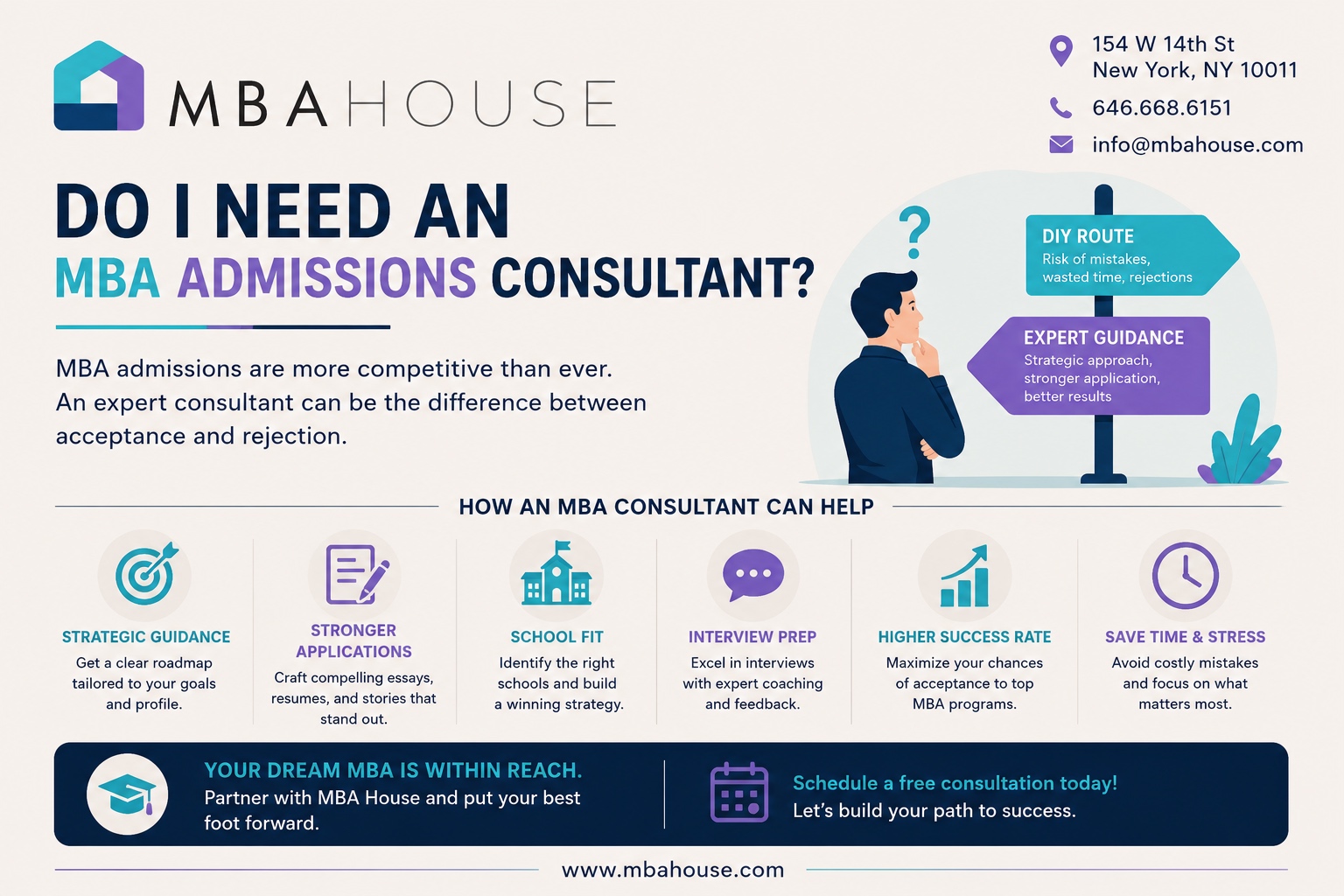
What does an admissions consultant actually do?
A strong consultant helps with school selection, application timing, resume positioning, essay strategy, recommendation planning, optional essays, interview preparation, and sometimes test strategy. Wharton’s application guide shows how many pieces need to work together: transcripts, GMAT or GRE scores, resume, essays, recommendation, and program-specific requirements (Wharton MBA application guide).
MBA House starts with an audit. We look at your goals, school list, work history, transcript, test plan, leadership examples, community contributions, and constraints. Then we build a plan that says what each application component should do.
When is consulting most useful?
Consulting is especially useful if you are applying to highly selective programs, trying to explain a career pivot, applying with a lower GPA, deciding whether to retake the GMAT, asking for scholarships, or managing several applications at once. It is also useful if English is not your first language and you need help making the story concise without losing personality.
It can also help strong candidates. Many applicants with impressive resumes still write generic essays because they describe jobs instead of decisions, impact, values, leadership, and growth. MBA House helps turn raw material into a school-specific application argument.
What should good MBA essay help look like?
Good essay help starts with answering the question. MBA.com warns applicants to read the prompt carefully and make sure they answer it, while using logical structure, personal anecdotes, and careful proofreading (MBA.com essay and interview advice).
MBA House does not believe every essay should sound the same. A goals essay, a contribution essay, a leadership story, and an optional essay each have a different job. The best applications feel precise, human, and grounded in evidence.
How does interview preparation fit in?
Interviews are not just a final formality. Harvard Business School explains that after the written application is reviewed, candidates may be invited to a 30-minute interview with an MBA Admissions Board member who has reviewed the application, and that the interview is one element among many in the final review (HBS application process).
MBA House prepares applicants to speak naturally about goals, decisions, leadership, failures, school fit, and post-MBA plans. The goal is not to memorize answers. The goal is to make sure the spoken version of the story reinforces the written application.
What does an MBA admissions consultant do? An MBA admissions consultant is a professional advisor who guides applicants through the business school application process. Services typically include school-list strategy, essay development and editing, résumé positioning, interview preparation, and scholarship guidance. Most full-service packages range from about $7,000 to $15,000 or more for applications to one to three schools.
The honest answer: do you actually need one?
Here is the truth most consultants will not lead with: no one strictly needs a consultant. GMAC itself says as much in its own guidance on the question, noting that plenty of applicants are admitted to top programs without paid help (GMAC guidance on admissions consultants). The useful question is not "do I need one?" but "would expert guidance meaningfully improve my odds, my efficiency, or my scholarship leverage given my specific profile and targets?" For some applicants the answer is clearly yes; for others, a well-organized do-it-yourself effort is enough.
The applicants who benefit most share a few traits: they are aiming at highly selective programs where small advantages matter, they have a complex or non-traditional story to frame, or they are short on time and need structure to hit deadlines without sacrificing quality. The applicants who often do fine alone tend to have strong, conventional profiles, flexible school targets, and the time and writing ability to manage the process themselves.
Who benefits most from an MBA admissions consultant?
Consulting tends to deliver the clearest value for:
- Career switchers targeting M7 programs, where the bar is high and the pivot needs a tight narrative.
- Applicants with non-traditional profiles — unusual industries, entrepreneurial paths, or careers that do not map neatly onto a standard resume.
- International applicants unfamiliar with US admissions culture and essay conventions.
- Candidates with a weakness to contextualize, such as a low GPA, an employment gap, or a score that needs framing.
- Re-applicants who need an honest diagnosis of why last cycle did not work.
- Busy NYC professionals juggling demanding jobs against competitive deadlines.
Notice that several of these come back to the test. Your GMAT score is usually one of the first things a consultant assesses, because it shapes both your school list and how the rest of the application has to compensate.
The true cost of MBA admissions consulting in 2026
Pricing varies enormously, and transparency matters. As a market reference, full-service packages commonly run from about $5,000 to $7,000 for a single school and can exceed $15,000 for comprehensive multi-school support at premium firms. Senior consultants often bill hourly in the several-hundred-dollars range, and interview-only preparation typically falls anywhere from a few hundred to a few thousand dollars depending on the school and depth (Poets & Quants cost benchmarks). By contrast, the pure DIY cost is mostly your time plus application fees, which run roughly $250 to $300 per school.
| Service tier | Typical price range | What it usually covers |
|---|---|---|
| Full-service (1 school) | ~$5K–$7K+ | Strategy, essays, resume, interview prep for one program |
| Full-service (multi-school) | ~$10K–$15K+ | End-to-end support across several programs |
| Hourly consulting | Several hundred $/hr | Targeted help on specific components |
| Interview-only prep | ~$500–$3,000 | Mock interviews and feedback per school |
| DIY | Application fees only | Self-managed; ~$250–$300 per school |
Can a consultant guarantee acceptance?
No — and this is the single most important red flag to watch for. Admissions decisions rest entirely with the schools, and GMAC explicitly warns applicants to be skeptical of anyone promising guaranteed results. Honest consultants talk in terms of improving your odds and strengthening your candidacy, not certainties. If a firm guarantees admission, refuses to name the actual person who will work with you, or runs a high-volume "essay mill" model, treat those as warning signs rather than selling points.
What is included in a full-service consulting package?
Packages vary, but a genuine full-service engagement generally covers the whole arc of an application rather than a single deliverable. Expect school-list strategy that balances reach, target, and likely admits against your goals; a positioning phase that defines the central theme your application will argue; essay development across multiple drafts; resume rework that emphasizes impact over job duties; recommender selection and briefing so your letters reinforce rather than repeat your story; interview preparation with mock sessions and feedback; and end-to-end timeline management so nothing slips before a deadline. Some engagements also coordinate test strategy, which is where an integrated provider has an edge.
What separates strong packages from weak ones is usually depth, not breadth. Two firms may both list "essay help," but one means three rounds of structural feedback that sharpens your narrative, while the other means a light grammar pass. When you compare options, ask how many drafts are included, who reviews them, and whether strategy sessions are capped. The line items matter less than the quality and seniority of the person doing the work.
Should you use a consultant if you have a low GPA or low test score?
This is one of the situations where guidance most often earns its cost. A below-average GPA or a test score under a school's median is not automatically disqualifying, but it does need handling — a deliberate strategy that contextualizes the weakness without dwelling on it and redirects attention to your strengths. That might mean an optional essay that explains a rough academic semester honestly, a quantitative course or a stronger GMAT score to signal current ability, or a school list calibrated to where your profile is actually competitive.
Left unaddressed, these weak spots become silent rejections: the committee fills in the blanks unfavorably. A good consultant helps you decide whether to retake the test, whether to address the issue head-on or let your record speak, and how to frame the rest of the application so a single number does not define you. If a higher score is the better lever, that decision also feeds your scholarship prospects.
What a good consultant will not do
Set expectations clearly. A reputable consultant will not write your essays for you — they will help you structure, challenge, and refine your own story so it stays authentically yours, which is exactly what admissions committees can tell apart from manufactured prose. They will not fabricate experiences, inflate accomplishments, or coach you to misrepresent your background; beyond the ethics, schools and interviewers are skilled at catching a story that does not hold together. And they will not promise an outcome they cannot control. The value is in clarity, strategy, and honest feedback, not in shortcuts that put your candidacy at risk if discovered.
The ROI calculation: is the investment worth it?
Frame the cost against the stakes. A $10,000 consulting fee is a fraction of an MBA's total cost, and a small fraction of the salary difference between getting into a target program versus a safety school — a gap that can compound across an entire career through network effects and recruiting access. There is also a direct financial channel: a stronger, better-positioned application can unlock partial or full merit scholarships, and consultants frequently help applicants present themselves for that aid. When a few thousand dollars of guidance plausibly shifts a six-figure outcome, the math often favors getting help — provided the help is genuinely strategic.
Consider a simplified example. Suppose guidance helps you move from a strong regional program to a top-15 school. The tuition is higher, but post-MBA compensation at the more selective program may run tens of thousands of dollars more per year, and that premium tends to persist and grow. Add even a partial scholarship negotiated off a competing offer, and the consulting fee can pay for itself before you finish your first year of work. The point is not that every applicant clears that bar — many do not need help to begin with — but that for borderline candidates at competitive targets, the asymmetry between a modest fee and a large lifetime outcome is exactly why the category exists.
The flip side deserves equal honesty: if your profile is strong, your targets are flexible, and you write well, paying for full-service consulting may add little beyond convenience. The investment makes sense when it changes a result, not when it merely adds polish you could have produced yourself.
When is the right time to hire a consultant?
Earlier than most people think. For maximum value, engage a consultant at least 12 months before you apply, while you are still deciding schools, rounds, score targets, and recommenders — the period when strategic input changes outcomes most. A practical minimum is about six months before your first deadline. By roughly four weeks out, a consultant can polish but can no longer reshape strategy, so the return drops sharply. If you are reading this with deadlines looming, the lesson is to decide quickly rather than wait.
How to choose the right MBA admissions consultant
Ask pointed questions before you commit. Who specifically will work with me, and what is their track record at my target schools? Have they served on an admissions committee or otherwise seen the process from the inside? How do they handle essays — do they coach your voice, or rewrite in theirs? What does the package include, and what costs extra? The answers separate strategic partners from transactional editors. And revisit the red flags: guaranteed acceptance, anonymous staffing, and factory-style throughput.
Should re-applicants work with a consultant?
Re-applicants are among the clearest beneficiaries of outside help, because the most valuable thing they need is an honest diagnosis they usually cannot produce themselves. After a ding, it is natural to assume the problem was the test score or a single essay, when the real issue was a vague career goal, a school list that was all reach, or recommendations that praised without evidence. A consultant who reads last cycle's application with fresh eyes can identify what actually held it back and help you show genuine growth — a stronger score, a promotion, a clarified goal — rather than resubmitting a lightly edited version of a rejected file. Schools explicitly look for what changed; a credible re-application answers that question directly.
What to bring to a first consulting conversation
You will get more from an initial call — free or paid — if you arrive prepared. Bring a current resume, your target school list with rough reasons for each, your test status and any scores, your undergraduate GPA, and a short, honest statement of your post-MBA goal. Be candid about weak spots, because the value of the conversation comes from addressing them, not hiding them. Come with questions too: who will work with you, what the package includes, how essays are handled, and what realistic outcomes look like for a profile like yours. A good consultant will give you a straight read even if the answer is that you may not need full-service help — and that honesty is itself a signal you have found the right kind of advisor.
Consultant vs DIY: a realistic comparison
The honest version is that both paths can work; they suit different situations. DIY rewards strong, conventional profiles with flexible targets and enough time. Consulting rewards competitive or non-traditional candidates who need strategy, structure, and an outside read on their blind spots.
| Factor | With a consultant | DIY |
|---|---|---|
| School selection | Data-driven, expert-guided | Self-researched |
| Essay quality | Strategically positioned and polished | Depends on your writing |
| Interview prep | Mock interviews with feedback | Practice alone or with peers |
| Weak-spot handling | Narrative strategy for gaps/scores | Risk of unexplained weaknesses |
| Cost | ~$7K–$15K+ | Application fees only |
| Best for | Competitive/M7 targets, non-trad profiles | Strong profiles, flexible targets |
Schedule a free 30-minute strategy call to find out whether your profile is ready for your target programs. In-person sessions are available at MBA House in New York; remote consultations are available nationwide.
What makes MBA House different?
MBA House connects admissions consulting with GMAT strategy. That matters because score decisions, school choices, scholarship goals, and application timing are linked. A consultant who ignores the test plan may miss the academic-readiness question. A tutor who ignores admissions may chase points that do not change the application outcome.
Our approach is boutique and audit-driven. We help with the personal statement, school-specific essays, resume, recommendations, interview training, and online applications, while keeping the full admissions and score strategy connected.
The integration matters more than it sounds. When the same team understands both your GMAT plan and your application narrative, decisions stop happening in isolation: a retake is weighed against your school list and your deadlines, an essay theme is chosen knowing what your score already proves, and your target programs are calibrated to where your whole profile — not just one number — is competitive. For New York applicants balancing demanding jobs with Round 1 deadlines at Columbia, NYU Stern, and beyond, that single connected plan removes a lot of guesswork. MBA House admissions advisors in New York combine deep knowledge of M7 programs with GMAT prep expertise, so your score and your application strategy are aligned from day one.
Book a free strategy call if you want a practical plan for your school list, score strategy, application timeline, and financing or scholarship goals.
Admissions consulting FAQs
Is MBA admissions consulting worth it?
It can be worth it when the application is competitive, complex, or high-stakes and when the consultant provides strategy rather than only grammar edits.
Will a consultant write my essays?
No. A good consultant should help structure, challenge, and refine your story while keeping the writing authentically yours.
When should I start working with a consultant?
Start before you draft essays, ideally while you are still deciding schools, rounds, score targets, and recommenders.
Can MBA House help with both GMAT and applications?
Yes. MBA House can connect GMAT prep, admissions consulting, school strategy, essays, recommendations, and interviews.
How much does an MBA admissions consultant cost?
The market is wide. Full-service packages commonly run from about $5,000 to $7,000 for one school and can exceed $15,000 for comprehensive multi-school support. Hourly help and interview-only prep are available at lower price points.
Can a consultant guarantee MBA acceptance?
No. No ethical consultant can guarantee admission. GMAC advises applicants to be wary of any consultant who promises guaranteed results, since decisions rest with the schools.
When should I hire an MBA admissions consultant?
For maximum value, engage a consultant at least 12 months before applying, or a minimum of six months before your first deadline. Hiring in the final weeks limits how much strategy a consultant can add.