
The one-sentence answer
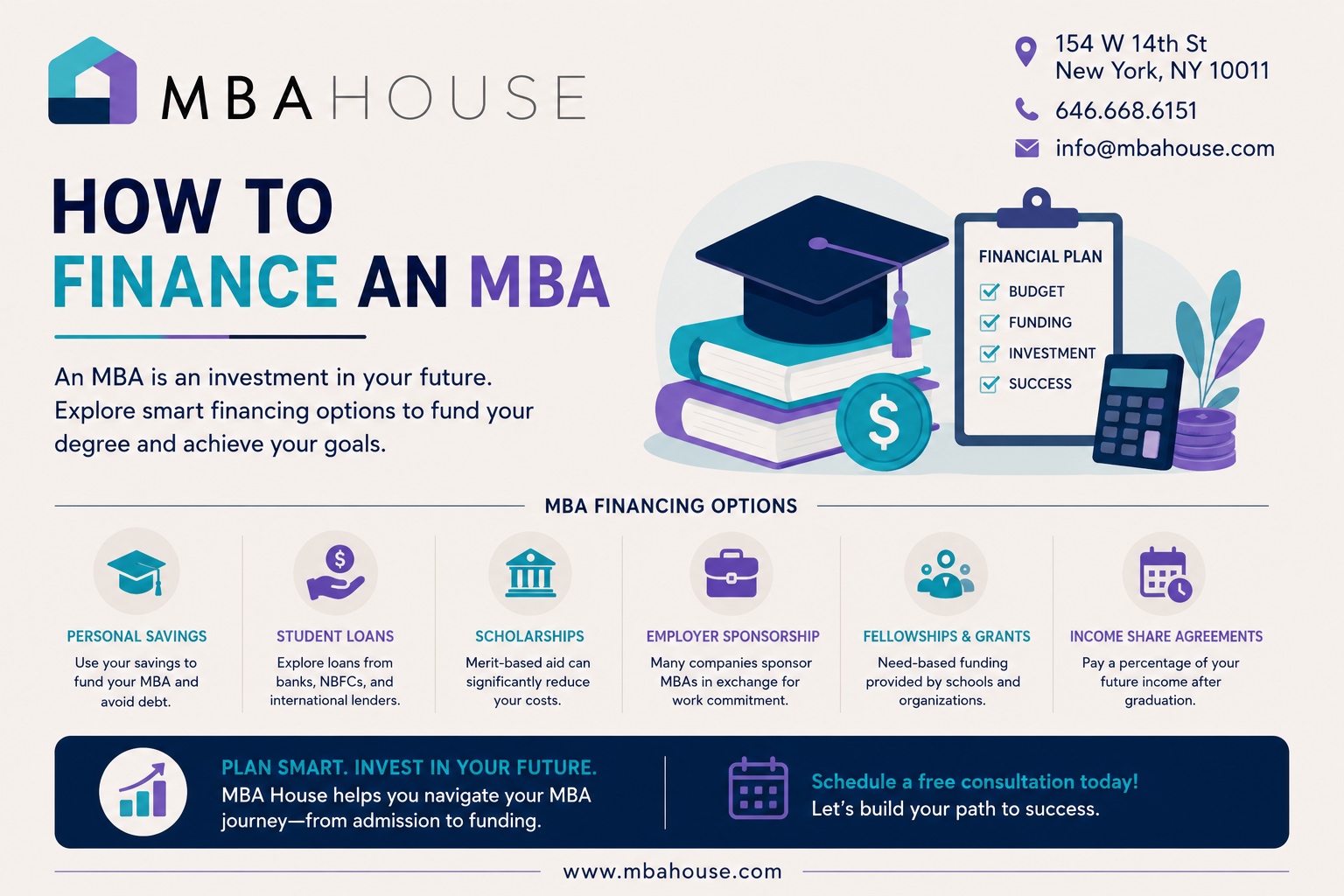
You can finance an MBA through a mix of savings, scholarships, fellowships, federal student loans, private loans, employer sponsorship, family support, and post-MBA career planning. The right mix depends on your citizenship, school, credit profile, scholarship potential, and risk tolerance.
MBA House helps applicants think about financing early because cost changes school strategy. A dream school with no scholarship, a slightly lower-ranked school with major aid, and a part-time program that lets you keep your salary may all create different outcomes.
Start with cost of attendance, not only tuition
MBA cost usually includes tuition, fees, living expenses, health insurance, books, travel, and the salary you may give up if you attend full time. This is why applicants should compare total cost of attendance and opportunity cost, not just published tuition.
The financing question also affects timing. If you need a stronger GMAT score for scholarship positioning, you may need to start test prep earlier. If you need to keep working, a part-time MBA may change the school list. If you are international, loan access may change the risk calculation.
Scholarships and fellowships
Scholarships and fellowships are usually the most attractive funding because they do not need to be repaid. Harvard Business School says approximately 50 percent of MBA students receive a need-based scholarship from HBS, with 10 percent of students receiving full-tuition scholarships, and lists an average need-based scholarship of $100,000 awarded over two years (HBS financial aid).
Stanford GSB says its fellowships are gifts that do not have to be repaid, are awarded based solely on demonstrated financial need, and that approximately half of Stanford MBA students receive fellowship funds with an average fellowship of about $47,000 per year (Stanford GSB types of aid).
Federal student loans for U.S. borrowers
For U.S. citizens and eligible borrowers, federal student loans may be part of the MBA plan. Eligibility usually starts by submitting the FAFSA. Federal Student Aid says eligible graduate students may borrow up to $20,500 in federal unsubsidized loans, and that federal student loans usually have more benefits than private loans (Federal Student Aid loan overview).
Graduate PLUS loans can also help cover cost of attendance minus other aid, but they require a credit check and have their own interest rate and loan fee. Federal Student Aid states that the maximum PLUS loan amount is the cost of attendance determined by the school minus other financial assistance, and that a credit check is performed during the application process (Federal Student Aid Grad PLUS loans).
Private loans and international borrowers
Private loans can be useful, especially for some international students or applicants who need to fill a gap, but terms vary widely. Federal Student Aid notes that student loans can come from federal, private, or other sources and says federal loans usually have more benefits than private loans (Federal Student Aid loan overview).
Stanford GSB advises students to compare interest rates, terms and conditions, and repayment options across loan programs; it also encourages international students to review private loan options carefully and look for better rates in their home country when possible (Stanford GSB types of aid).
Employer sponsorship and career ROI
Employer sponsorship can reduce debt, but it may come with repayment conditions or a requirement to return to the sponsor. Stanford GSB advises applicants to understand all repayment terms required by a sponsor, especially if the student chooses not to return after graduation (Stanford GSB types of aid).
MBA House encourages applicants to model several scenarios: full-time MBA with loans, full-time MBA with scholarship, part-time MBA with salary, employer-sponsored MBA, and a lower-cost option. The best option is not always the cheapest. It is the one that supports the career change you actually want.
How much does an MBA actually cost in 2026?
Sticker tuition is only the visible part of the bill. Total cost of attendance bundles tuition and fees with housing, health insurance, books, and travel — and for full-time students, the salary you forgo while in school is often the largest line of all. At M7 programs, two-year tuition runs roughly $157,000 to $185,000 (Wharton near the top, Harvard the lowest of the seven), and once living costs are included the all-in figure at many top programs lands between $210,000 and $280,000 (GMAC MBA tuition fees). For a fuller picture of program types and what drives cost, see our guide on what an MBA is.
| School tier | 2-year tuition | Est. total cost of attendance (2 yrs) |
|---|---|---|
| M7 (Wharton, Harvard, etc.) | $157K–$185K | $210K–$280K |
| Top 15 (NYU Stern, Tuck, etc.) | $140K–$170K | $190K–$250K |
| Top 25–50 | $100K–$150K | $140K–$200K |
| Regional / state programs | $40K–$100K | $60K–$140K |
How to read a financial-aid offer before you compare schools
Once admissions decisions arrive, applicants often try to compare offers by glancing at the scholarship number alone. That is the wrong unit. The figure that decides which school is actually cheaper is your net cost: total cost of attendance minus grant aid that never has to be repaid. A school that quotes a smaller scholarship but a lower sticker price — or a stronger summer-internship salary that offsets second-year living costs — can leave you with less debt than a flashier headline award elsewhere.
Read each award letter for three things. First, separate gift aid (scholarships and fellowships) from self-help aid (loans and work), because only gift aid reduces what you owe. Second, check whether a scholarship is guaranteed for both years or only the first, since renewal conditions change the two-year math. Third, note the cost-of-living assumption baked into the school's stated cost of attendance; an MBA in New York carries a higher living number than one in a smaller market, and that gap is real money you will borrow or earn. Lining offers up this way turns a confusing pile of letters into a single comparable figure per school.
Federal student loans for MBA students: what changed for 2026
This is the most important update for anyone researching MBA financing right now, because most older articles describe a system that no longer applies. The One Big Beautiful Bill Act, signed July 4, 2025, eliminated the Graduate PLUS loan for new borrowers starting July 1, 2026. For decades Grad PLUS let graduate students borrow up to the full cost of attendance; that door is closing for new borrowers, which reshapes how MBAs fund the gap above the basic federal loan.
Federal MBA loans in 2026: Starting July 1, 2026, the Grad PLUS program was eliminated for new MBA borrowers under the One Big Beautiful Bill Act. New federal Direct Unsubsidized Loans for master's-degree students are capped at $20,500 per year and $100,000 over the lifetime of graduate study. Students who borrowed a federal direct loan before July 1, 2026 may qualify for a legacy provision allowing continued Grad PLUS access for up to three more years.
The old system (through June 30, 2026)
Under the rules still in effect through mid-2026, eligible graduate students can borrow up to $20,500 per year in Direct Unsubsidized Loans (7.94% for 2025–26) and use Grad PLUS to cover the remaining cost of attendance after other aid (8.94% for 2025–26), subject to a credit check (2025–26 federal loan rates). Federal Student Aid remains the authoritative source for current terms (StudentAid.gov Grad PLUS).
The new system (starting July 1, 2026)
For new borrowers from July 1, 2026, Grad PLUS is gone, and federal borrowing for master's students is capped at $20,500 per year and $100,000 in total across graduate study. A legacy provision may let students who already borrowed a federal direct loan before that date continue under the old rules for up to three more years (Urban Institute analysis; GWU financial aid guidance).
What this means for MBA applicants
Two practical points. First, MBA programs are classified as graduate (master's) degrees, not professional degrees, so the higher limits some sources cite for JD and MD students do not apply — MBAs face the $20,500 annual cap. Second, there is now a large gap between that cap and the $80,000-plus annual cost of a top program, which will push more applicants toward scholarships, employer support, and private loans. If you are weighing whether to enroll before July 1, 2026, doing so may preserve Grad PLUS access under the legacy provision — a timing decision worth discussing with an advisor.
Private student loans for MBA
With Grad PLUS narrowing, private loans become a larger part of many plans. Qualifying depends on creditworthiness, and many applicants — especially younger or international borrowers — need a co-signer. Rates vary widely with credit and can range from the high single digits up to roughly 18% for weaker profiles, compared with the fixed federal rates near 7.94–8.94%. Reputable lenders in this space include Earnest, Sallie Mae, Citizens, and Ascent, among others (Ascent on the Grad PLUS change).
Federal Student Aid notes that federal loans generally carry more borrower protections than private loans, so the usual sequence is to exhaust federal eligibility first and use private loans to fill what remains (Federal Student Aid loan overview). Compare interest rates, repayment terms, deferment options, and co-signer release policies carefully before signing.
Employer sponsorship and tuition reimbursement
Employer support can dramatically cut out-of-pocket cost, and it is worth investigating before you rule it out. Under IRS Section 127, employers can provide up to $5,250 per year of educational assistance tax-free to an employee; amounts above that are generally taxable income. Many large firms across consulting, technology, and finance offer reimbursement or sponsorship programs, typically with conditions: a minimum tenure, a grade requirement, and a "stay-back" commitment to remain with the employer for a period after graduation.
Sponsorship fits part-time and executive MBA formats especially well, since you keep working while you study. If you are considering this route, negotiate the terms before you enroll, and read the repayment clause closely — you may owe money back if you leave early. As Stanford GSB advises, understand every condition a sponsor attaches, particularly if you might not return after graduation (Stanford GSB types of aid).
Scholarships, 529 plans, and other assets
Because scholarships do not have to be repaid, they should be the first line of any financing plan — and with federal borrowing tightening, free money matters more than ever. A strong GMAT score above 655 is one of the single best levers for merit aid, and our dedicated guide explains how to get MBA scholarships in detail. Beyond awards, a 529 education savings plan can be used for graduate study, and some applicants strategically draw down taxable brokerage holdings to limit borrowing. Whatever the source, the goal is to minimize high-interest debt without starving your living budget during a demanding program.
Financing options for international MBA students
International applicants face a different calculus, because most US federal loans require citizenship or eligible non-citizen status. That removes the $20,500 federal option for many, making scholarships, school-administered loans, and private financing central. Some US lenders offer loans to international students with a creditworthy US co-signer, and a growing number of programs partner with lenders that do not require a co-signer for admitted students at specific schools. Stanford GSB encourages international students to compare private loan options carefully and to look for better rates in their home country when those exist (Stanford GSB types of aid).
For international candidates, the financing plan should be built alongside the school list, not after admission. A school that offers strong merit aid or a no-co-signer loan program can be dramatically more affordable than a higher-ranked program that offers neither, even before currency and visa considerations enter the picture.
One more consideration for international applicants: post-MBA earning geography. If you intend to repay loans from a US salary, a US-dollar loan is straightforward; if you expect to return home, borrowing in your home currency may reduce exchange-rate risk over a multi-year repayment. Model repayment against the currency you will actually earn in, not just the currency of the program.
Why financing strategy should start before you apply
The most common financing mistake is sequencing it last — choosing schools, applying, and only then asking how to pay. That order quietly removes your best options. Scholarship budgets favor early rounds, merit aid rewards a score you have to earn months in advance, and the school where you are above median (and therefore most likely to be funded) only appears on your list if cost shaped that list in the first place. By the time admission letters arrive, the levers that most affect cost have already been pulled or missed.
Starting early changes the outcome in concrete ways. It gives you time to raise a GMAT score into merit-aid territory, to build a school list that balances reach programs with ones likely to fund you, to line up employer sponsorship before you enroll, and to map external scholarship deadlines that often close before decisions are released. None of this requires a wealthier background — it requires treating financing as part of the application strategy rather than a separate, later problem.
For New York applicants in particular, the higher local cost of living makes this discipline matter more, since the gap between a funded and an unfunded offer is larger in absolute dollars. MBA House helps GMAT NY candidates build the score, school list, and scholarship plan together, so the financing answer is shaped before it becomes urgent.
Work-study, assistantships, and earning during school
At some programs — more often outside the very top of the rankings — teaching and research assistantships can offset part of tuition or provide a stipend in exchange for supporting faculty work. Part-time and online students frequently keep working through the degree, which both reduces the need to borrow and preserves career momentum. Full-time students typically rely on a paid summer internship between the two years, which at top programs can cover a meaningful slice of second-year living costs. None of these alone will fund an MBA, but stacked with scholarships and loans they reduce the total you have to borrow.
Building your personal MBA financing strategy
The smartest approach is stackable: layer the cheapest money first and borrow for the gap. A simple sequence works for most applicants:
- Step 1 — Maximize scholarships. Free money first; raise your test score and sharpen your application to compete for merit aid.
- Step 2 — Employer sponsorship. If available, capture tax-free assistance and any sponsorship, mindful of stay-back terms.
- Step 3 — Federal loans. Borrow up to the $20,500 annual cap, which carries fixed rates and federal protections.
- Step 4 — Private loans or family support. Fill the remaining gap, comparing rates and terms carefully.
Worked through at a hypothetical top-10 program, that might mean a partial merit scholarship covering a chunk of tuition, $20,500 a year in federal loans, and a private loan for the balance — with the exact mix depending on your scholarship outcome, citizenship, and credit. The lesson is to plan the stack before you commit to a school, because the financing answer can change which school is actually the best value. If you are still deciding whether the degree pays off, weigh this against the value of strong application support and your projected return.
MBA financing changed significantly in 2025–2026. If you plan to start an MBA, acting before July 1, 2026 may preserve Grad PLUS access under the legacy provision. MBA House advisors stay current on every option, from scholarship positioning to employer sponsorship, and can help you minimize out-of-pocket cost.
How MBA House connects financing to admissions
Financing strategy begins before applications are submitted. The GMAT score, school list, round choice, essays, recommendations, and interview preparation can all affect scholarship and aid outcomes. If scholarship matters, the application should be built with that goal in mind.
MBA House helps candidates identify which schools are worth the cost, where scholarships may be more realistic, when a higher GMAT score is worth chasing, and how to explain goals in a way that makes the MBA investment credible.
Book a free strategy call if you want a practical plan for your school list, score strategy, application timeline, and financing or scholarship goals.
MBA financing FAQs
Can I get loans for an MBA?
Many U.S. borrowers use federal unsubsidized loans and private loans. The Grad PLUS loan was eliminated for new borrowers starting July 1, 2026, so private loans, scholarships, and employer support fill the gap above the federal cap. Eligibility and terms depend on the borrower and the school.
What happened to the Grad PLUS loan for MBA students?
Under the One Big Beautiful Bill Act, signed July 4, 2025, the Grad PLUS program was eliminated for new borrowers starting July 1, 2026. Borrowers who took a federal direct loan before that date may qualify for a legacy provision allowing continued access for up to three more years.
What are the new federal loan limits for graduate students in 2026?
Starting July 1, 2026, federal Direct Unsubsidized Loans for master's-degree students such as MBAs are capped at $20,500 per year and $100,000 over the lifetime of graduate study.
Are MBA scholarships common?
Many schools offer scholarships or fellowships, but the rules vary. Some are merit-based, some are need-based, and some require separate applications.
Should I choose the school that gives me the most money?
Not always. Compare scholarship amount, total cost, career outcomes, fit, and the role the school plays in your goals.
Can MBA House help with financing strategy?
Yes. MBA House can connect school selection, GMAT strategy, scholarship positioning, and application planning.