
The one-sentence answer
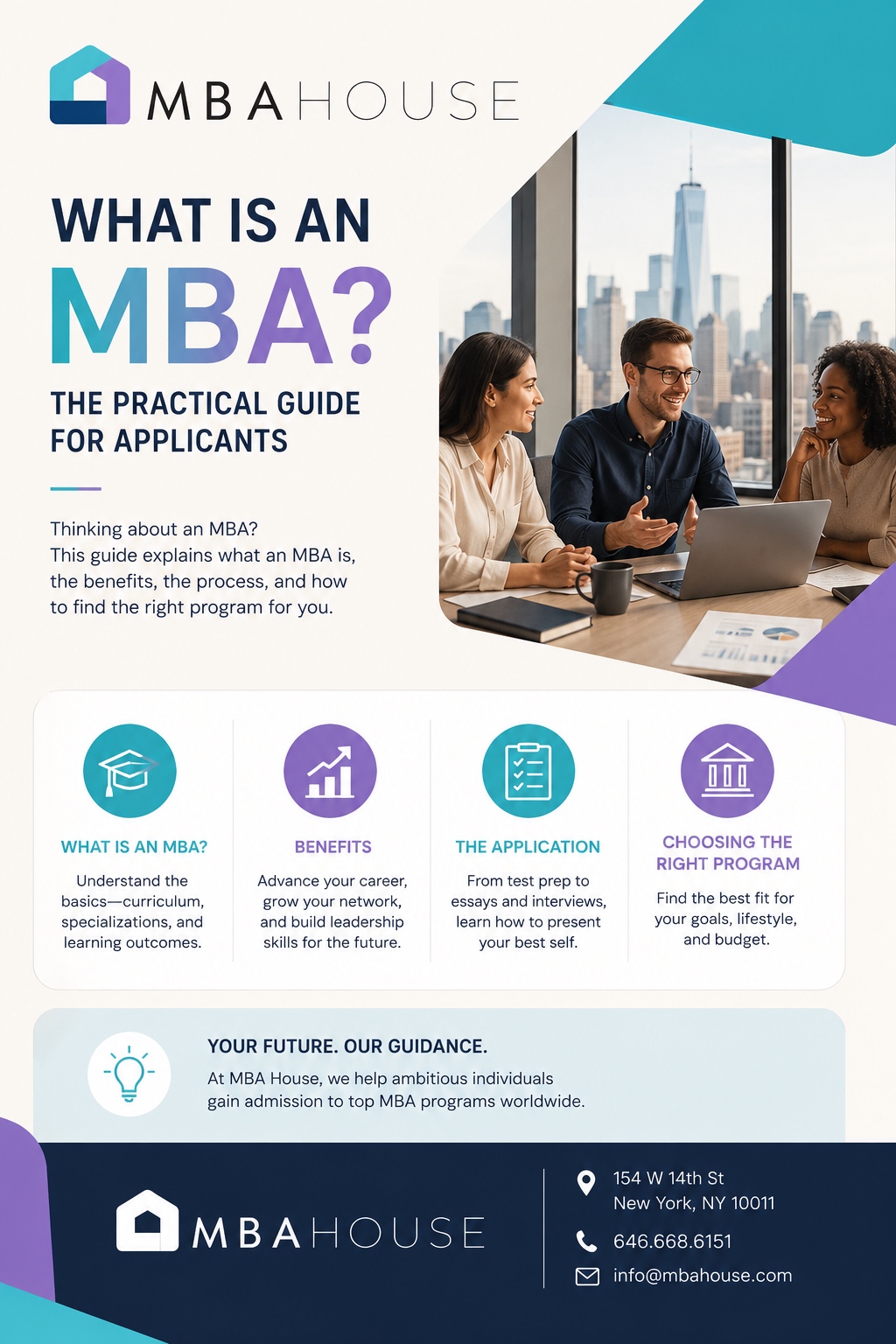
An MBA is a graduate management degree that teaches business fundamentals such as strategy, finance, marketing, accounting, operations, leadership, communication, and negotiation. MBA.com describes the MBA as a generalist degree that gives students a holistic view of business while building hard and soft skills (MBA.com MBA overview).
The MBA is not just a classroom credential. It is usually a career decision. Applicants use it to change industries, move into management, accelerate compensation, build a network, or gain credibility for entrepreneurship. MBA House helps students connect that career question to the admissions plan, GMAT plan, school list, and financing strategy.
Who is an MBA for?
An MBA is usually for professionals who already have work experience and want to move into a stronger leadership, management, strategy, finance, consulting, technology, entrepreneurship, or general business role. MBA.com says the degree often targets professionals with three to five years of work experience who want to accelerate their careers (MBA.com MBA overview).
That does not mean every applicant needs the same kind of MBA. A full-time MBA may make sense if you want a major career pivot. A part-time or executive format may make sense if you want to keep working. An online MBA may make sense if flexibility matters more than campus recruiting. MBA House starts with the candidate’s goal before recommending schools or test strategy.
What do you study in an MBA?
Most MBA programs combine core business classes with electives. Common core subjects include accounting, finance, economics, marketing, strategy, operations, leadership, business communication, data analytics, and ethics. MBA.com describes the MBA curriculum as a mix of core management foundations and electives that match individual career goals (MBA.com MBA overview).
The practical value is that the MBA gives you a shared business language. You learn how to read financial tradeoffs, discuss markets, evaluate teams, understand strategy, and make decisions with incomplete information. That is why admissions committees care about more than grades and test scores. They want to understand how you will contribute to class and where the degree fits in your career arc.
Is an MBA worth it?
An MBA can be worth it when the career upside, network, recruiting access, and personal growth justify the tuition, time, and opportunity cost. MBA.com notes that leading MBAs can cost over $200,000 in total and that applicants should scrutinize return on investment carefully (MBA.com MBA overview).
MBA House treats “worth it” as a personal calculation. The answer depends on your current salary, target industry, scholarship potential, school rank, immigration goals, family obligations, and how quickly you can build a credible application. A strong MBA plan should include admissions odds, scholarship strategy, test score strategy, and realistic post-MBA outcomes.
How do you apply for an MBA?
Most MBA applications ask for transcripts, a resume, essays, recommendation letters, test scores or a test-waiver decision, and sometimes an interview. Wharton’s application guide, for example, asks applicants to upload academic transcripts, submit GMAT or GRE results, provide a one-page resume, complete essays, and arrange a recommendation (Wharton MBA application guide).
A strong application is not a pile of documents. It is one coherent argument: who you are, what you have done, where you are going, why the MBA is necessary, and why a specific school is the right environment. MBA House helps candidates build that argument before they start drafting essays.
What is an MBA? An MBA (Master of Business Administration) is a graduate-level degree that develops leadership, management, and strategic business skills. Typically lasting one to two years full-time, it is offered by accredited business schools and recognized by employers worldwide. Unlike specialized master's programs, the MBA is a generalist degree with optional concentrations in finance, marketing, operations, technology, and more.
Types of MBA programs
"MBA" is not one format. The degree comes in several shapes, and choosing the wrong one is one of the most common — and most expensive — mistakes applicants make. The right format depends on whether you want to change careers, keep your salary, or maximize flexibility.
Full-time MBA (one to two years)
The classic format. You step away from work, immerse yourself in coursework and recruiting, and graduate in two years (or one, in accelerated programs). Full-time MBAs offer the strongest on-campus recruiting and networking, which is why they remain the go-to for people targeting top consulting and finance roles or making a clean career pivot.
Part-time MBA (two to four years)
Designed for working professionals who keep their jobs and study evenings or weekends. You trade speed and full-time recruiting access for the ability to earn while you learn and apply lessons immediately. A strong option for New York professionals who want to stay on their current track while leveling up.
Executive MBA (EMBA, around 1.5 to 2 years)
Built for mid-to-senior managers with significant experience, often with employer sponsorship. Classes cluster on weekends or in intensive modules, and cohorts are more seasoned, which changes the classroom dynamic toward peer leadership lessons.
Online MBA (two to three years)
Maximum flexibility and usually the lowest cost. Employer acceptance of online MBAs has grown substantially, though on-campus recruiting access is more limited. Best when geography or schedule rules out a residential program.
One-year accelerated MBA
A compressed full-time option for candidates who already have a strong business or quantitative background and want to minimize time out of the workforce.
| Program type | Duration | Best for | Typical cost |
|---|---|---|---|
| Full-time MBA | 1–2 years | Career switchers, top consulting/finance | $80K–$180K+ |
| Part-time MBA | 2–4 years | Working professionals keeping their jobs | $40K–$120K |
| Executive MBA | 1.5–2 years | Mid-to-senior managers (often sponsored) | $80K–$200K |
| Online MBA | 2–3 years | Maximum flexibility, lower cost | $20K–$80K |
| Accelerated (1-year) | 12 months | Strong quant/business background | $60K–$130K |
Popular MBA specializations
Within the generalist core, most programs let you concentrate. The most common specializations are finance, marketing, operations and supply chain, healthcare management, technology and product management, and entrepreneurship. What is new is how thoroughly artificial intelligence, data analytics, and sustainability are now woven into nearly every track rather than siloed into a single elective. GMAC's research points to AI fluency becoming a baseline expectation rather than a niche skill, which is reshaping how schools teach even traditional subjects like finance and strategy.
For most applicants the concentration matters less than the school's strength in your target field and its recruiting pipeline into that industry. A finance concentration at a school that funnels graduates into investment banking is worth more than the label alone.
Is an MBA worth it in 2026? The ROI data
"Worth it" is a financial question with a personal answer, but the recent data is encouraging for top programs. Post-MBA compensation at leading US schools regularly clears the quarter-million mark when salary and bonus are combined, and the Financial Times MBA ranking tracks these salary outcomes school by school. On the demand side, GMAC's 2025 Corporate Recruiters Survey found roughly 90 percent of employers planned to hire MBA graduates, with AI fluency rising to the top of in-demand skills.
Application volume tells the same story: GMAC's 2025 Application Trends Survey reported MBA applications grew about 7 percent in 2025, building on stronger growth the prior year, with a notable milestone: women applicants outpaced men. Demand has also concentrated — a "flight to the top" toward elite, in-person programs — which makes a sharp application and a competitive test score matter more, not less.
Still, the MBA is not automatically worth it for everyone. The calculation depends on your current salary, target industry, scholarship potential, school rank, immigration goals, and family obligations. Run the numbers honestly, and weigh tuition against the full financing picture and your realistic post-MBA outcomes before committing.
MBA admissions requirements
Top programs evaluate the whole candidate, but the core components are consistent: a competitive GMAT or GRE score (or an approved waiver), typically three to five years of work experience for full-time programs, undergraduate transcripts, recommendation letters, essays, and an interview. Increasingly, programs accept either test, so the choice comes down to your strengths and your schools' policies — our guide on what the GMAT is explains the current Focus Edition format and how to decide.
Class profiles at top US schools cluster around strong undergraduate records, meaningful leadership, and clear post-MBA goals. The test score is the single most controllable piece of that profile, which is why many applicants start there. If your background is non-traditional or your story is complex, it may also be worth reading whether you need an MBA admissions consultant.
How much does an MBA cost?
Tuition at M7 programs runs roughly $157,000 to $185,000 over two years — Wharton sits near the top at about $184,560, while Harvard is the most affordable of the M7 at roughly $157,400 (GMAC MBA tuition fees). Regional and state programs often fall in the $50,000 to $120,000 range. But tuition is only part of the story: once you add housing, fees, health insurance, and the salary you give up while studying full-time, total cost of attendance at a top program can reach $210,000 to $280,000.
That is exactly why financing strategy belongs in your planning from day one, not after you are admitted. Many applicants cut their net cost substantially through merit aid, so it is worth understanding both how to get MBA scholarships and the federal and private options for financing an MBA — especially as the federal loan landscape changed for 2026.
MBA application trends for 2026
Three trends define the current cycle. First, demand is up: applications grew about 7 percent in 2025 per GMAC, continuing a rebound. Second, the field is diversifying: women applicants outpaced men for the MBA in 2025, a notable shift. Third, top programs are more selective, with demand consolidating at elite, in-person full-time programs while some online segments cooled (Poets & Quants acceptance-rate data).
For applicants, the implication is practical: at the top of the market, the bar is rising. A competitive test score, a sharply differentiated story, and a well-built school list matter more in a more selective field. New York professionals targeting Columbia or NYU Stern feel this acutely, since local demand is strong.
What jobs can you get with an MBA?
The MBA is intentionally broad, and so are its destinations. The traditional high-volume paths remain management consulting and investment banking, both of which recruit heavily and predictably on top campuses. But MBA graduates also move into technology (product management, strategy, and operations roles at large platforms and startups), corporate finance and treasury, brand and growth marketing, healthcare and biotech management, private equity and venture capital, and general management leadership tracks. A meaningful share use the degree to launch or join early-stage companies.
The common thread is that an MBA is most powerful when it bridges where you are and where you want to be. If your target role already values your current experience, the degree adds a credential and a network. If you are pivoting — from engineering into product, from the military into corporate strategy, from a regional role into global management — the MBA's recruiting access and structured re-positioning are often the actual mechanism of the switch. That is the question worth answering before you apply: not just "is an MBA valuable?" but "what specific door does it open for me?"
MBA vs a specialized master's (MiM, MSF, and others)
A frequent point of confusion is how the MBA differs from degrees like the Master in Management (MiM), Master of Science in Finance (MSF), or other specialized master's programs. The simplest distinction: the MBA is a generalist leadership degree usually aimed at professionals with several years of experience, while specialized master's programs are deeper but narrower and often aimed at recent graduates with little or no work experience.
If your goal is to become a domain expert early in your career — say, a quantitative finance role straight out of undergrad — a specialized master's can be a faster, cheaper route. If your goal is to broaden into general management, switch industries, or build a senior leadership network, the MBA's breadth and recruiting access usually justify the higher cost and the work-experience requirement. The two are tools for different jobs, not interchangeable.
Do you need work experience to apply for an MBA?
For full-time MBA programs, yes, in nearly all cases. Most top programs expect roughly three to five years of professional experience, because the classroom learning model relies on students bringing real workplace examples to discussions and because recruiters hire for roles that assume some seniority. A handful of deferred-admission pathways let undergraduates secure a spot to enroll a few years later, but the enrollment itself still follows a period of work.
Executive MBAs sit at the opposite end, expecting substantial managerial experience. The practical lesson for younger applicants: if you are not yet at the experience level your target schools expect, the strongest move is often to keep building a track record while preparing your test score, so you apply from a position of strength rather than reaching too early.
Studying for an MBA in New York City
New York is one of the deepest MBA markets in the world, home to Columbia Business School and NYU Stern, with strong part-time and executive options and unmatched access to finance, consulting, technology, and media recruiting. For local professionals, that density is an advantage: you can pursue a part-time or executive format without leaving your job or your network, and full-time students recruit into firms headquartered blocks from campus.
It also means competition is sharp and deadlines are demanding. NYC applicants frequently juggle intense jobs with application timelines, which is where a structured plan — test score first, then school list, essays, and interviews — pays off. MBA House works with New York professionals to sequence those decisions sensibly.
Is an MBA right for you?
Use a short checklist. Do you have a clear post-MBA goal the degree actually accelerates? Will the recruiting access or network change your trajectory? Can you absorb the cost — net of likely scholarships — within a reasonable payback window? Are you ready to invest in a competitive application now? If most answers are yes, an MBA is likely a strong move. If the goal is vague or the math does not work, it may be worth waiting or choosing a different format.
Preparing your MBA application from New York? MBA House offers personalized admissions advising for NYC-area applicants targeting top programs, and our advisors have helped many local professionals navigate exactly this decision.
How MBA House helps
MBA House helps applicants answer the MBA question in context. We look at your career goal, transcript, GMAT or GRE profile, school list, timeline, geography, financing concerns, and scholarship goals. Then we decide what has to happen first: test prep, school selection, resume repositioning, essays, recommendations, interview preparation, or a full application plan.
If you are searching for GMAT NY support or MBA admissions help in New York, the goal is not to collect more information. The goal is to turn information into a sequence of decisions. MBA House helps you decide whether an MBA is the right move, which schools make sense, and what score or application strategy gives you the best chance.
Book a free strategy call if you want a practical plan for your school list, score strategy, application timeline, and financing or scholarship goals.
MBA basics FAQs
What does MBA stand for?
MBA stands for Master of Business Administration.
Is an MBA only for finance or consulting?
No. MBA students move into finance and consulting, but also technology, entrepreneurship, healthcare, nonprofit leadership, operations, marketing, and general management.
Do I need the GMAT for an MBA?
Many programs accept the GMAT or GRE, and some offer waiver options. The right choice depends on your schools, academic profile, and whether a score can strengthen your application.
When should I start planning?
Start at least several months before your target deadline. If you need a GMAT score, scholarship strategy, or major career-positioning work, start earlier.
How long does it take to complete an MBA?
A full-time MBA usually takes two years, with one-year accelerated options available. Part-time and executive MBAs typically run two to four years so students can keep working.
What is the difference between a full-time, part-time, and executive MBA?
Full-time MBAs suit career switchers and offer the strongest recruiting access. Part-time MBAs let working professionals keep their jobs. Executive MBAs target mid-to-senior managers, often with employer sponsorship.
How much does an MBA cost at a top school?
Tuition at M7 programs runs roughly $157,000 to $185,000 over two years. Total cost of attendance including living expenses can reach $210,000 to $280,000.
Is an MBA worth it in 2026?
It can be, especially at programs with strong recruiting and salary outcomes. GMAC's 2025 Corporate Recruiters Survey found about 90 percent of employers planned to hire MBA graduates, and application volume grew in 2025.