
The one-sentence answer
The GMAT is a standardized exam built specifically for graduate business education. The official GMAT site describes it as the most widely used assessment designed for graduate business education and says it is trusted by more than 7,700 programs and 2,400 business schools worldwide (official GMAT overview).
MBA House treats the GMAT as an admissions tool, not just a math test. The score should serve your school list, application story, scholarship goals, and timeline. If a higher score does not change your admissions strategy, the study plan should look different.
What does the GMAT test?
The current GMAT tests problem solving, critical thinking, and data analysis, according to the official GMAT overview (official GMAT overview). In practical terms, it asks whether you can reason under time pressure, interpret information, and avoid attractive but wrong answers.
That is why MBA House does not teach GMAT prep as memorization. We build section-specific habits: clean setup in Quant, argument logic in Verbal, and structured interpretation in Data Insights.
What is the current GMAT format?
The current GMAT has three sections: Quantitative Reasoning, Verbal Reasoning, and Data Insights. Each section is 45 minutes. The official exam structure page lists 21 Quantitative Reasoning questions, 23 Verbal Reasoning questions, and 20 Data Insights questions, for 64 total questions and 2 hours 15 minutes of testing time (official GMAT exam structure).
Students can take the sections in any order and have one optional 10-minute break. The current exam also includes Question Review & Edit, which lets test takers bookmark questions and edit up to three answers per section if time remains (official GMAT exam structure).
What is a good GMAT score?
A good GMAT score depends on your target schools and the rest of your profile. A candidate with a strong transcript, unusual career story, and clear leadership record may need a different score from a candidate using the GMAT to offset academic concerns.
MBA House starts with the school list, not a generic number. A score goal for Columbia, NYU Stern, Harvard, Wharton, MIT Sloan, or Stanford should be tied to admission odds, scholarship goals, and the time remaining before deadlines.
Should I take the GMAT, GRE, EA, or use a waiver?
The GMAT is often a strong choice for applicants who are comfortable with quantitative reasoning, logic, and data interpretation. The GRE may be better for some applicants, the Executive Assessment may fit certain experienced candidates, and a waiver may make sense when the rest of the application already proves academic readiness.
The wrong choice can waste months. MBA House helps applicants compare diagnostic performance, school policy, scholarship goals, and timeline before choosing a test path. If a score can improve your application, it deserves a serious plan. If it cannot, the application strategy should shift.
How should New York applicants prepare?
New York professionals often study around demanding jobs, long commutes, travel schedules, and competitive deadlines. A GMAT NY plan needs live structure, realistic weekly assignments, private support, and admissions-aware score targets.
MBA House combines 90-minute live classes, private tutoring support, Data Insights practice, and score strategy. The goal is not to study every topic forever. The goal is to identify the score that matters and build the most efficient path to it.
What is the GMAT Focus Edition (the version you take in 2026)?
The GMAT Focus Edition is the only version of the GMAT available today. The Graduate Management Admission Council (GMAC) retired the classic four-section GMAT, and since late 2023 every test taker sits the streamlined Focus Edition. That matters because most of the older GMAT advice still floating around the web describes an exam that no longer exists: a 3 hour 7 minute test with an essay, a separate Integrated Reasoning score, Sentence Correction, and heavy geometry. If a study guide still talks about the Analytical Writing Assessment, it is out of date.
The redesign was deliberate. GMAC stripped out content that no longer predicted business-school success and doubled down on the skills MBA programs actually use, especially data literacy. The result is a shorter, more flexible exam that rewards clean reasoning over memorized tricks. For applicants, the practical takeaway is simple: prepare for the current GMAT, with current materials, on the 205 to 805 scale.
What is the GMAT? The GMAT (Graduate Management Admission Test) is a standardized exam administered by the Graduate Management Admission Council (GMAC). Used by more than 7,700 programs at over 2,400 business schools worldwide, it measures quantitative reasoning, verbal reasoning, and data-analysis skills relevant to graduate management education. Since 2023, the only version offered is the GMAT Focus Edition, scored from 205 to 805.
Old GMAT vs GMAT Focus Edition: what changed?
The fastest way to understand the current exam is to compare it with the version it replaced. The classic GMAT had four parts and ran more than three hours. The Focus Edition has three 45-minute sections, no essay, and a calculator only in Data Insights.
| Feature | Classic GMAT (retired) | GMAT Focus Edition |
|---|---|---|
| Sections | AWA, Integrated Reasoning, Quant, Verbal (4) | Quant, Verbal, Data Insights (3) |
| Total questions | 80 | 64 |
| Testing time | About 3 hr 7 min | 2 hr 15 min |
| Score scale | 200–800 | 205–805 |
| AWA essay | Required (30 min) | Removed |
| Sentence Correction | In Verbal | Removed |
| Geometry | In Quant | Removed |
| Section order | Fixed | Your choice |
| Answer review | Not allowed | Edit up to 3 per section |
| Calculator | None | Data Insights only |
Notice what is gone: the essay, Sentence Correction, and standalone geometry. Notice what is new: Data Insights now counts inside your total score, you choose your section order, and you can bookmark and revise up to three answers per section if time remains. These features change how you should practice, which is why MBA House rebuilt its prep around the Focus Edition rather than recycling classic-GMAT drills.
GMAT Focus Edition sections explained
All three sections are 45 minutes, and you may take them in any order. The official exam structure page lists 21 Quantitative Reasoning questions, 23 Verbal Reasoning questions, and 20 Data Insights questions (official GMAT exam structure).
Quantitative Reasoning (21 questions, 45 minutes)
Quant on the Focus Edition is pure Problem Solving: arithmetic, algebra, word problems, and statistics. There is no calculator and, importantly, no geometry. This is good news for many adult test takers who have not touched a compass since high school. MBA House Quant prep concentrates on careful setup, number sense, and avoiding the time traps that quietly drain your section, rather than on memorizing rarely tested formulas.
Verbal Reasoning (23 questions, 45 minutes)
Verbal now covers two question types: Reading Comprehension and Critical Reasoning. Sentence Correction has been removed entirely, so grammar drilling is no longer the path to a higher Verbal score. Instead, the section rewards reading carefully, mapping argument structure, and recognizing the exact logical gap a question is testing. For non-native English speakers, this is often a more learnable section than the old grammar-heavy format.
Data Insights (20 questions, 45 minutes)
Data Insights is the section most applicants underestimate. It blends the old Integrated Reasoning question types — Data Sufficiency, Multi-Source Reasoning, Table Analysis, Graphics Interpretation, and Two-Part Analysis — into one scored section that counts fully toward your 205 to 805 total. Because data literacy is exactly the skill MBA programs and employers want, schools pay attention to this section. It is also the only section with an on-screen calculator. MBA House gives Data Insights dedicated practice because it is often where a focused student can find the fastest score gains.
GMAT Focus Edition scoring: 205 to 805
The Focus Edition total score runs from 205 to 805 in 10-point increments, not the old 200 to 800. Each of the three sections is scored from 60 to 90, and all three count equally toward your total — including Data Insights, which did not feed the classic total at all. Because the scales differ, you cannot read a Focus Edition score as if it were a classic score.
GMAC publishes a concordance so schools can compare fairly. The headline reference point: a 645 on the Focus Edition corresponds to roughly a 700 on the old scale. GMAC explicitly warns against comparing a current GMAT score directly to an old score without using the official concordance and current percentiles (understanding your GMAT score). Percentiles, not raw numbers, are what admissions committees ultimately weigh. Your scores are valid for five years from the test date, so one strong result can cover more than one application cycle.
What is a good GMAT score for MBA programs?
A good score is the one that makes your target schools say yes — ideally with scholarship money attached. There is no universal number, but the ranges below give a realistic frame. A strong transcript and career story can offset a slightly lower score; using the GMAT to answer academic questions usually calls for aiming higher.
| Program tier | Typical GMAT Focus range | Rough old-scale equivalent |
|---|---|---|
| M7 (Harvard, Stanford, Wharton) | 685–760 | ~720–760 |
| Top 15 (NYU Stern, Columbia, Cornell) | 655–705 | ~700–720 |
| Top 25–50 | 615–665 | ~640–680 |
| Strong regional programs | 570–620 | ~590–640 |
For New York applicants targeting Columbia Business School or NYU Stern, a Focus Edition score in the mid-600s and up keeps you in competitive territory, and pushing toward 685+ strengthens both admissions odds and merit-aid leverage. A score above 655 (about the 90th percentile) is also the rough threshold where merit scholarships become realistic at top programs. If you are still deciding whether an MBA is the right move, our companion guide on what an MBA is walks through program types, cost, and ROI.
How to register for the GMAT (cost, scheduling, NYC test centers)
You register through the official GMAT site, where you can pick a test-center appointment or the online exam. As of 2025–2026, the exam costs about $275 at a test center and $300 online in the United States, with separate fees for rescheduling and additional score reports (official GMAT exam payment). The GMAT is offered year-round, and appointments can often be booked close to your preferred date, so you have real control over timing.
The at-home and test-center versions share the same content, scoring, and structure; the difference is the environment and the proctoring setup. Test-takers in New York City can sit the GMAT at test centers throughout Manhattan and the boroughs, or online from home. MBA House GMAT NY tutors serve students across all five boroughs and can help you prepare wherever you plan to test.
Preparing for the GMAT in New York? MBA House offers personalized GMAT tutoring with proven score-improvement strategies for the current Focus Edition.
How many times can you take the GMAT?
You can take the GMAT up to five times in a rolling 12-month period and up to eight times in your lifetime. Test-center and online attempts count toward the same limits, and you must wait at least 16 days between attempts. In practice, most applicants take it one to three times. A planned retake can be smart — schools generally consider your highest score — but retaking without changing how you study rarely moves the number. MBA House builds retake strategy around a specific, diagnosed weakness and a realistic timeline, not hope.
GMAT vs GRE for MBA: which should you take?
Most US MBA programs now accept either the GMAT or the GRE, and very few prefer one outright. The GMAT is purpose-built for business school and is often the natural choice for applicants comfortable with quantitative reasoning, logic, and data interpretation. The GRE can suit candidates applying to a mix of degree types or those whose strengths play better on its question formats. Some experienced candidates instead use the Executive Assessment, and some qualify for a test waiver.
The wrong choice can cost months. The right way to decide is with data: take a diagnostic in each test, check your target schools' policies, weigh your scholarship goals, and look at your timeline. MBA House helps GMAT NY applicants run exactly that comparison before committing to a test path, so the months you invest actually move your application forward.
How to prepare for the GMAT Focus Edition
Start with official material so you practice on real question logic: the GMAT Official Guide and the official practice exams on mba.com are the baseline every serious plan uses. Most applicants need roughly three to six months of consistent study, though the right number depends on your diagnostic, your target score, and how much time you can protect each week around work.
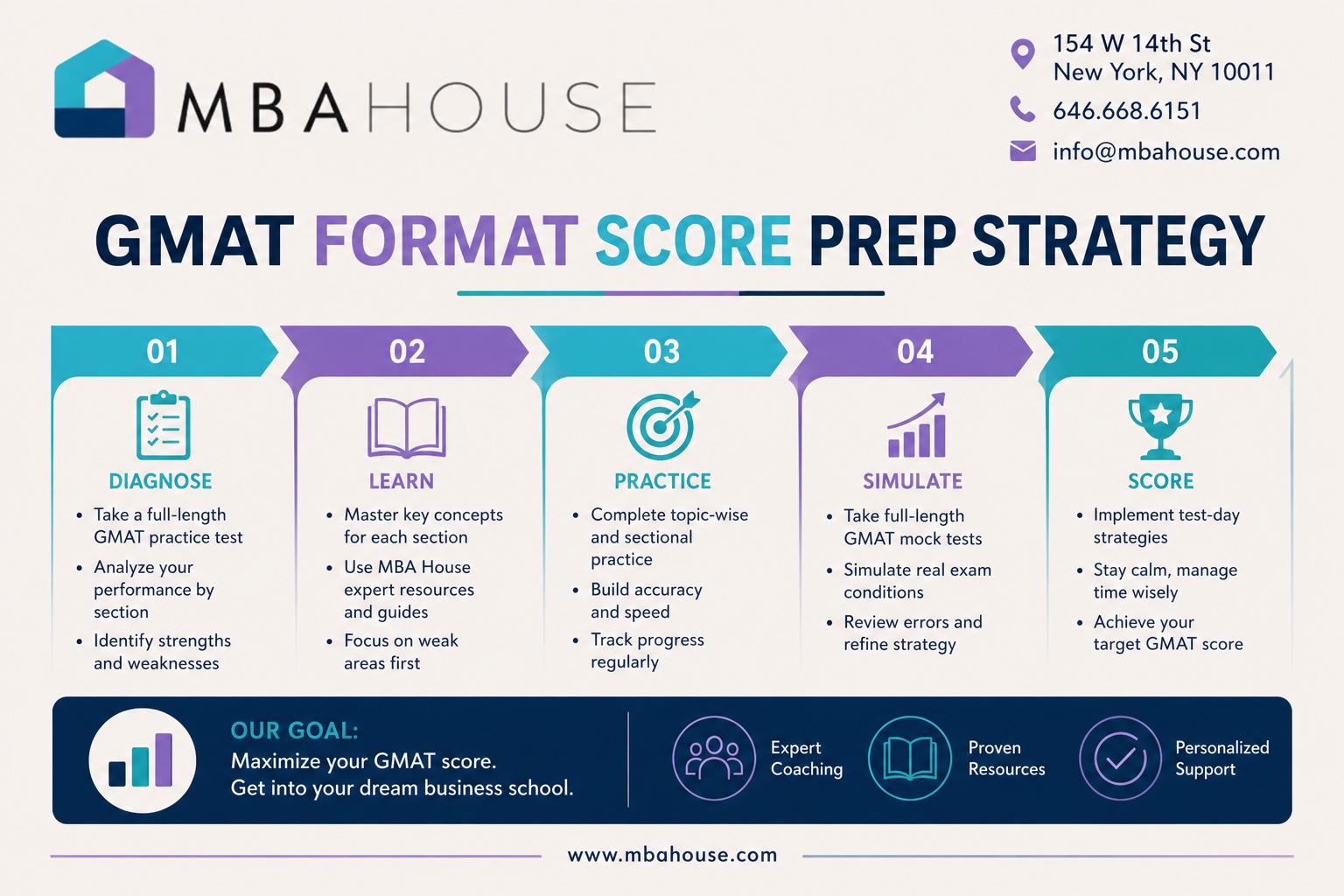
An efficient plan has four moving parts: a diagnostic to find your real starting point, focused content review on the topics that actually cost you points, timed practice that builds pacing and stamina, and full-length simulations that rehearse section order and the Question Review & Edit feature. Busy New York professionals rarely fail the GMAT for lack of effort — they stall because their study time is scattered. A GMAT NY tutor keeps the plan tied to your school list and your deadline so every hour counts. If your application strategy is still taking shape, a strong score also feeds directly into how you finance the degree and whether an admissions consultant makes sense for your profile.
Not sure if your target score is competitive for your dream school? Our NYC GMAT tutors can build a custom study plan around your timeline and schools.
How do business schools actually use your GMAT score?
It helps to remember what the score is for. Admissions committees read applications holistically, but the GMAT plays three specific roles. First, it is an academic-readiness signal: schools want evidence you can handle a quantitative, fast-paced curriculum, especially if your transcript is older, non-quantitative, or from an unfamiliar institution. Second, it is a comparability tool: a candidate from a boutique consulting firm and one from a national bank can be compared on the same percentile scale. Third, it influences class profile and rankings, which is part of why a score above a program's median can unlock merit money.
This is also why the GMAT is rarely a pure pass/fail gate. A score below a school's average does not automatically end your candidacy if the rest of your application is strong, and a high score does not guarantee admission if your story, recommendations, or essays are thin. The smartest applicants treat the GMAT as one lever among several — one they happen to control more directly than most. If you are weighing whether expert help is worth it, our guide on whether you need an MBA admissions consultant explains how score, story, and school list fit together.
Why updated, Focus-Edition prep matters
Because the exam changed so recently, a lot of free advice and even some paid courses still teach the retired format. Studying Sentence Correction rules, drilling geometry, or rehearsing the AWA essay is wasted effort on the current GMAT — and worse, it crowds out the section that now carries real weight: Data Insights. Preparing on outdated material can leave you confident about skills the exam no longer tests and unprepared for the ones it does.
Current prep means three things: practicing the exact three-section, 64-question format; treating Data Insights as a scored priority rather than an afterthought; and rehearsing the features that are genuinely new, including flexible section order and the Question Review & Edit option. MBA House rebuilt its GMAT NY curriculum around the Focus Edition for exactly this reason, so the hours you invest map cleanly onto the test you will actually sit. A focused, current plan is the difference between a score that decorates your application and one that changes your odds and your scholarship leverage.
Book a free strategy call if you want a practical plan for your school list, score strategy, application timeline, and financing or scholarship goals.
GMAT guide FAQs
Is the GMAT the same as GMAT Focus?
Yes. Many students still say GMAT Focus, but the current official exam is the Focus-style GMAT with Quantitative Reasoning, Verbal Reasoning, and Data Insights.
How long is the GMAT?
The current GMAT is 2 hours and 15 minutes of testing time, with three 45-minute sections and one optional 10-minute break.
What sections are on the GMAT?
The sections are Quantitative Reasoning, Verbal Reasoning, and Data Insights.
Can MBA House help me choose between GMAT and GRE?
Yes. MBA House can review your diagnostic scores, target schools, timeline, and admissions profile before recommending a test path.
What is the GMAT Focus Edition score scale?
The total score ranges from 205 to 805 in 10-point increments. Each section — Quantitative Reasoning, Verbal Reasoning, and Data Insights — is scored from 60 to 90, and all three count toward your total.
How much does the GMAT cost?
In the United States the GMAT costs about $275 at a test center and $300 online as of 2025–2026, with separate fees for rescheduling and extra score reports.
How many times can you take the GMAT?
Up to five times in a rolling 12-month period and up to eight times in your lifetime, counting test-center and online attempts together, with at least 16 days between attempts.
How long is a GMAT score valid?
Scores are valid for five years from the test date, so most applicants can use one strong score across more than one admissions cycle.
Can I take the GMAT at home or do I need a test center?
You can do either. The online and test-center exams share the same content and scoring. New York applicants can use Manhattan-area test centers or test online from home.
What is a good GMAT Focus Edition score?
It depends on your schools. Many top MBA programs see averages around 655 or higher (about the 90th percentile), while strong regional programs are competitive in the high-500s to low-600s.