
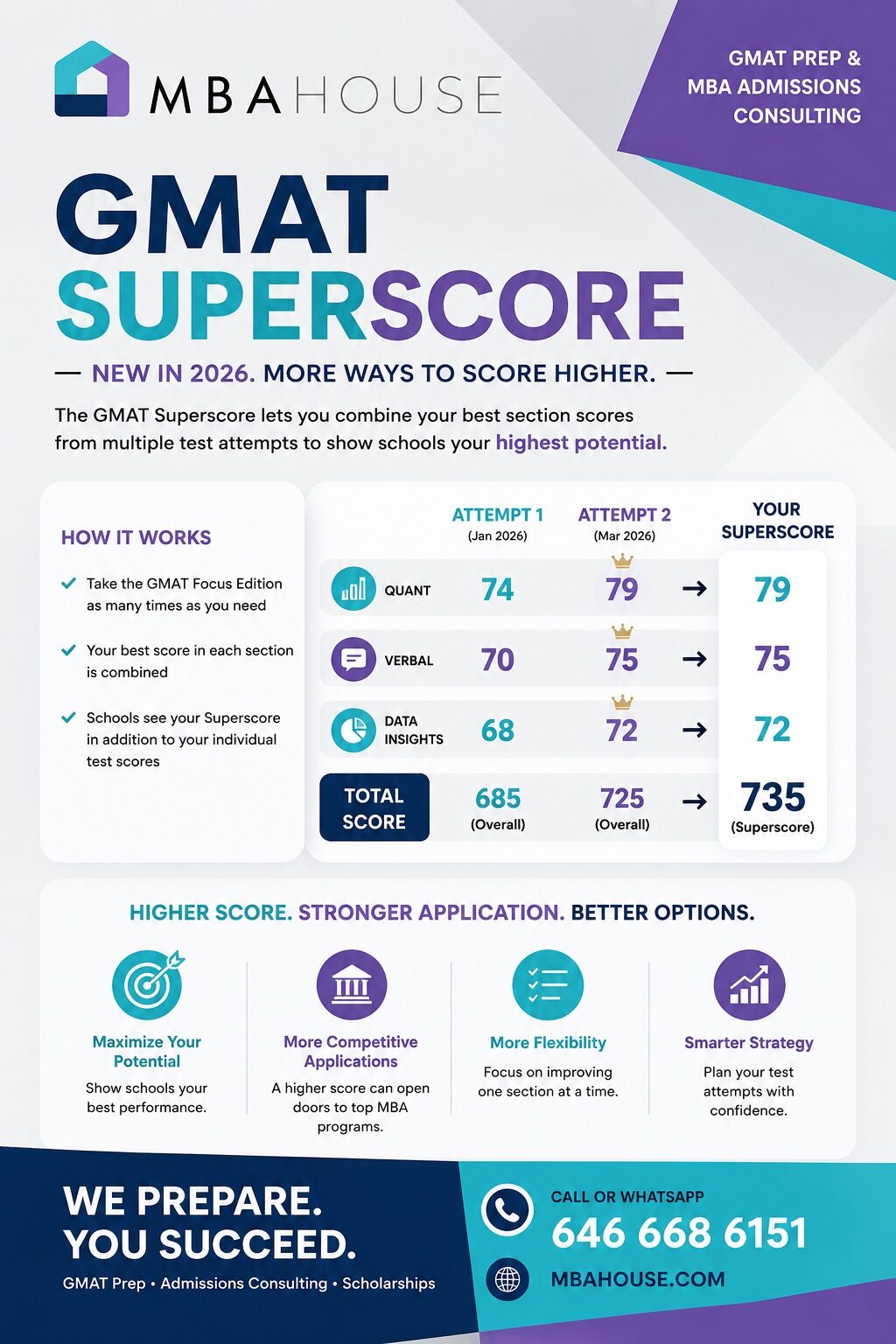
On June 15, 2026, the Graduate Management Admission Council (GMAC) announced the GMAT Superscore — a new feature that automatically combines a candidate's highest section scores across all valid GMAT Focus Edition attempts into a single, optimized total score on the 205–805 scale. The feature rolls out August 12, 2026, is free, cannot be opted out of, and appears on every Official Score Report sent to MBA programs. Superscoring is standard for the SAT and ACT — the GMAT is finally catching up. Historical GMAC data suggests candidates can gain 20–50 points vs. a single-sitting total (GMAC, ARINGO analysis).
If you're testing for Round 1 or Round 2 2026–2027, this changes your retake strategy. This guide covers every angle: exact mechanics, worked examples, school-by-school posture, how it stacks against SAT/ACT/TOEFL superscoring, and a targeted three-attempt playbook. For the fundamentals of the exam itself, start with our GMAT Focus overview.
What is the GMAT Superscore?
The GMAT Superscore is an official GMAC feature that automatically calculates a candidate's best aggregate performance across every valid GMAT Focus Edition attempt — whether taken at a test center or online. GMAC pulls the highest score you've ever earned in each of the three sections — Quantitative Reasoning, Verbal Reasoning, and Data Insights — and combines them into a new total on the 205–805 scale.
Three defining facts:
- No extra fee. The superscore is generated free of charge for every eligible test-taker.
- No opt-out. Every candidate with two or more valid Focus Edition attempts automatically receives one.
- Included on every Official Score Report sent to programs, alongside the single-sitting score you chose to send.
GMAC CEO Joy Jones framed the launch this way: "Very qualified candidates sometimes walk away from the testing process with less confidence than their abilities deserve, often because one section score or one testing experience doesn't tell the full story. GMAT Superscore is our commitment to helping make sure that persistence and preparation are always rewarded." (GMAC press release, June 15, 2026).
The GMAT Superscore applies only to the GMAT Focus Edition (the current exam, launched November 2023, scored 205–805). It does not combine scores from the retired Classic GMAT (200–800) with Focus Edition scores.
How GMAC calculates the superscore (with examples)
GMAC's algorithm is straightforward:
- Scan every valid, non-expired GMAT Focus attempt (scores are valid for 5 years).
- From each attempt, identify the candidate's section scores: Quant (60–90), Verbal (60–90), and Data Insights (60–90).
- Pull the highest score from each section, regardless of which sitting produced it.
- If two attempts produced identical highest section scores, use the score from the most recent attempt.
- Combine using GMAC's public formula: (Q + V + DI − 180) × (20/3) + 205, rounded to the nearest multiple of 5 ending in 5 (GMAT Club formula reference).
Worked example 1 — the "classic one weak section" story
A candidate takes the GMAT three times. Their section scores:
| Attempt | Date | Quant | Verbal | Data Insights | Total (single-sitting) |
|---|---|---|---|---|---|
| 1 | Feb 2026 | 84 | 78 | 80 | 645 |
| 2 | May 2026 | 82 | 85 | 79 | 655 |
| 3 | Aug 2026 | 81 | 82 | 87 | 685 |
| Superscore | — | 84 | 85 | 87 | 725 |
That candidate's best single sitting was 685. Their superscore is 725 — a 40-point boost, and 725 sits at the top 5% of test-takers (Target Test Prep percentiles).
Worked example 2 — the "already strong, still helps" story
A candidate who was strong from the start:
| Attempt | Date | Quant | Verbal | Data Insights | Total |
|---|---|---|---|---|---|
| 1 | Jan 2026 | 87 | 84 | 82 | 705 |
| 2 | Apr 2026 | 85 | 87 | 85 | 725 |
| Superscore | — | 87 | 87 | 85 | 735 |
Their best single sitting was 725. The superscore lifts them to 735 — a 10-point bump that pushes them past the median for M7 admits (GMAC Focus percentiles).
Worked example 3 — the "targeted retake" story
A candidate who identified a weak Data Insights section and retook with laser focus:
| Attempt | Date | Quant | Verbal | Data Insights | Total | Strategy |
|---|---|---|---|---|---|---|
| 1 | Mar 2026 | 88 | 83 | 74 | 685 | Full test |
| 2 | Sep 2026 | 82 | 81 | 84 | 675 | DI-only prep |
| Superscore | — | 88 | 83 | 84 | 715 | — |
Attempt 2's total was actually lower than Attempt 1. But because superscoring pulls only the best from each section, the retake's stronger DI score contributes and the weaker Q is ignored. Result: 30-point net gain with a targeted study block.
This is the crucial mental model: a lower section score on a retake cannot decrease your superscore. The floor is your prior best (ARINGO analysis).
GMAT Focus Edition section structure & percentiles
Before you strategize, know the underlying math. The Focus Edition has three equally weighted sections, each scored 60–90:
| Section | Questions | Time | Score Range | Score Interval | Standard Error of Measurement |
|---|---|---|---|---|---|
| Quantitative Reasoning | 21 | 45 min | 60–90 | 1 point | ±3 points |
| Verbal Reasoning | 23 | 45 min | 60–90 | 1 point | ±3 points |
| Data Insights | 20 | 45 min | 60–90 | 1 point | ±3 points |
| Total Score | 64 | 135 min | 205–805 | 10 points | ±30–40 points |
Source: GMAC Official Exam Scores.
Percentile snapshot (2020–2025 norm)
| Section Score | Quant %ile | Verbal %ile | Data Insights %ile |
|---|---|---|---|
| 90 | 100 | 100 | 100 |
| 85 | 89 | 96 | 99 |
| 80 | 66 | 60 | 86 |
| 75 | 35 | 19 | 51 |
| 70 | 14 | 4 | 24 |
| 65 | 4 | 1 | 8 |
| 60 | 1 | 0 | 4 |
Source: MBA Crystal Ball percentiles, GMAT Panda scoring guide.
Two things worth calling out for superscore strategy:
- Data Insights percentiles are the most forgiving at the top. An 84 in DI is 98th percentile — but an 84 in Verbal is only 91st. If you're already at 82+ in DI, don't burn a retake trying to squeeze one more point. Attack Verbal instead.
- Verbal has the steepest percentile curve. Moving from 80 → 85 in Verbal jumps you from the 60th to the 96th percentile — a 36-point percentile leap for just 5 raw points. This is often the highest-ROI section to retake.
Total score benchmark table
| Total Score | Percentile | Common target for |
|---|---|---|
| 805 | 100% | Perfect score |
| 745+ | ~99% | HBS, Stanford GSB, Wharton stretch |
| 705–745 | ~95% | M7 median range |
| 655–705 | ~85% | Top 20 competitive |
| 605–655 | ~70% | Top 40 competitive |
| 555–605 | ~50% | US News top 100 median |
| 505–555 | ~30% | Regional / part-time programs |
Sources: Target Test Prep, Career Launcher.
Rule of thumb from GMAT Club: on the Focus Edition, a 645 is the new 700 — the scale is compressed, so don't reflexively map old GMAT expectations onto Focus numbers (GMAT Club calculator). We unpack this in detail in our GRE-to-GMAT Focus score conversion guide.
Timeline: key dates every MBA applicant needs
| Date | Event | Why it matters |
|---|---|---|
| Nov 7, 2023 | GMAT Focus Edition launched (205–805 scale) | Only Focus Edition attempts count toward superscore |
| June 15, 2026 | GMAC announces GMAT Superscore | Public reveal; press release + FAQ published |
| Aug 12, 2026 | GMAT Superscore rolls out | Every Official Score Report sent from this date forward automatically includes the superscore |
| Sep 1, 2026 | Most M7 Round 1 deadlines open | First applications submitted with superscores attached |
| Sep–Oct 2026 | Round 1 deadlines close | Roughly 40% of M7 admits are made in R1 |
| Jan 2027 | Round 2 deadlines | Peak volume for MBA admissions |
| Apr 2027 | Round 3 deadlines | Highest-yield window for superscore benefit — three retakes possible before deadline |
Application deadlines source: GMAC and official school admissions calendars.
Practical implication: if you took the GMAT Focus once in April 2026 and got a 665, you have time for up to 4 more attempts (GMAC limits candidates to 5 attempts per rolling 12 months) before Round 2 — every one of them feeds your superscore.
GMAT Superscore vs. single best score — head-to-head
| Dimension | Single Best Score | GMAT Superscore |
|---|---|---|
| What it is | Total from your best single test day | Highest section scores combined across attempts |
| Which attempts count | One sitting | All valid Focus Edition sittings within 5-year validity window |
| Score range | 205–805 | 205–805 |
| Percentile shown | Yes | No |
| Cost | Free | Free |
| Auto-generated | Yes | Yes |
| Sent to schools | Yes, on Official Score Report | Yes, as additional data point on every Official Score Report after Aug 12, 2026 |
| Can it decrease with a retake? | Yes — you can send a lower sitting if you choose | No — a weaker section on retake cannot lower a superscore |
| Applicant-controlled | You pick which sitting to send | Automatic (cannot opt out) |
| Used for MBA rankings | Sometimes | Not yet — GMAC pursuing validity studies |
| Historical GMAC score lift vs. single best | — | 20–50 points typical |
Source: ARINGO, GMAC press release.
The 15 perks and 5 caveats of the GMAT Superscore
15 concrete perks
- Free of charge. GMAC absorbs the cost.
- Automatic — zero paperwork. You don't request it, submit a form, or opt in.
- Applies retroactively. Any Focus Edition attempts from November 2023 forward already count toward your superscore.
- Cannot go down. A weak section on a retake is discarded — your superscore only moves up.
- 20–50 point typical lift vs. a single best sitting, per GMAC's own historical modeling.
- Enables single-section targeted prep. Instead of re-studying all three sections for a full retake, focus 100% of your study block on your weakest section.
- Cuts retake anxiety. The mental cost of a retake drops dramatically when the downside is zero.
- Costs less than one-on-one tutoring. A targeted retake with home prep is lower-cost than endless full-test tutoring.
- Works for both test-center and online attempts. GMAC treats both formats as equal inputs.
- Displayed in your mba.com account. You can see your live superscore before deciding what to send.
- Shown alongside a single-sitting score on the report. Schools that prefer traditional single-sitting evaluation still see it.
- Signals persistence to admissions committees. Cornell Johnson's admissions director Eddie Asbie called it a way to "approach retesting more strategically" — a positive signal, not a red flag (GMAC).
- Rebalances the exam's inherent variance. GMAC's standard measurement error is ±30–40 points on the total.
- Helps re-applicants. If you're reapplying, a higher superscore is a clean way to show measurable improvement.
- Reduces the peak-testing-day pressure. You no longer need everything to click on one 135-minute morning.
5 real caveats to know before you plan
- Elite programs may still weight single-sitting. ARINGO notes that historically, many M7 and Top 20 schools refused ETS MyBest for TOEFL.
- Score inflation risk. As average superscores rise across the applicant pool, competitive bars will rise.
- Pay-to-play bias. Superscoring rewards candidates who can afford multiple attempts and take time off work to prep.
- No percentile shown for the superscore itself. Interpretation is harder for admissions committees.
- Only applies to Focus Edition. Classic GMAT attempts do not feed a superscore.
Which MBA programs accept the GMAT Superscore?
As of the June 2026 announcement, no top program has formally rejected the superscore, and one — Cornell Johnson — has publicly endorsed it via a statement from admissions director Eddie Asbie (GMAC).
Because the superscore appears on the Official Score Report regardless of school policy, adcoms will see it whether they want to or not. The practical question is which schools will formally evaluate on it vs. those that will note the superscore but weight the single sitting.
Expected posture by program tier (mid-2026 projections)
| Tier | Programs | Expected 2026–2027 posture on GMAT Superscore |
|---|---|---|
| M7 endorsers | Cornell Johnson | Full acceptance, evaluated as primary data point |
| M7 likely to accept | HBS, Stanford GSB, Wharton, Booth, Kellogg, Columbia, MIT Sloan | Will accept; internal weighting mix of superscore + best single sitting |
| Top 10 non-M7 | NYU Stern, Yale SOM, Duke Fuqua, Michigan Ross, UVA Darden, UC Berkeley Haas | Broad acceptance expected |
| Top 20 US | UNC Kenan-Flagler, UT Austin McCombs, USC Marshall, Emory Goizueta, CMU Tepper, Georgetown McDonough, Vanderbilt Owen, Notre Dame Mendoza, Washington Foster | Likely acceptance; some may explicitly prefer single-sitting |
| European top 10 | INSEAD, LBS, IESE, IE, HEC Paris, IMD, Oxford Saïd, Cambridge Judge, ESADE, Bocconi | Historically test-flexible — likely early adopters |
| Asian top 10 | INSEAD Singapore, CEIBS, HKUST, NUS, ISB, Nanyang | Fast adoption expected |
| Part-time / EMBA | Wharton EMBA, Kellogg EMBA, Columbia EMBA, Booth Weekend/Evening | Very likely to embrace |
How to check a specific school: After August 12, 2026, every top MBA program's admissions website is expected to publish a superscore policy statement. Until then, assume acceptance as a data point, but continue targeting a strong single-sitting score for the actual send. If you're focused on New York programs, our guides on getting into NYU Stern and Columbia Business School walk through how each reads test scores.
The 3-attempt superscore playbook
Here's the practical retake framework we use with MBA House / GMAT NY clients. It pairs naturally with the way we think about the whole application in our GMAT and MBA admissions strategy guide.
Attempt 1 — Baseline
Timing: 3–4 months of prep, take by March–May of your application year.
Goal: Score your target total in one sitting. Don't plan on a retake — plan to hit your goal.
Why: The best superscores start with a strong Attempt 1 baseline. Every section score you produce here becomes the floor.
Study allocation: ~35% Quant, ~35% Verbal, ~30% Data Insights.
Attempt 2 — Targeted retake on weakest section
Timing: 4–6 weeks after Attempt 1.
Trigger: Your Attempt 1 has one section that's a clear outlier — usually the section 5+ points below your other two.
Study allocation: ~85% on the weakest section, ~15% general timing/stamina drills.
Downside: Zero. Weaker scores in your two already-good sections cannot decrease your superscore.
Realistic gain: 3–7 points in the targeted section, translating to a ~20–40 point superscore lift.
Attempt 3 — Second targeted retake
Timing: 6–8 weeks after Attempt 2, at least 30 days before your Round 1 or Round 2 deadline.
Trigger: After Attempt 2, one of two conditions still holds:
- Your Data Insights is under 80.
- Your Verbal is under 82.
Study allocation: 90% on whichever section is now the outlier. If that section is Data Insights, our Data Insights tutor NYC page explains how we attack it.
Cutoff rule: If Attempt 3 doesn't move your target section by at least 3 points, stop. You've hit your practical ceiling. Focus on essays.
Prep budget benchmark
| Item | Cost | Notes |
|---|---|---|
| GMAT Official Guide bundle | ~$80 | Baseline problem set for all three sections |
| One targeted prep course | ~$400 | Example: an MBA House Data Insights sprint |
| Three exam registrations | ~$900 | GMAT Focus Edition is about $275 per attempt in the US |
| Total | ~$1,380 | vs. full retake tutoring packages that can cost more |
At MBA House, our targeted single-section retake sprints are built exactly for this playbook — 6 weeks, one section, score-report readiness. Book a free 30-minute strategy call on our contact page.
Not sure which section to retake for the biggest superscore lift? Bring your section-by-section score history to a free strategy call and our Union Square team will map the highest-ROI retake for your target schools.
Common mistakes that waste the superscore advantage
- Not studying at all between attempts. A retake without prep is a coin flip.
- Trying to re-peak all three sections in one retake. Full re-prep makes less sense when superscoring lets you target one section at a time.
- Waiting too long between attempts. Ideal spacing is 4–8 weeks.
- Ignoring Data Insights. Many candidates leave 3–5 easy points on the table because they treat DI as the leftover section.
- Sending Attempt 1 only, out of principle. GMAC includes the superscore automatically once it is live.
- Retaking after a low sitting for revenge. Retake only when your data shows a clear weak section and you have a plan to move it.
- Assuming your school won't count the superscore. Even schools that don't formally evaluate on it will see it.
- Forgetting the 5-attempt rolling limit. Plan your retakes so you don't burn attempts on impulse.
Frequently asked questions
When does the GMAT Superscore launch?
The GMAT Superscore rolls out August 12, 2026. Every Official Score Report sent from that date forward automatically includes the superscore as an additional data point, alongside the single-sitting score the candidate chose to send (GMAC).
Does the GMAT Superscore cost extra?
No. The superscore is generated automatically and included on Official Score Reports at no additional cost. Standard GMAT registration fees still apply per attempt (GMAC).
Can I opt out of the GMAT Superscore?
No. Every candidate with two or more valid GMAT Focus Edition attempts automatically receives a superscore, and it appears on every Official Score Report (ARINGO).
Does the superscore apply to the Classic GMAT?
No. It applies only to the GMAT Focus Edition, scored 205 to 805 and launched November 2023. Classic GMAT attempts are not combined with Focus attempts.
How is the GMAT Superscore calculated?
GMAC takes the highest section score from each of your valid GMAT Focus attempts — Quantitative Reasoning, Verbal Reasoning, and Data Insights — and combines them using the formula: (Q + V + DI − 180) × (20/3) + 205, rounded to the nearest multiple of 5 ending in 5.
Which business schools accept the GMAT Superscore?
As of the June 15, 2026 launch, Cornell Johnson has publicly endorsed the superscore. No top program has formally rejected it, and by 2027 most M7 and Top 20 programs are expected to accept it as at least a supporting data point. Because the superscore appears on every Official Score Report by default, admissions committees see it regardless of formal policy.
Can a retake lower my GMAT Superscore?
No. A lower section score on a retake is discarded — GMAC uses only your highest section score across all valid attempts. The superscore's floor is your prior best in each section (ARINGO).
How many times can I take the GMAT to build a superscore?
GMAC allows 5 attempts per rolling 12 months and 8 total lifetime attempts of the Focus Edition. Most candidates need only 2–3 attempts to maximize their superscore.
How much does the GMAT Superscore typically raise my total score?
GMAC historical data suggests candidates gain 20–50 points on the 205–805 scale when comparing their superscore to their best single sitting. The exact lift depends on how uneven your sitting-to-sitting section performance has been (ARINGO analysis).
Is the GMAT Superscore percentile-ranked?
The superscore total is displayed without a separate percentile — GMAC reports percentiles only for the underlying single-sitting section scores. Rough percentile mapping: 705 ≈ 95th percentile, 745 ≈ 99th percentile (Target Test Prep).
Do MBA rankings use the superscore?
Not yet. Ranking publications historically use school-reported median GMAT scores of admitted classes, based on the score sent to each school. GMAC has committed to validity studies with business schools to explore whether the superscore predicts academic success as well as single-sitting scores (GMAC).
Should I take the GMAT online or at a test center for superscoring purposes?
GMAC treats both formats identically for superscoring — highest section scores from either format count equally. Choose whichever format you personally perform best in.
How does the GMAT Superscore compare to SAT superscoring?
Both combine highest section scores across multiple attempts, both are free and automatic, and both were designed to reward persistent test-takers. SAT superscoring has been broadly accepted by US colleges since 2019, and industry analysts expect GMAT Superscore adoption to follow a similar 3–5 year curve (GMAC, PrepScholar SAT guide).
When does a GMAT Focus score expire?
Focus Edition scores are valid for 5 years from the test date. Any attempt within that window counts toward your superscore.
Where can I get help planning my GMAT retake strategy for the superscore?
MBA House / GMAT NY runs targeted single-section retake sprints designed for the superscore era from our Union Square location in Manhattan. Book a free strategy call on our contact page or call (646) 668-6151. If you want a dedicated tutor, start with our GMAT Focus tutor NYC page.
GMAT vs. SAT vs. ACT vs. TOEFL superscoring
Undergraduate testing has offered superscoring for years. The GMAT is finally aligning. Here's how the systems compare:
| Feature | GMAT Superscore | SAT Superscore | ACT Superscore | TOEFL MyBest Scores |
|---|---|---|---|---|
| Launched | Aug 2026 | 2019 | 2020 | 2019 |
| Governing body | GMAC | College Board | ACT Inc. | ETS |
| Sections combined | Quant, Verbal, Data Insights | Math, Evidence-Based Reading & Writing | English, Math, Reading, Science | Reading, Listening, Speaking, Writing |
| Score range | 205–805 | 400–1600 | 1–36 | 0–120 |
| Test window for combining | 5-year validity | Any past SAT | Any past ACT since Sept 2016 | 2-year validity |
| Cost | Free | Free | Free | Free |
| Automatic on score report? | Yes | Colleges request from student | Yes | Yes |
| Opt-out available? | No | Effectively yes | Yes | No |
| Accepted by top programs? | Rolling — TBD | ~85% of US colleges | ~60% of US colleges | Elite programs historically resistant |
| Documented score lift | 20–50 points | ~30–50 points | ~1–2 composite points | ~3–8 points |
Sources: College Board / PrepScholar SAT superscoring, ACT superscoring, ETS TOEFL MyBest.
The most important pattern: in every prior case, superscoring has become an accepted standard within 3–5 years of launch. Even TOEFL's MyBest — initially rejected by many M7 and Top 20 programs — is now broadly accepted at the master's level. Expect a similar trajectory for the GMAT Superscore.
Sources and further reading
- GMAC — GMAT Superscore official announcement
- GMAC — Official Focus Edition exam scores & scoring
- ARINGO — The New GMAT Superscore: What MBA Applicants Need to Know
- Target Test Prep — GMAT Focus scoring system
- GMAT Club — Focus Edition score calculator + formula
- MBA Crystal Ball — GMAT percentile tables
- GMAT Panda — How GMAT Focus scoring works
About the author
This guide was written by the MBA House / GMAT NY team. We prep MBA applicants for the GMAT, GRE, TOEFL, and IELTS from our Union Square location in Manhattan (154 W 14th Street), and consult on admissions to M7 and Top 20 programs. Book a free 30-minute strategy call on our contact page · Call: (646) 668-6151.