
The mistake: treating the GMAT as a separate project
Many applicants start with a simple goal: get the highest score possible, then think about essays later. That sounds disciplined, but it can waste months if the score plan is not tied to the schools, rounds, scholarships, and career story you are actually pursuing. The GMAT is expensive in the one currency busy professionals cannot get back — time — and time spent on the wrong target is time stolen from essays, recommenders, and school research.
A candidate aiming for a highly quantitative program, a scholarship-heavy strategy, or a school list with aggressive medians may need a very different test plan than a candidate with strong academic proof and a tight application deadline. The score is not just a number. It is one piece of the admissions argument, and its job changes depending on what the rest of your application already proves.
The schools themselves frame the application as an integrated whole rather than a stack of independent parts. Wharton's application guide, for example, shows how transcripts, the GMAT or GRE, your resume, essays, and recommendations are reviewed together as a single case (Wharton MBA application guide). If admissions committees read your file as one argument, it makes little sense to build the pieces in disconnected silos.
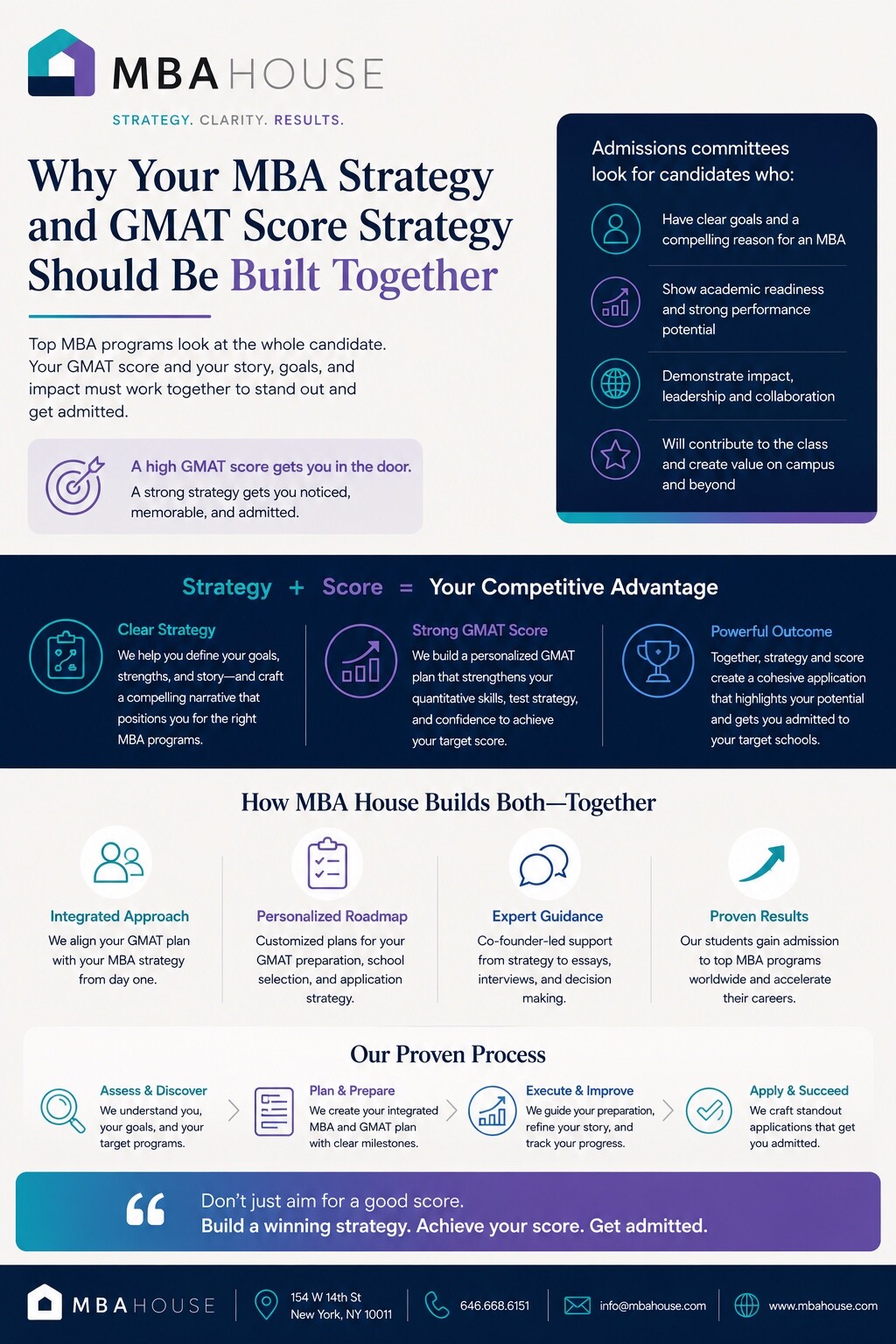
What an integrated GMAT and admissions strategy changes
When the score plan and the school plan are built together, every week has a clearer purpose. You always know whether the next best move is another Quant push, a Data Insights reset, a test-date change, a school-list adjustment, a resume rework, or a waiver conversation. The plan stops being "study more" and becomes a sequence of decisions, each one informed by the others.
- Target schools: Your school mix tells you how much score pressure you are really carrying, and where the median you are chasing actually sits.
- Scholarship goals: A stronger score can matter even when a school might admit you without one, because merit aid often rewards applicants above the class median.
- Application timing: Round 1, Round 2, and rolling programs each demand different test-risk decisions and different points of no return.
- Career story: If your resume already proves analytical strength, the test has a different job than if your transcript is lighter in quantitative work.
- Risk profile: The single weakest part of your application should usually decide where your effort goes next — and that weak spot is rarely obvious without an honest audit.
Our strategy calls look at your score history, target schools, professional profile, transcript context, and application timing together. The output is not just "study more." It is a practical, prioritized next-step map that tells you what to do this month and what to leave alone.
Start with an audit, not a study plan
The first move in a coordinated strategy is diagnosis, not action. Before you book a tutor or open an essay document, you need an honest read on what your application has to prove and where it is currently weakest. MBA House calls this the application audit, and it is the foundation for every downstream decision.
An audit answers a small set of high-leverage questions. What is the realistic range of your current profile? Which schools are reaches, targets, and likely admits given your goals? Is the GMAT your binding constraint, or is it a transcript gap, a vague career goal, or a recommender problem? Is a retake worth the weeks it will cost, or would those weeks do more good on essays? Answering these in the right order is what separates a strategy from a to-do list.
The reason diagnosis comes first is simple: effort spent on a strength rarely changes an outcome, while effort spent on the binding constraint almost always does. An applicant with a 705 and a thin career narrative does not need a 735 — they need a sharper story. An applicant with a compelling story and a 615 at schools with a 690 median has a clear, measurable gap to close. Same effort, opposite priorities, and only an audit tells you which case you are in.
How your target score connects to your school list
Target scores should be set backwards from the schools you actually want, not chosen as a round number in the abstract. The practical anchor is each program's published class median: a score at or above the median tends to strengthen both your admission odds and your scholarship leverage, while a score well below it usually needs either a deliberate retake plan or a recalibrated list. The table below shows how the same raw score can be a strength or a liability depending entirely on where you are aiming.
| Your situation | What the score has to do | Likely next move |
|---|---|---|
| Score at/above target medians | Confirm readiness; protect scholarship leverage | Shift effort to essays, resume, recommenders |
| Score 20–40 points below median | Close a measurable, closeable gap | Targeted retake plan with a hard deadline |
| Score far below median, deadline close | Decide whether the score is even strategic this round | Recalibrate list, consider a later round or waiver |
| Strong score, weak narrative | Stop chasing points it cannot fix | Reposition story; freeze the test |
| Quant-light transcript | Provide the analytical signal the transcript lacks | Prioritize Quant + Data Insights |
This is why a generic "aim as high as you can" goal is misleading. A 735 is a poor use of three extra months if a 705 already clears your list and your essays are the real risk. Conversely, settling for a score under your targets' medians to save time can quietly cap your scholarship potential. The right number is the one your specific school list and aid goals demand — no more, no less.
Scholarships: where the score and the application meet
Merit scholarships are the clearest place where score strategy and admissions strategy stop being separate questions. Schools use aid to attract applicants who lift their reported averages, so a score above the class median frequently translates into negotiating leverage and merit dollars. That makes the GMAT a financial lever, not just an admissions one — a point we develop in our guide to how to get MBA scholarships.
The math can be decisive. A few extra weeks of focused prep that move you from just below a median to comfortably above it can be the difference between full-pay and a partial or full ride — a swing measured in tens of thousands of dollars against the program's total cost. When you frame the GMAT this way, the question "is another retake worth it?" becomes a return-on-investment calculation rather than a willpower test. Sometimes the honest answer is yes precisely because of the scholarship upside; sometimes it is no, because the aid you would unlock does not justify the time. Either way, you cannot answer it without looking at the score and the money together.
Diagnosing applicant risk before you commit months
Every application has a single weakest link, and admissions committees tend to read to it. Left unaddressed, a weak spot becomes a silent rejection: the reader fills in the blank unfavorably and moves on. A coordinated strategy starts by naming that risk honestly, then deciding whether the GMAT, the essays, the school list, or the recommenders is the right tool to manage it.
- Academic-readiness risk: a lower GPA or a quant-light transcript. Here a strong GMAT — especially Quant and Data Insights — does real work, and the test is genuinely strategic.
- Narrative risk: a vague "why MBA," a career pivot that is not yet explained, or essays that list jobs instead of decisions. More points will not fix this; story work will.
- List risk: a school list that is all reach with no realistic targets. The fix is calibration, not effort.
- Timing risk: deadlines that no longer leave room for a retake. The fix is a round decision, not another practice test.
- Recommender risk: letters that will praise without evidence. The fix is recommender selection and briefing, long before the deadline.
If you are still deciding whether you need outside help to diagnose any of this, our piece on whether you need an MBA admissions consultant walks through who benefits most — and who is usually fine without.
We look at score history, target schools, timeline, transcript context, and profile goals before recommending whether your next step should be GMAT Focus prep, admissions work, or a combined plan. Naming the binding constraint first is what keeps the plan honest.
When to combine GMAT prep and admissions consulting
Not every applicant needs both at once. The combination earns its value in specific situations — and recognizing yours saves you from either over-investing or leaving a gap unmanaged.
Combine the two when your school list is genuinely competitive, when your timeline is tight enough that a score decision and an essay decision compete for the same weeks, when your profile has a weakness that needs framing, or when scholarships are a priority. In each of these cases, the test decision and the application decision are not really separate — they are the same decision viewed from two angles, and splitting them across two providers who never talk to each other produces duplicated effort and contradictory advice.
You may not need the full combination if your profile is strong and conventional, your targets are flexible, your score already clears your list, and you write well. In that case, disciplined GMAT prep plus a self-managed application can be enough. The honest version is that the integrated plan is a tool for managing complexity and risk, not a default everyone must buy.
Why this matters for busy NYC professionals
Most applicants do not have unlimited evenings. If you work in finance, consulting, tech, real estate, healthcare, or a startup, your plan has to survive late nights, travel, and unpredictable weeks. The right strategy tells you what to protect and what to stop doing, because the real constraint is rarely ability — it is calendar.
For some candidates, the fastest path is a six-week GMAT Focus sprint with live classes and private tutoring — the same approach we describe for choosing a GMAT Focus tutor in NYC. For others, the first move is school selection, resume positioning, or a test-choice decision. A one-size-fits-all study plan ignores the thing that actually breaks applications for working professionals: time pressure that arrives all at once in the final weeks.
New York adds its own texture. Round 1 deadlines at Columbia Business School and NYU Stern often land in the busiest stretch of the professional calendar, and many local applicants are targeting exactly those programs. A plan that maps test dates and essay drafts against your real work weeks — rather than an idealized study schedule — is what keeps a strong candidate from submitting a rushed file. We go deeper on this in our NYC GMAT and MBA admissions guide.
Local and online: the same integrated plan, either way
The integrated approach is not limited to people who can walk into a classroom in Manhattan. MBA House works with applicants in person at its New York location and remotely with applicants across the country. The audit, the GMAT Focus instruction, the essay reviews, and the interview prep all run online when they need to, so an out-of-town applicant gets the same coordinated plan as a local one.
That flexibility matters because the value of the model is the coordination, not the room. Whether your strategy call happens across a table on West 14th Street or over video from another time zone, the point is the same: one team that can see your score path and your application path at once, and adjust either when the data changes.
Essays, recommenders, and interviews in a connected plan
Once the score's job is clear, the rest of the application has to carry the argument the number cannot. This is where most of the human judgment lives, and where a connected plan pays off — because each piece is built knowing what the others already prove.
Essays. Good essays answer the actual prompt and replace job descriptions with decisions, impact, and growth. MBA.com frames the essay as the applicant's chance to get beyond GPA and test numbers and reveal something deeper (MBA.com essay and interview advice). When the score already proves analytical readiness, the essays are freed to do the work only they can do: explain the "why" behind a pivot, a goal, or a value. When the score is shakier, the essays may need to acknowledge and reframe an academic weakness rather than ignore it.
Recommenders. Letters fail most often by praising without evidence. Choosing the right recommenders and briefing them early — so their stories reinforce rather than repeat your essays — is a scheduling and strategy task that has to start months before the deadline, not a box checked at the end.
Interviews. Interviews are not a formality. Harvard Business School describes the interview as a roughly 30-minute conversation with an admissions board member who has read your file, treated as one element among many in the final review (HBS application process). The spoken version of your story has to match the written one; preparation is about coherence under questioning, not memorized answers.
For a deeper look at how these admissions components fit together, see our MBA admissions consulting overview and our breakdown of what NYC applicants should look for in a consultant.
How to build the combined plan
The sequence matters as much as the components. Building in the wrong order is how applicants end up drafting essays before they know their school list, or grinding for points the application never needed. A workable order looks like this:
- Start with your admissions objective. Identify target programs, application round, career goal, and scholarship priority before anything else.
- Run an honest audit. Name the single weakest part of the application and decide whether the GMAT is your binding constraint or a distraction from it.
- Diagnose the score gap. Separate content gaps from timing, accuracy, and test-choice problems, and measure the gap against your targets' medians.
- Choose the right test path. Decide whether GMAT Focus, GRE, Executive Assessment, or a waiver best supports the total application — our GMAT Focus explainer covers how the exam's Quant, Verbal, and Data Insights sections are structured.
- Map the work backwards. Put classes, tutoring, practice exams, essay drafts, recommender briefings, and interview prep on one timeline anchored to your deadlines.
- Review weekly. Adjust the school list, test date, and package level as real performance data comes in, and stop work on anything that has stopped moving the outcome.
Schedule a free 30-minute strategy call to map your score target, school list, timeline, and scholarship goals into one plan. In-person sessions are available at MBA House in New York; remote consultations are available nationwide.
Combined plan vs. separate silos: a realistic comparison
Both approaches can technically work, but they fail in different ways. Running the test and the application as separate projects is cheaper to start and easier to schedule, and it is fine when the two genuinely do not interact. A single coordinated plan costs more attention up front but removes the duplicated and contradictory decisions that quietly cost applicants weeks.
| Factor | Combined plan | Separate silos |
|---|---|---|
| Score target | Set from school medians and aid goals | Chosen in the abstract |
| Effort allocation | Directed at the binding constraint | Often spent on a strength |
| Timeline | One calendar, deadline-anchored | Two calendars that collide late |
| Retake decisions | Weighed against essays and rounds | Made in isolation |
| Scholarship leverage | Actively engineered | Left to chance |
| Best for | Competitive lists, tight timing, profiles with risk | Strong, conventional profiles with flexible targets |
What makes MBA House different
MBA House connects admissions consulting with GMAT strategy under one roof. That matters because score decisions, school choices, scholarship goals, and application timing are linked. A consultant who ignores the test plan may miss the academic-readiness question entirely; a tutor who ignores admissions may chase points that never change the outcome. When the same team understands both, a retake is weighed against your list and your deadlines, an essay theme is chosen knowing what your score already proves, and your targets are calibrated to where your whole profile — not one number — is competitive.
The approach is boutique and audit-driven. We help with the personal statement, school-specific essays, resume, recommendations, interview training, and online applications, while keeping the full score and admissions strategy connected from day one. For applicants comparing options, our look at MBA House versus other test-prep providers explains what the integration adds in practice.
The takeaway
GMAT Focus prep and MBA admissions consulting should not compete for your attention. They should make each other smarter. When one team understands both the score path and the application path, you make fewer isolated decisions, waste fewer weeks, and move faster toward a stronger, more coherent application. Start with the audit, set the score target from your real school list, manage your weakest link deliberately, and build everything on a single deadline-anchored timeline. If you want that plan mapped for your profile, the next step is a conversation.
Book a free strategy call if you want a practical plan for your school list, score strategy, application timeline, and financing or scholarship goals. Bring your target schools, timeline, transcript context, and score history.