
Getting into Columbia Business School is hard, but it is not random. The applicants who get rejected are rarely the ones with low scores — they are the ones whose applications never cohere into a clear, Columbia-specific story. CBS practices genuinely holistic admissions: there is no published minimum GMAT, no minimum GPA, and no single number that admits or rejects you. The Class of 2026 enrolled 972 students from 7,487 applications, an implied acceptance rate of approximately 20–21% (CBS does not publish an official figure). What separated the admits was not raw scores; it was the way their academic ability, professional trajectory, leadership, and — critically — their fit with Columbia's New York-anchored, "very fingertips of the business world" culture combined into one answer: why this person, why Columbia, and why now?
This guide walks through every component of a winning CBS application using current, source-attributed data: the admissions criteria, the full Class of 2026 profile, GMAT Focus / classic GMAT / GRE / Executive Assessment score strategy, the short answers and three essays, the single recommendation, the résumé and employment history, the blind interview, the NYC and entrepreneurship advantages, scholarships and financial aid, the true cost of attendance, employment outcomes, how Columbia compares with Harvard, Wharton, and NYU Stern, the most common applicant mistakes, and a 12/6/3-month timeline. MBA House — known to New York applicants as GMATNY — has spent years helping candidates turn raw credentials into admitted applications, and this is the strategy we use. If you want to pressure-test your own profile, you can book a free strategy call at any point, and if you are still deciding whether the degree is right for you at all, start with our overview of what an MBA is.
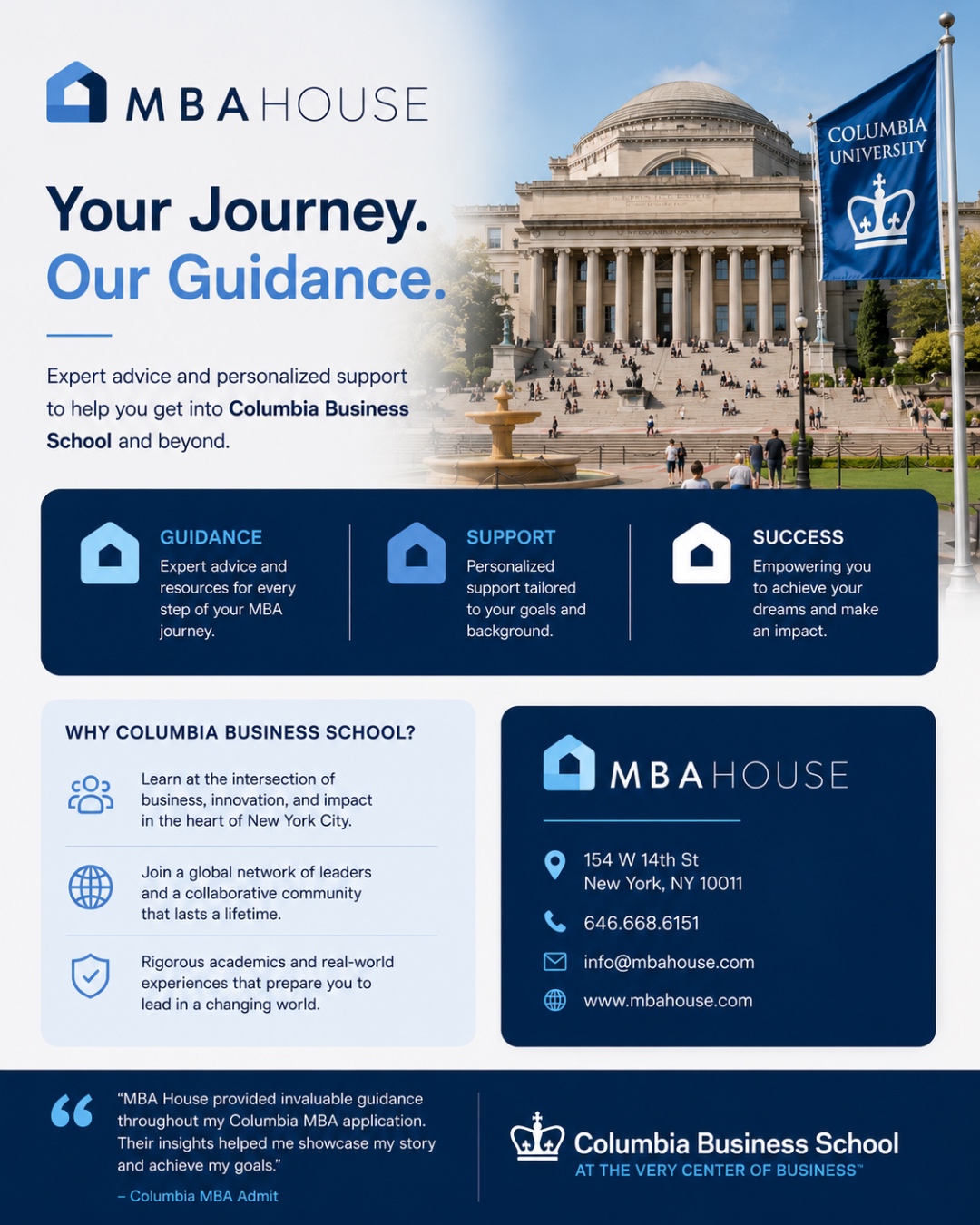
Why Columbia Business School? The NYC Edge and the M7 Pedigree
Columbia Business School is one of the original M7 schools, and its single biggest differentiator is geography. CBS does not just happen to be in New York — it is built around New York. Wall Street, the world's deepest venture and private-equity ecosystem, global media, luxury retail, and Fortune 500 headquarters are not a flight away; they are a subway ride away. Executives-in-residence, adjunct faculty who run real funds, and guest speakers who lead public companies are a constant feature of the calendar precisely because they can be on campus over lunch. For applicants who want to recruit hard in finance, consulting, or tech-in-NYC, that proximity is a structural advantage that no amount of programming elsewhere fully replicates.
The Manhattanville Campus and Access to Industry
CBS moved into its purpose-built campus at Columbia's Manhattanville development in 2022 — Henry R. Kravis Hall and David Geffen Hall — giving the school modern space designed for collaboration in the middle of Manhattan. The campus matters less as architecture than as logistics: it keeps students inside the city's professional bloodstream. When CBS describes itself as being "at the very center of business," it is describing a recruiting and networking reality, not a slogan. If your goals depend on being physically present in the New York market — for coffee chats, for club events with visiting executives, for internships you can start before the summer — Columbia's location is doing real work for your career.
August Entry vs. January Entry (J-Term): Which Is Right for You?
Columbia is unusual among top programs in offering two entry points, and choosing correctly is a genuine strategic decision rather than a scheduling footnote. August entry is the traditional, roughly 20-month MBA that includes a summer internship between the first and second years — the right choice for career switchers who need that internship to break into a new industry or function. January entry (J-Term) is an accelerated, roughly 16-month program that skips the summer internship; J-Term students complete second-semester coursework over the summer instead. About 70% of the class enters in August and 30% in January.
J-Term is purpose-built for a specific candidate: someone who does not need a summer internship to pivot. That includes applicants continuing in the same industry, sponsored employees returning to their firm, family-business successors, and — explicitly — entrepreneurs who would rather spend the summer building than recruiting. If you choose J-Term, the short-answer prompt asks directly why you prefer it, and a vague answer is a red flag. Choose the entry term that matches your career logic, then make that logic obvious in the application.
The Cluster System: Community at Scale
A class of nearly 1,000 students could feel anonymous, so Columbia organizes the first year into clusters — cohorts of roughly 65–70 students who take their core curriculum together. The Class of 2026 was organized into 14 clusters (10 for August entry, 4 for January). The cluster becomes your built-in study group, social anchor, and first professional network, and it is the mechanism by which CBS delivers small-school intimacy inside a large-school brand. For the application, the takeaway is cultural: CBS is screening for people who will contribute to a tight community, not just consume a credential. The "relationship builder" trait the adcom prizes is operationalized in the cluster, and your essays should signal that you will add to it.
What is the Columbia MBA acceptance rate? Columbia Business School's implied acceptance rate is approximately 20–21%. The Class of 2026 enrolled 972 students from 7,487 applications, across 14 clusters. CBS does not publish an official acceptance rate, so this is a derived figure — best described as "roughly one in five applicants."
Columbia MBA Class Profile (Class of 2026)
The class profile is the clearest picture of who actually gets in, and it is the benchmark every applicant should measure against honestly. The figures below come from Columbia's own reporting.
Class Size and Application Volume
For the Class of 2026, CBS received 7,487 applications and enrolled 972 students — 734 in the August-entry class (10 clusters) and 238 in the January-entry class (4 clusters). That implied acceptance rate of roughly 20–21% places Columbia among the most selective programs in the world, though it is meaningfully less selective than Harvard's ~10%. You can review the official numbers on the CBS Class Profile page, which Columbia updates annually.
GMAT and GRE Score Ranges
Here is where applicants most often misread the data, so be precise. Because Columbia accepts both the classic GMAT (10th Edition) and the GMAT Focus Edition — two exams scored on different scales — the class profile reports two separate averages, and you must not average or conflate them.
| Test metric (Class of 2026) | Average | Range |
|---|---|---|
| GMAT Classic (10th Edition) | 732 | 600–780 |
| GMAT Focus Edition | 690 | 615–805 |
| GRE Verbal | 162 | 146–170 |
| GRE Quantitative | 162 | 143–170 |
| Undergraduate GPA | 3.6 | — |
The published GMAT Classic range of 600–780 reflects the full admitted class, including recruited diversity, international, and special-profile admits. The operative competitive benchmark for most applicants sits well inside that band — think 700+ on the Classic and 680+ on the Focus Edition. Treat the bottom of the range as the exception, not the target.
GPA Expectations
The average undergraduate GPA is 3.6 on a 4.0 scale. As with the test score, there is no published minimum, and a GPA below the average is survivable if the rest of your file is strong — especially if you can demonstrate quantitative ability through your test score, MBA Math, or graduate coursework. If your GPA is below roughly 3.4, the smart move is to neutralize the concern proactively: a strong quant score plus, where possible, an A in a recent quantitative course tells the adcom your transcript does not define your current ability.
Work Experience, Gender, and Diversity
The Class of 2026 averages about 5 years of work experience, with the class being 44% women, 46% international, and 44% U.S. minorities. The diversity figures are not incidental — they reflect Columbia's deliberate construction of a class that mirrors the global, multi-industry market it sits inside. The practical implication for applicants is the same as at any holistic program: you are not competing to match an average, you are competing to be undeniable on your strengths while clearing the bar on the rest. The five-year work-experience norm also tells you the sweet spot for applying: most admits are three to seven years into their careers.
Admissions Criteria: What Columbia Business School Is Really Looking For
Columbia's evaluation rewards four things, and understanding them changes how you write every section of the application. CBS is assembling a community of operators who will thrive in New York and contribute to a tight cluster — not a leaderboard of test scores.
Academic Credentials
Your transcript and test score establish that you can handle the quantitative rigor of the core curriculum. This is a threshold, not a competition: once you clear it, additional points have sharply diminishing returns. The adcom is checking that you will not struggle in finance, accounting, and statistics, and that you can keep pace in a cluster of high performers. If your academic signal is mixed — a strong GPA but a weak quant score, or vice versa — your job is to send a second, consistent signal that resolves the ambiguity.
Professional Accomplishment and Trajectory
CBS reads your résumé and employment history for trajectory: increasing responsibility, measurable impact, and evidence that you make things happen rather than simply occupy roles. A title matters less than the slope of your growth and the concreteness of your results. The adcom wants to see that you have already started behaving like the kind of professional CBS graduates become — someone who takes initiative, owns outcomes, and influences beyond their formal authority.
Leadership and Community Contribution
Leadership at Columbia is explicitly not confined to the org chart. CBS looks for people who lead through influence, mentor others, and build communities — in the office and outside it. A thin extracurricular and community story signals a narrow profile even when the professional record is strong. Essay 2, which asks how you made a team more collaborative or inclusive, is the adcom operationalizing exactly this criterion, so treat your community contributions as primary evidence, not décor.
Cultural Fit and the "Relationship Builder" Trait
This is Columbia's most distinctive screen. CBS prizes candidates who are relationship builders and impact makers — people who will energize a cluster, contribute to clubs, and use the New York network generously rather than transactionally. Essay 3, the "co-create your CBS experience" prompt, is the most direct test of fit anywhere in the M7, and it cannot be faked with generic praise. Demonstrating fit means naming specific professors, courses, clubs, and programs, and showing that you understand what makes Columbia Columbia. If you are wondering whether you need outside help to get this right, our honest take lives in our guide to whether you need an MBA admissions consultant.
Columbia MBA GMAT Score: What You Need to Know
Test scores are the single most misunderstood part of the CBS application. They matter as a signal of academic readiness, not as a ranking that decides admission, and Columbia gives you four ways to satisfy the requirement. Here is how to choose and how to think about scores strategically.
GMAT Classic vs. GMAT Focus Edition at CBS
Columbia accepts both the classic GMAT (10th Edition, the 200–800 exam) and the GMAT Focus Edition (the current 205–805 exam), and reports them separately: a 732 average on the Classic and a 690 average on the Focus Edition for the Class of 2026. Because the two exams use different scales and percentile distributions, you should never compare a Focus score to a Classic score directly. If you are still learning how the current exam is structured, our guide to what the GMAT Focus Edition is breaks down the sections, scoring, and timing, and our broader overview of what the GMAT is covers how the test functions in admissions. The GMAT/EA code for Columbia is QF8-N6-52.
GRE Scores at Columbia Business School
Columbia accepts the GRE with no stated penalty, and for the Class of 2026 the averages were 162 Verbal and 162 Quantitative, with ranges of 146–170 and 143–170 respectively. If verbal reasoning is your strength, or if you are applying across program types beyond the MBA, the GRE is a fully competitive choice. The GRE code for Columbia is 6442. Registration and official preparation materials are available through ETS GRE.
Executive Assessment (EA) at CBS
Columbia also accepts the Executive Assessment, a shorter exam originally designed for executive MBA candidates and increasingly accepted for full-time programs. The EA is a strong option for applicants with substantial work experience and a track record that already demonstrates quantitative competence, since it requires less of the multi-month grind that the GMAT or GRE demands. If you are weighing the GMAT, GRE, EA, or a waiver against one another, our GMAT, GRE, Executive Assessment, and waiver decision guide walks through how the choice interacts with school fit and your timeline. Official GMAT and EA registration runs through GMAC at mba.com.
Testing Strategy: When to Retake
Use this simple competitiveness map for the GMAT Focus Edition, calibrated to Columbia's 690 average, then apply the same logic proportionally to the Classic exam and GRE.
| GMAT Focus score | Competitive odds at CBS |
|---|---|
| 720+ | Well above average; a clear strength |
| 700–719 | Competitive; pairs well with a strong file |
| 680–699 | Around the average; holistic strength required |
| 660–679 | Below average; significant compensating factors needed |
| Below 660 | Retake strongly recommended if time allows |
If your score sits below the average and you have time before your deadline, a retake usually pays for itself — landing near or above the average removes a question mark from your file. But beware the opposite error: a score well above average will not rescue a generic application. Once you are competitive, your hours are better spent on essays, recommender briefing, and interview preparation than on chasing another 10 points. New York applicants can use MBA House GMAT tutors for structured, fast score improvement so the test phase does not consume the months you need for the rest of the application; our NYC GMAT and MBA admissions guide covers the local logistics.
What GMAT score do you need for Columbia Business School? There is no published minimum. The Class of 2026 averages are 732 on the GMAT Classic (range 600–780) and 690 on the GMAT Focus Edition (range 615–805), with a GRE average of 162 Verbal / 162 Quant. Aim for roughly 720+ Classic or 680+ Focus, then let the rest of the application do the work.
Columbia MBA Application Requirements
The CBS application is a tightly defined set of components, and each one has to earn its place. Here is what Columbia requires and what each piece is really testing. Always confirm the current specifications against the official CBS application requirements page before you submit.
Transcripts and GPA
You need a bachelor's degree (or its equivalent from an accredited institution) and must submit transcripts from every post-secondary institution you attended. Test scores are self-reported at the application stage; official scores are required only upon admission. Both GMAT editions are accepted, and scores are valid for five years from the test date. If your transcript has a soft spot, address it directly through your quant score or the optional essay rather than hoping the adcom overlooks it.
Résumé / CV
CBS prefers a one-page résumé, though one to two pages is acceptable. The adcom reads it for trajectory and impact, so every bullet should function as a micro-story: action, outcome, and scale. "Led a team" means little; "led a 6-person team to cut onboarding time 40%" means something. Use sections for professional experience, education, and activities/leadership, and quantify wherever you honestly can. This is the document that frames everything else, so it should be the cleanest, sharpest version of your professional story.
Letters of Recommendation: Who to Ask and What CBS Wants
Columbia requires one professional letter of recommendation — fewer than most peers, which makes the single choice more consequential, not less. The ideal recommender is your current direct supervisor, assuming you have worked with them full-time for at least six months. CBS asks recommenders two specific questions: how your performance, potential, and personal qualities compare to other well-qualified people in similar roles (with specific examples), and the most important piece of constructive feedback they have given you, including the circumstances and your response. The recommended length is about 1,000 words. One non-negotiable detail: recommenders must use an institutional or professional email address — letters submitted from Gmail, Yahoo, or similar accounts are subject to scrutiny and, if significant discrepancies are found, can put your admission at risk. Brief your recommender on your goals and themes, but never draft the letter yourself.
Application Fee
The CBS application fee is $250 and is non-refundable. If the fee is a genuine barrier, contact admissions about fee-waiver eligibility rather than letting it stop you from applying.
The CBS application gives you very little room for error — one recommendation, three short essays, and two 50-character short answers. An MBA House application audit pressure-tests your essays, recommender choice, and overall narrative before you submit, while there is still time to fix the weak spots.
Columbia MBA Application Deadlines and Rounds (2025–2026)
Columbia runs separate deadline structures for its two entry terms, and the rounds behave differently — a point that trips up applicants who assume CBS still uses rolling admissions. It does not, for August entry. Always confirm the current dates against the official CBS options and deadlines page, since all cutoffs are stated at noon Eastern Time.
August 2026 Entry Rounds
| Round | Application deadline | Interview decisions | Final decisions |
|---|---|---|---|
| Round 1 | September 3, 2025 (noon ET) | By November 13, 2025 | By December 15, 2025 |
| Round 2 | January 6, 2026 (noon ET) | By February 19, 2026 | By March 31, 2026 |
| Round 3 | March 26, 2026 (noon ET) | By May 1, 2026 | By May 20, 2026 |
Importantly, CBS eliminated rolling admissions for August entry in 2023, along with its old Early Decision option. August applications are now reviewed in fixed rounds after each deadline. The Round 1 enrollment deposit for admitted students is $6,000 (non-refundable).
January 2026 Entry Rounds
| Round | Application deadline | Review | Final decisions |
|---|---|---|---|
| Round 1 | June 17, 2025 (noon ET) | Rolling within round | No later than August 6, 2025 |
| Round 2 | August 13, 2025 (noon ET) | Rolling within round | No later than October 8, 2025 |
January entry is reviewed on a rolling basis within each round, so applying earlier inside a round is genuinely advantageous for J-Term candidates. This is the one place where the "apply early" instinct is correct at CBS.
Early Round Advantage: Funding Priority
The most actionable deadline insight has nothing to do with admit rates and everything to do with money. Columbia gives priority for institutional funding — merit fellowships and need-based scholarships — to applicants in Round 1 and Round 2. Round 3 applicants are effectively out of the running for fellowships like the Feldberg or the Board Fellowship. If scholarship money matters to you, that fact alone should push you to a polished Round 1 or Round 2 submission rather than a last-minute Round 3 attempt. There is also a separate Deferred Enrollment Program (DEP) for current undergraduates and students in terminal master's programs (not law, medicine, or PhD), who can secure admission before graduating and then work two to five years before matriculating.
Columbia MBA Essays: Deep Dive and Analysis
Columbia's essay set is the most distinctive in the M7, and it is where most strong candidates either separate themselves or quietly disqualify themselves. The set is short — two 50-character short answers and three essays totaling roughly 1,000 words — which makes every word count. Here is how to attack each piece.
Short Answer 1: Immediate Post-MBA Goal (50 characters)
The first short answer asks for your immediate post-MBA professional goal in 50 characters or fewer. This is not a summary; it is a test of precision and clarity. Fifty characters is roughly the length of "Product manager at a top consumer-tech company." Applicants who try to hedge with two goals, cram in nuance, or get cute expose a lack of focus. Treat it like a sharp job title plus a target — concrete, specific, and confident.
Short Answer 2: Summer Plan / Why J-Term (50 characters)
The second short answer differs by entry term. August-entry applicants are asked how they plan to spend the summer after the first year (again in 50 characters). January-entry applicants are asked why they prefer the January-entry term. For J-Term candidates especially, this is a high-stakes question disguised as a small one: a vague or unconvincing answer about why you want January entry undermines your whole application, because it suggests you have not thought through the program's structure. The convincing J-Term answers map to a real reason — same-industry continuation, family business, or entrepreneurship.
Essay 1: Career Goals (500 words)
Essay 1 asks about your career goals over the next three to five years and your long-term dream job, in 500 words. The structure that works: a crisp short-term goal, a longer-term vision that the short-term goal logically leads to, and a clear account of why a Columbia MBA — at this moment — is the bridge between where you are and where you are going. The adcom is reading for coherence and feasibility, not grandiosity. Critically, prepare a credible "Plan B"; CBS interviewers regularly ask what you will do if your primary goal does not pan out, and an essay that demonstrates flexibility and self-awareness, rather than naive certainty, reads as more mature.
Essay 2: Collaboration and Inclusion (250 words)
Essay 2 asks for a specific example of how you made a team more collaborative, more inclusive, or fostered a greater sense of community, in 250 words. This is the "relationship builder" criterion made explicit. The trap is writing abstractly about your values; the win is a single, concrete story with a clear action you took and a measurable or observable result. CBS wants evidence that you will add to a cluster, a club, and the broader community — so choose a story that shows you actively improving a group, not just performing well within one.
Essay 3: Co-Creating Your CBS Experience (250 words)
Essay 3 — how would you co-create your optimal MBA experience at CBS, with specifics — is Columbia's signature prompt and the single hardest essay to fake. "Be specific" is not boilerplate; it is the entire instruction. Generic references to "location" or "the alumni network" read as template writing the adcom has seen a thousand times. Winning essays name actual professors and the courses they teach, specific clubs you will join and contribute to, programs like the Eugene Lang Entrepreneurship Center or the Tamer Institute, and concrete ways you will give back to the community. The word "co-create" is deliberate: CBS wants to know what you will add, not just what you will take. This essay rewards genuine research, and it is where an applicant who has actually talked to current students and alumni pulls decisively ahead.
Optional Essay: Addendum / Areas of Concern
The optional essay (up to 500 words, bullet points allowed) is for genuine context — a low GPA semester, an employment gap, a quirk in your transcript, or anything else the adcom should understand. Use it to explain, not to add a fourth narrative essay. Reapplicants have a separate prompt (up to 500 words) asking how they have enhanced their candidacy since their previous application; answer it with concrete improvements — a higher score, a promotion, new leadership — rather than vague reassurances.
| Essay component | Prompt focus | Limit |
|---|---|---|
| Short Answer 1 | Immediate post-MBA professional goal | 50 characters |
| Short Answer 2 | Summer plan (August) / why J-Term (January) | 50 characters |
| Essay 1 | Career goals (3–5 years) and long-term dream job | 500 words |
| Essay 2 | Making a team more collaborative or inclusive | 250 words |
| Essay 3 | Co-creating your optimal CBS experience | 250 words |
| Optional | Additional context or areas of concern | 500 words |
The Columbia MBA Interview: Format, Questions & How to Prepare
The CBS interview is invitation-only and distinctive in format, and understanding how it works removes most of the anxiety around it. An invitation is a strong positive signal — but, as at every top program, it is not a guarantee of admission.
Blind Interview Format Explained
Columbia's interview is blind: the interviewer does not have access to your full application. This is a meaningful difference from Harvard's interview, where the board member has read everything. There is, however, an important nuance — you have the option to share your résumé with your interviewer ahead of time, and you generally should, because it gives the conversation context. Many applicants forget this and walk into an interview where the interviewer knows nothing about them, squandering an easy advantage.
Who Conducts the Interview
Interviews are conducted virtually by a current CBS second-year MBA student, an alumnus, or a member of the admissions team. Because the interviewer may be a peer rather than an admissions officer, the tone is often conversational — but the evaluation is real, and your answers are reported back to the adcom. Treat it as a high-stakes professional conversation regardless of who is across the screen.
Common Question Themes
The questions cluster around predictable themes: "Tell me about yourself," "Why an MBA?", "Why Columbia?" (specifically — generic answers fall flat here), your short- and long-term goals, your "Plan B" if those goals do not materialize, how you will contribute to the CBS community, and behavioral and leadership questions drawn from your experience. Because the interview is blind, you carry the narrative — which means you must be able to tell your story crisply without relying on the interviewer to prompt you from your file.
Top Interview Preparation Tips
Prepare a tight two-minute "walk me through your background" narrative, a Columbia-specific "Why CBS?" answer that names real programs and people, a clear career-goals story with a credible Plan B, and two or three leadership and teamwork stories you can deploy across behavioral questions. Send your résumé to your interviewer in advance. And start preparing the moment you submit — CBS interviews can come quickly after the application review, so do not wait for the invitation to begin. Mock interviews with someone who knows the CBS format are among the highest-ROI hours you can spend in the final stretch.
Entrepreneurship at Columbia Business School
Columbia is frequently underrated for entrepreneurship because of its finance reputation, but the resources are deep — and, thanks to the J-Term, the program is unusually well-suited to founders who would rather build than recruit over the summer.
Eugene Lang Entrepreneurship Center and Lang Fund
The Eugene Lang Entrepreneurship Center is the flagship hub for founders, joiners, and investors at CBS, hosting Startups Week, competitions, and mentorship. Its best-known asset is the Lang Fund, established in 1996 through a $1 million gift from alumnus Eugene M. Lang. The Lang Fund invests $25,000 in select graduating-student ventures and up to $100,000 in CBS alumni ventures, running two alumni cycles per year (fall and spring). Be precise about eligibility: the $25,000 graduating-student investment requires at least one second-year CBS student on the founding team and a full-time commitment to the venture after graduation — it is a specific program, not a blanket grant. You can read the details on the official CBS Lang Fund page.
Tamer Institute for Social Enterprise and Climate Change
The Tamer Institute for Social Enterprise and Climate Change supports students focused on social enterprise, climate, and nonprofit board leadership, with offerings including the Social and Environmental Summer Fellowship and the Inclusive Entrepreneurship Initiative. For applicants whose goals blend impact with business, Tamer is a concrete, nameable resource to cite in Essay 3 — and a real reason to choose Columbia. Explore it at the official CBS Tamer Institute page.
Columbia Venture Community
Founded in 2006, the Columbia Venture Community is a 7,500-plus member alumni entrepreneurship network spanning more than 50 countries — a standing resource for founders long after graduation. For an applicant who intends to build, this network is part of the long-term value of the degree, not just the two years on campus. You can learn more at the Columbia Venture Community site.
Summer Startup Track and Venture Capital Pathway
The Summer Startup Track gives rising second-years advisory support, a peer network, and industry programming while they build over the summer, with grants available at the program's end — a structure that pairs naturally with J-Term for committed founders. CBS also runs a dedicated Venture Capital Pathway for students targeting VC careers, leveraging Columbia's proximity to one of the world's densest investor ecosystems. If entrepreneurship is your direction, our explainer on what an MBA is covers how the degree functions as a launchpad rather than just a credential.
Columbia MBA Cost of Attendance (2025–2026)
The honest cost of a Columbia MBA is larger than the tuition line, and applicants who plan around tuition alone badly underestimate the investment. New York living costs are a real factor. Always verify current figures against the official CBS cost of attendance page, since Columbia updates the budget annually.
Tuition and Mandatory Fees
Tuition for 2025–2026 is $91,172, with mandatory fees of roughly $6,473 (August entry). On top of that come health insurance, books, and the substantial cost of living in Manhattan. The full first-year budget for an August-entry student is approximately $137,571.
Full First-Year Budget: August vs. January Entry
| Expense category | August entry (9-month) | January entry (8-month) |
|---|---|---|
| Tuition | $91,172 | $91,172 |
| Mandatory fees | $6,473 | $5,750 |
| Health insurance | $5,367 | $3,323 |
| Books & supplies | $1,250 | $1,250 |
| Food & housing | $28,476 | $25,312 |
| Personal expenses | $3,510 | $3,120 |
| Transportation | $1,323 | $1,176 |
| First-year total | ~$137,571 | ~$131,103 |
Second-Year Costs and Budget Growth
Tuition and fees generally increase 2–7% in the second year, so the estimated two-year total — including the second year — exceeds $275,000 in direct costs. Then there is opportunity cost: with pre-MBA salaries for admits commonly in the six figures, two years of foregone income can add $200,000 or more, pushing the total economic investment well past $450,000. The point is not to scare you off — CBS graduates routinely earn the investment back — but to ensure your financing plan is built on the real number. Our guide to financing an MBA lays out the full stack of scholarships, loans, and sponsorship, including the 2026 federal-borrowing changes that make free money matter more than ever.
How much does a Columbia MBA cost? Tuition for 2025–2026 is $91,172. The full first-year budget for an August-entry student is approximately $137,571, including fees, insurance, housing, and living expenses. The two-year total exceeds $275,000 in direct costs before scholarships — and well over $450,000 once foregone salary is counted.
Columbia MBA Scholarships, Fellowships, and Financial Aid
Columbia's aid model combines need-based scholarships with merit-based fellowships, and — unlike Harvard's need-only approach — a high test score can genuinely function as a money lever here. Understanding the structure and timing is worth real dollars.
Need-Based Scholarships
Need-based scholarships at CBS typically range from $10,000 to $30,000 (averaging around $20,000, though amounts can be higher in certain circumstances). About half of applicants who apply for need-based aid receive one — note the careful wording: that is half of those who apply for aid, not half of all enrolled students, and aid is never guaranteed. Need-based scholarships are available to both domestic and international students. You can review the framework on the official CBS scholarships page.
Merit-Based Fellowships
Columbia's named fellowships are where exceptional candidates can win major awards, up to full tuition. For August-entry applicants, no separate application is required — all applicants are automatically considered through the admissions process.
- Meyer Feldberg Distinguished Fellowship — full tuition, for extraordinary leadership potential and academic excellence, with lifelong membership in the Feldberg Fellow network.
- CBS Board Fellowship — full tuition, for candidates of exceptional academic and professional promise, selected by the admissions committee.
- Perelman Scholarship Fund — full tuition, for students from underrepresented racial, ethnic, and socioeconomic groups.
- Robert F. Smith Scholarship — full or partial, for HBCU graduates and those who have overcome systemic hardship with a commitment to diversity.
- R. C. Kopf Global Fellowships — for candidates with significant international experience aligned to CBS's global focus.
- Forté Fellowship — for admitted women committed to the Forté Foundation's mission of advancing women in business.
Awarded institutional aid ranges from roughly $25,000 per year up to full tuition, combining merit and need. Details on the named fellowships live on the official CBS fellowships page, and the broader funding framework is on the CBS institutional funding page.
When and How to Apply
The single most important timing rule: apply in Round 1 or Round 2 for funding priority. Round 3 applicants are effectively excluded from institutional fellowships. For August entry, merit consideration is automatic, while the need-based aid application generally becomes available at the interview-invitation stage; January-entry students access it through the admitted-student portal. Gather your financial documents early so you are not scrambling when the window opens.
Loans and External Funding Sources
Beyond CBS scholarships and fellowships, students use federal and private loans, employer sponsorship, and external scholarships. For a strategic view of how scholarships, loans, and sponsorship fit together — and how to maximize free money before borrowing — see our guides to getting MBA scholarships and financing an MBA.
Columbia MBA Career Outcomes and Employment Report (Class of 2025)
The return on the investment shows up in the employment report, and the Class of 2025 data is strong — notably, offers, acceptances, and pay all rose in a soft job market. The figures below come from Columbia's own reporting. You can review the full report on the official CBS employment report page.
Job Offer and Acceptance Rates
Among job-seeking graduates in the Class of 2025, 92% received an offer within three months of graduation and 90.2% accepted within the same window. A total of 346 organizations hired CBS graduates, including more than 200 first-time employers — evidence of the breadth of the New York recruiting market the school sits inside.
Median Salary and Signing Bonus
| Metric | Class of 2025 |
|---|---|
| Median base salary | $175,000 |
| Median signing bonus | $30,000 |
| % receiving signing bonus | 68.9% |
| Median other guaranteed compensation | $32,000 |
| Total median compensation (estimated) | ~$200,630 |
One honest comparison point: Columbia's $175,000 median base sits roughly $10,000 below Harvard's $184,500 and is comparable to Wharton's figure. CBS is an elite outcome by any standard, but do not claim salary parity with Harvard without that qualifier.
Top Industries: Finance, Consulting, Tech
Columbia's industry mix reflects its New York DNA: financial services led at 35.4%, followed by consulting at 33.2% and technology at 10.2%. The finance concentration is meaningfully higher than at most M7 peers — a direct function of being steps from Wall Street — which is both an advantage if finance is your goal and a fit consideration if it is not.
Top Employers
The largest recruiters cluster in consulting and finance: McKinsey (62 hires), Boston Consulting Group (62), Bain & Company (33), PwC (24), Deloitte (23), JPMorgan (22), and Amazon (21), among many others. The dominance of the MBB consulting firms and bulge-bracket banks at the top of the list is the clearest signal of where CBS's recruiting pipeline is strongest.
Geographic Placement
About 82% of graduates took roles in the United States, with the New York metro area unsurprisingly the single largest destination. If your goal is to build a career in New York, Columbia's placement geography is a structural fit; if you are targeting the West Coast or international markets, the network is still strong but the gravitational pull toward New York is real and worth weighing.
Columbia MBA vs. Harvard, Wharton, and NYU Stern
Columbia is not automatically the right school for everyone admitted to it. Knowing where it fits — and where a peer program fits better — is part of building an application that reads as genuine rather than prestige-chasing. Here is an honest comparison across the schools applicants most often weigh against CBS.
| Dimension | Columbia | Harvard | Wharton | NYU Stern |
|---|---|---|---|---|
| Location | NYC | Boston | Philadelphia | NYC |
| GMAT Classic avg | ~734 | ~730 | ~735 | ~737 |
| GPA avg | 3.6 | 3.76 | 3.7 | 3.64 |
| Acceptance rate | ~20% | ~11% | ~21% | ~25% |
| Class size | ~982 | ~943 | ~888 | ~336 |
| Median base salary | $175K | $184.5K | ~$175K | — |
Columbia vs. Harvard Business School
Harvard is more selective (~11% vs. ~20%), reports a higher median base salary ($184,500 vs. $175,000), and runs an almost entirely case-method classroom in Boston. Columbia counters with New York location, a finance-heavy recruiting pipeline, the J-Term option Harvard does not offer, and a blind interview format. If your goals are Wall Street, NYC tech, or anything that benefits from being in the city during school, Columbia's structural advantage is real. If you want the single strongest global brand and a need-based-only aid model, Harvard leads. For a full breakdown of HBS specifically, see our Harvard MBA admissions guide.
Columbia vs. Wharton
Wharton offers deeper, more quantitatively rigorous finance coursework, a larger required core, and a famously analytical culture in Philadelphia. Columbia matches Wharton's finance strength on the recruiting side — both feed Wall Street heavily — but adds the in-city advantage of actually being in New York during the program, which matters for off-cycle networking and internships. Acceptance rates are similar (~20–21%). The choice often comes down to whether you value Wharton's curricular depth in finance or Columbia's location and flexibility.
Columbia vs. NYU Stern
Both are New York schools, but they are different animals. Stern is smaller (~336 vs. ~972), slightly less selective on paper, and known for strengths in finance, luxury, and tech with a more intimate community. Columbia carries the M7 brand, a larger and more global alumni network, and a heavier MBB/bulge-bracket recruiting pipeline. For applicants set on New York, the decision is essentially brand-and-scale (Columbia) versus community-and-fit (Stern) — and the right answer depends entirely on your goals and the kind of environment in which you do your best work. For a full breakdown of Stern specifically, see our NYU Stern MBA admissions guide.
Decision Framework: When Columbia Wins
Columbia is the strongest choice when your career depends on being in New York during school, when you want elite finance recruiting with M7 brand strength, when the J-Term's flexibility fits your situation (same-industry continuation, family business, or entrepreneurship), or when merit-based fellowship money is part of your calculus. It is a weaker fit if you need the absolute highest brand prestige regardless of location (Harvard, Stanford), if you want a smaller and more intimate cohort (Stern, Tuck), or if you are a deep quant-finance specialist who values Wharton's curricular depth. The smartest applicants choose deliberately rather than defaulting to the highest-ranked admit — and that is exactly the kind of call an MBA admissions consultant can help you make.
Common Columbia MBA Application Mistakes (and How to Avoid Them)
Most rejections at CBS are self-inflicted in predictable ways. Avoid these and you immediately separate yourself from a large share of the pool.
- Writing a generic "Why Columbia" in Essay 3. The co-create-CBS essay is the school's most unique prompt; vague references to "location" or "the network" without naming specific professors, courses, clubs, or programs read as template writing the adcom can spot instantly.
- Misusing the 50-character short answers. These test precision, not nuance. Hedging with two goals or cramming in detail exposes a lack of focus. Treat them like a sharp headline, not a cover letter.
- Submitting in Round 3 when you want aid. CBS gives funding priority to Rounds 1 and 2; Round 3 applicants are effectively out of the running for fellowships like the Feldberg or Board Fellowship.
- Using a personal email for your recommender. CBS scrutinizes letters from Gmail, Yahoo, or similar accounts, and significant discrepancies can put admission at risk. Use institutional or professional email only.
- Writing career goals with no Plan B. CBS interviewers regularly ask what you will do if your primary goal does not pan out; an essay and interview that address a backup read as more self-aware.
- Assuming rolling admissions still exists for August entry. CBS eliminated rolling admissions and Early Decision for August entry in 2023. Only J-Term uses rolling review within rounds.
- Neglecting the community-contribution dimension. CBS prizes relationship builders; an application that is all career and no community story will underperform, especially in Essay 2.
- Applying to J-Term without a clear rationale. The January short answer asks specifically why you prefer J-Term; a weak answer is a red flag. J-Term is for same-industry continuation, family business, or entrepreneurship — say so.
- Forgetting to send your résumé to your blind interviewer. The interview is blind, but you can share your résumé in advance — and many applicants forget, leaving the interviewer with zero context.
- Confusing the GMAT range with the competitive bar. The published 600–780 Classic range covers the full admitted class; the operative benchmark for most applicants is well inside it, around 700+.
Almost every mistake on this list is invisible to the applicant who makes it — that is why a structured outside review pays for itself. MBA House helps New York applicants catch these before submission, not after a ding.
Your Columbia MBA Preparation Timeline — 12, 6, and 3 Months Out
Strong CBS applications are built on a runway, not a sprint. Here is what to do and when, with the specific actions that actually move the needle.
12 Months Before Applying
Take a diagnostic GMAT or GRE to establish your baseline, then enroll in structured prep targeting roughly 720+ on the Classic or 680+ on the Focus Edition. Research the two entry options (August vs. J-Term) and decide which fits your career logic. Begin attending CBS information sessions and webinars, identify your recommender early and invest in that relationship, and audit your résumé for leadership or impact gaps. If your GPA is below 3.4, plan to take a quantitative course or MBA Math to demonstrate ability. Action: establish a baseline and strategy with an MBA House application audit or GMAT consultation.
6 Months Before Applying
Complete your GMAT, GRE, or EA and hit your target score, planning any retakes now rather than later. Finalize your entry-term decision and choose your round — Round 1 for maximum funding priority. Connect with current CBS students and alumni for informational conversations (this is also research fuel for Essay 3), begin essay brainstorming using the actual CBS prompts, and draft your résumé to CBS standards. Formally request your single letter of recommendation and brief your recommender on your goals and themes. Re-read the class profile and confirm you understand how your profile compares. Action: engage MBA House for essay strategy and a full profile review; New York applicants can review local logistics in our NYC GMAT and MBA admissions guide.
3 Months Before Applying (Final Sprint)
Complete all essay drafts, with special attention to the 50-character short answers and the specificity of the co-create-CBS essay. Confirm your recommender is on track and submitting from an institutional email on the right timeline. Prepare your financials if you intend to apply for need-based aid, and submit your application ideally one to two weeks before the round deadline rather than at the wire. Begin interview preparation immediately upon submitting — CBS interviews come quickly — and rehearse the blind format: a tight self-introduction, a Columbia-specific "Why CBS?", your career narrative with a credible Plan B, and leadership stories. Action: book MBA House application review and mock interview sessions.
Should You Work with an MBA Admissions Consultant?
Columbia rejects roughly four out of five applicants, many with strong scores and prestigious employers. At that level of competition, the differentiator at the margin is rarely another credential — it is narrative: how you frame your story, which experiences you surface, and whether your essays read as a coherent, unmistakably Columbia-specific whole. CBS's application is unusually demanding in exactly the places where outside help matters most: the 50-character short answers reward ruthless precision, and the co-create-CBS essay rewards genuine, specific research into the school. A good consultant provides application strategy, essay coaching, interview preparation for the blind format, and a profile gap analysis well before submission, when there is still time to act on it. This help is especially high-ROI for career switchers, international applicants, reapplicants, and anyone sitting below the average test score who needs the rest of the file to overperform. New York applicants have access to specialized GMAT coaching and admissions consulting through MBA House / GMATNY; our honest take on when this help is worth it lives in do I need an MBA admissions consultant.
The Bottom Line on Getting Into Columbia
Getting into Columbia Business School is not about clearing a single bar. It is about assembling a multi-dimensional profile — academic ability, professional trajectory, leadership, community contribution, and genuine Columbia fit — into a story that answers one question: why this person, why Columbia, why now? The data backs this up at every turn. There is no published minimum GMAT or GPA; both GMAT editions, the GRE, and the EA are accepted; funding priority goes to early rounds; and the most distinctive parts of the application — the short answers and the co-create-CBS essay — reward precision and specific research over polish. The applicants who get in are rarely the ones who started in August. They are the ones who diagnosed their test situation a year out, chose the right entry term, briefed a recommender who could speak to specifics, and wrote essays that could only describe them at Columbia.
That kind of application is buildable, and it is exactly the work MBA House does with New York applicants every cycle — connecting your GMAT, GRE, or EA plan, your school list, your essays, and your blind-interview preparation into one coherent strategy aimed at CBS. If you want a candid read on where your profile stands today and the highest-leverage moves between now and your deadline, book a free strategy call and we will build the plan with you.
Ready to pressure-test your Columbia application? Book a free strategy call for a candid assessment of your profile, a realistic score and timeline plan, and the specific moves that will strengthen your CBS candidacy.
Columbia MBA Admissions FAQs
What GMAT score do I need to get into Columbia Business School?
The average GMAT Classic score for the CBS Class of 2026 is 732 (range 600–780); the average GMAT Focus Edition score is 690 (range 615–805). To be competitive, aim for roughly 720+ on the Classic or 680+ on the Focus Edition. Columbia also accepts the GRE (average 162 Verbal / 162 Quant) and the Executive Assessment.
What is the Columbia MBA acceptance rate?
Approximately 20–21%. The Class of 2026 received 7,487 applications and enrolled 972 students across 14 clusters. CBS does not publish an official acceptance rate, so this is a derived figure.
What are the Columbia MBA essay prompts for 2025–2026?
Two short answers (50 characters each) and three essays: Essay 1 on career goals over 3–5 years and your long-term dream job (500 words); Essay 2 on how you made a team more collaborative or inclusive (250 words); Essay 3 on how you would co-create your optimal CBS experience (250 words). An optional addendum of up to 500 words is also available.
What is the Columbia MBA application deadline?
For August 2026 entry: Round 1 is September 3, 2025; Round 2 is January 6, 2026; Round 3 is March 26, 2026 (all noon ET). For January 2026 entry: Round 1 closed June 17, 2025 and Round 2 closed August 13, 2025, with rolling review within each round.
How much does a Columbia MBA cost?
The 2025–2026 first-year budget for August entry is approximately $137,571 (tuition $91,172 plus fees, insurance, and living costs). The estimated two-year total exceeds $275,000 in direct costs, and tuition increases 2–7% annually.
Does Columbia Business School offer MBA scholarships?
Yes. Need-based scholarships range from $10,000–$30,000 (averaging about $20,000), and roughly half of applicants who apply for need-based aid receive one. Merit-based fellowships — including the full-tuition Feldberg Fellowship, the Perelman Scholarship, and the CBS Board Fellowship — are awarded automatically through the admissions process for August-entry applicants, with no separate application required.
What are the Columbia MBA employment outcomes?
For the Class of 2025: 92% of job-seeking graduates received an offer within three months and 90.2% accepted. Median base salary was $175,000 and the median signing bonus was $30,000. Top industries were financial services (35.4%), consulting (33.2%), and technology (10.2%); top employers included McKinsey, BCG, and Bain.
What is the difference between August and January entry at Columbia MBA?
August entry is the traditional ~20-month program with a summer internship. January entry (J-Term) is an accelerated ~16-month program with no internship — students complete second-semester coursework over the summer. J-Term suits applicants staying in the same industry, family-business successors, and entrepreneurs. About 70% enter in August and 30% in January.
How many recommendation letters does Columbia Business School require?
One professional letter, ideally from your current direct supervisor if you have worked together full-time for at least six months. Recommenders must submit from an institutional or professional email; personal accounts such as Gmail or Yahoo are subject to scrutiny.
Should I use an MBA admissions consultant for Columbia?
Given a roughly 20% acceptance rate and unusually specific essays — the 50-character short answers and the co-create-CBS prompt — working with an experienced NYC-based admissions consultant who understands Columbia's culture can be a meaningful advantage, especially for career switchers, international applicants, and reapplicants.