
Getting into Stanford Graduate School of Business is the hardest admissions outcome in business education, but it is not random. The school enrolls about 431 students a year from a pool that makes its implied acceptance rate roughly 6.8%, the lowest among the M7 — and yet the applicants who get in are rarely the ones with the highest scores. Stanford practices genuinely holistic admissions organized around three plain-spoken questions: how you think, how you lead, and how you see the world. There is no minimum GMAT, no minimum GPA, and no checklist. As the admissions office puts it, "there is no typical Stanford MBA student, no ideal for applicants to chase." What separates admits from the rest of a brilliant pool is self-knowledge: a coherent, deeply personal account of what drives them and the impact it has produced.
This guide walks through every component of a competitive Stanford GSB application using current, source-attributed data: the three evaluation pillars, the full class profile, GMAT and GRE score ranges, the 2025–2026 deadlines, the legendary "What matters most to you, and why?" essay and the "Why Stanford?" essay, the new short-answer impact section, recommendations, the partially blind behavioral interview, financial aid and the true cost of attendance, employment and entrepreneurship outcomes, how Stanford compares with Harvard, the most common mistakes, and a 12/6/3-month timeline. MBA House — known to New York applicants as GMATNY — has spent years helping candidates turn raw credentials into admitted applications, and this is the strategy we use. If you want to skip ahead and pressure-test your own profile, you can book a free strategy call at any point, or read our overview of MBA admissions consulting in NYC first.
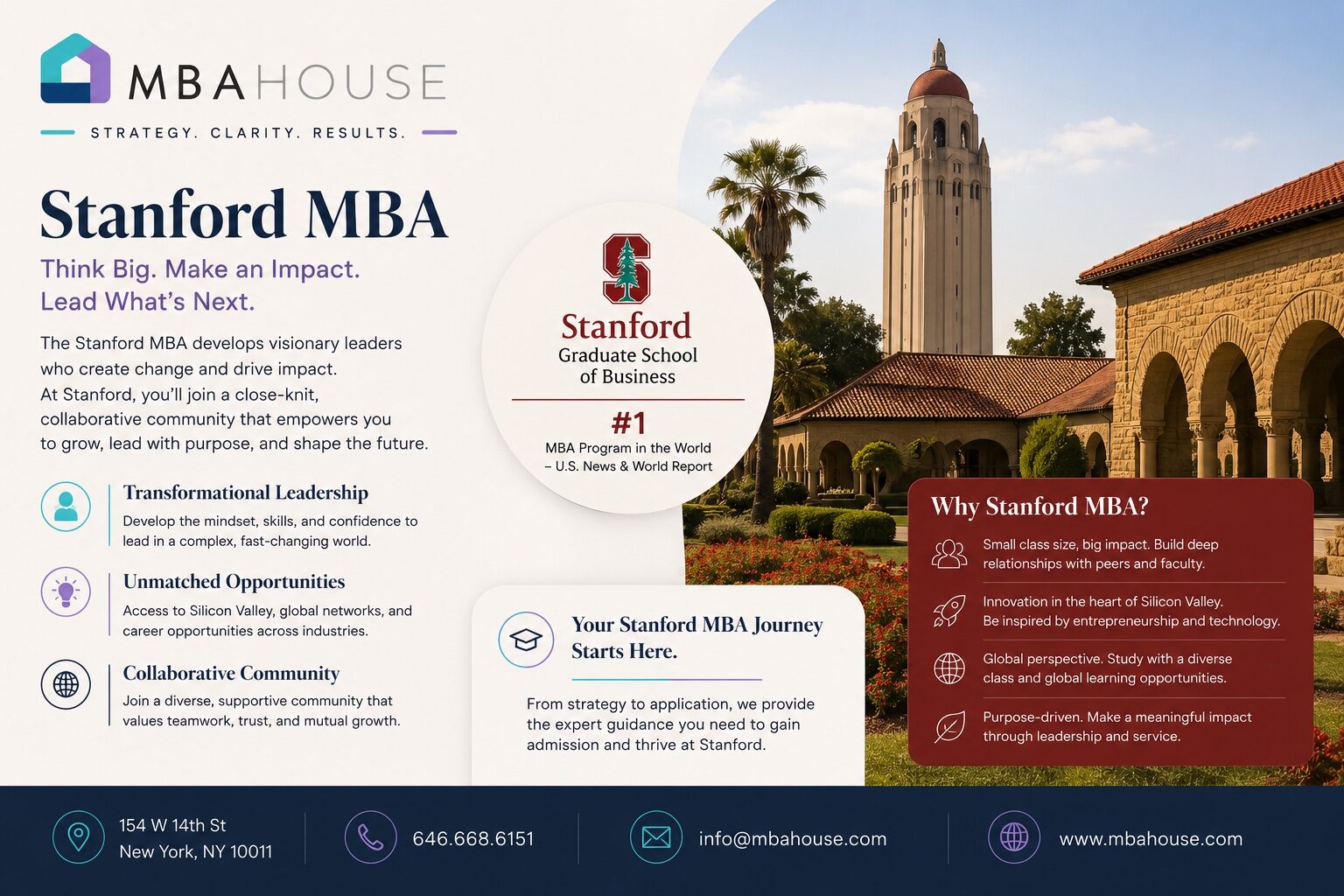
What Stanford GSB Is Really Looking For
Stanford frames its entire evaluation around three dimensions, and understanding them changes how you write every part of your application. The school is not assembling a class of test-takers; it is assembling a small, intimate community of about 431 people who will spend two years being unusually honest with one another — in T-groups, in the TALK storytelling forum, and in a curriculum built around leadership and self-awareness. That intimacy has direct consequences for who gets in.
The Three Evaluation Pillars (Official)
Stanford's admissions committee explicitly evaluates candidates across three dimensions, described on its official evaluation criteria page. The first is how you think: intellectual vitality, initiative in learning, the ability to solve hard problems and develop new insights. GPA and test scores inform this dimension but never determine it. The second is how you lead: creating positive change in organizations and communities, taking initiative, persisting through challenge, and engaging and supporting others — impact at any level, with no title required. The third is how you see the world: your values, beliefs, identity, and ambitions, and how your background shaped the path you are on. Notice what is missing: there is no pillar for "prestige of employer" or "selectivity of undergraduate institution." Stanford is reading for a person, not a résumé.
Holistic Review — What "Holistic" Actually Means at Stanford
Holistic is not a soft word; it is a specific process. Stanford explicitly tells applicants: "We won't give you a checklist to mark off, because there isn't one… Our advice is to just focus on you." In practice, this means no single weakness disqualifies you and no single strength admits you. A 3.4 GPA does not end your candidacy if your trajectory and self-awareness are exceptional; a 790 GMAT will not rescue a generic, externally motivated application. What ties the dimensions together is authenticity — the sense that the committee has met a real, specific human being whose story only they could tell. This is why Stanford's essays are introspective rather than achievement-focused, and why its interview is partially blind: the school is repeatedly testing whether your self-account holds up.
The Ideal Stanford Profile (Data-Backed)
The most recent class gives a concrete picture of who gets in. The class numbers 431 students with an average GPA of 3.75, an average GMAT of 738, average work experience of about 5 years, and an average age of 28. The class is 47% women — among the highest of any M7 program — and 35% international, representing more than 57 countries. You can read the official figures on the Stanford GSB class profile page, and the independent GMAC class-profile breakdown provides additional context. The lesson is not to match the averages — it is to be undeniable on the dimensions where you are strong while clearing the bar on the rest.
What is the Stanford MBA acceptance rate? Stanford GSB's acceptance rate is approximately 6.8% for the Class of 2026 — the lowest of any M7 program. Its yield rate is roughly 85%, among the highest in MBA admissions, which means students who are admitted almost always enroll. Stanford interviews about two to three candidates per available seat.
Stanford MBA Class Profile & Demographics
Understanding who is actually in the room helps you calibrate your own application — not to imitate, but to find where your story is distinctive. Here is the most recent class at a glance.
| Metric | Stanford GSB |
|---|---|
| Class size | 431 students |
| Average GPA | 3.75 |
| Average GMAT | 738 (range 500–790) |
| Average GRE (Verbal / Quant / AW) | 164 / 164 / 4.8 |
| Average work experience | 5 years |
| Average age | 28 |
| Women | 47% |
| International students | 35% |
| Countries represented | 57+ |
Undergraduate Backgrounds
One number stands out and tells you something real about Stanford's character: roughly 40% of the class studied engineering as undergraduates, with about 26% in economics, 24% in humanities, social sciences, and business, and 10% in other fields. That engineering share is notably higher than at peer schools like Harvard or Columbia, and it reflects Stanford's position at the heart of the Silicon Valley ecosystem. If you come from a technical background, you are in good company; if you do not, your differentiated perspective can itself be an asset — but you should be ready to demonstrate quantitative readiness, which is where a strong GMAT or GRE quant score earns its keep.
Pre-MBA Industries
The class arrives from a deliberately broad set of industries: consulting (about 28%), financial services (about 21%), government, education, and nonprofit (about 16%), technology (about 15%), healthcare and social impact (about 9%), military (about 5%), and consumer, manufacturing, and energy (about 6%). The takeaway for applicants is that there is no single feeder industry — Stanford actively builds a class of varied perspectives. The largest country cohorts after the United States (279 students) include India (14), China (13), Canada (4), Hong Kong (4), and the United Kingdom (4), underscoring how internationally distributed the class is even within a small cohort.
Stanford MBA GMAT & GRE Scores — What You Actually Need
Test scores are the most misunderstood part of the Stanford application. They matter — Stanford uses them to assess academic readiness under "how you think" — but they are a threshold signal, not a ranking that decides admission. Stanford accepts the GMAT and the GRE with no stated preference. Here is what each looks like, and how to think about your target.
GMAT Scores
The average GMAT for the most recent entering class is 738, with a reported range of 500–790. That average is among the highest in the world, and the tight clustering near the top signals a very competitive baseline — even though Stanford publishes no minimum. If you are still learning how the current exam is structured, our guide to what the GMAT is and how it works breaks down the sections, scoring, and timing in detail, and New York applicants can find structured, fast score improvement through GMAT Focus prep in New York.
GRE Scores
The GRE is accepted on equal footing with the GMAT. The most recent class averaged 164 Verbal, 164 Quantitative, and 4.8 Analytical Writing. If verbal reasoning is your strength, or you are also applying to non-MBA graduate programs, the GRE is a fully competitive choice. Registration and official preparation materials are available through ETS GRE for business school. If you are deciding between exams — or converting a practice GRE into a GMAT-equivalent target — our GRE to GMAT score conversion guide shows how the scales line up, and our broader GMAT vs GRE for MBA applications guide walks through how the choice interacts with school fit.
No Test Waiver at Stanford
This is an important contrast with some peers: Stanford does not appear to offer a test waiver. The official admissions site states that interviews are by invitation only and will not be granted without valid test score(s) submitted. In other words, a strong GMAT or GRE score is effectively a prerequisite for a competitive application — you cannot route around it the way you might at a school with a waiver policy. Treat the test as a gate you must clear early, not a variable you can defer. You can register for the GMAT and access official prep through mba.com. The application fee is $275 (U.S. military and veterans may be eligible for a fee waiver).
When to Retake
Because the average is 738 and the competitive range sits high, applicants well below the mid-700s should seriously weigh a retake if time allows — landing closer to the average removes a question mark from the "how you think" assessment, especially for candidates without a quantitative undergraduate background. But beware the opposite error: a score above the average will not carry an otherwise undifferentiated application. Once you are competitive, additional points have sharply diminishing returns, and your hours are better spent on the "What matters most to you" essay, recommender briefing, and interview preparation. The goal is to make the score a non-issue so the committee can focus on the parts of your file that actually differentiate you.
What GMAT score do you need for Stanford? There is no published minimum. The most recent class averaged 738 on the GMAT (range 500–790) and 164 Verbal / 164 Quant / 4.8 AW on the GRE. Aim to land at or near the 738 average, then let the essays, recommendations, and interview do the differentiating work.
Stanford MBA Application Deadlines (2025–2026)
Stanford runs three rounds, and the deadlines for the 2025–2026 cycle are below. All materials — including letters of recommendation and the application fee — are due at 4:00 PM Pacific Time on the deadline date, and the cutoff is strict. Always confirm against the official Stanford GSB deadlines page, with cross-reference to Clear Admit's deadline tracker.
| Round | Application deadline | Decision notification |
|---|---|---|
| Round 1 | September 9, 2025 (4:00 PM PT) | December 10, 2025 |
| Round 2 | January 7, 2026 (4:00 PM PT) | April 2, 2026 |
| Round 3 | April 7, 2026 (4:00 PM PT) | May 28, 2026 |
A few rules matter. You may apply in only one round per year. Stanford recommends Round 1 or Round 2 for couples applying together, so both know the outcome before acceptance deadlines. Deferred-enrollment applicants may apply in any round. There are no early decisions and no phone or in-person decision requests. Note one important coordination point: Knight-Hennessy Scholars candidates must apply to the MBA by the Round 1 deadline (September 9, 2025) and to the Knight-Hennessy program separately by October 8, 2025 at 1:00 PM PT.
Which Round Should You Choose?
Stanford does not state a round preference, but conventional admissions wisdom strongly favors Rounds 1 and 2. Round 3 is smaller and statistically riskier, because most of the class is filled by then and the bar to displace earlier admits is higher. The rule of thumb that survives every cycle still applies: never rush an early round just to "beat the competition." A genuinely polished Round 2 application beats a hurried Round 1 application every time, and Stanford's essays in particular reward reflection that cannot be faked under time pressure. Apply in the round where your file — and especially your "What matters most" essay — is honestly strongest. That judgment is exactly the kind of thing a second set of expert eyes can de-risk, which is why many applicants run a pre-submission application audit before committing to a round.
The Stanford MBA Essays (2025–2026)
If there is one place the Stanford application diverges sharply from every peer, it is the essays. Stanford does not ask you to narrate your accomplishments; it asks you to reveal your interior life. The two required essays are unchanged from previous cycles, and Stanford notes pointedly that "we often read effective essays that are written in fewer words." For a deeper read on essay strategy across schools, see our guide to MBA application strategy; the official prompts live on the Stanford essays page, with respected analyses from Clear Admit and Stacy Blackman.
| Essay | Prompt | Length |
|---|---|---|
| Essay A | What matters most to you, and why? | Up to 650 words |
| Essay B | Why Stanford for you? | Up to 350 words |
| Optional short answer | Up to 3 examples of significant positive impact | ~200 words (1,200 characters) each |
| Optional additional context | How background/life experiences shaped recent choices | 800 characters max |
Essay A — "What Matters Most to You, and Why?"
This is the most famous prompt in MBA admissions, and Stanford calls it both its most important and most difficult essay. There is no "right answer"; authenticity is everything. The structure of the prompt is deceptively simple — identify what matters most, then explain why: what people, insights, or experiences shaped that perspective. The single most common failure mode is writing about an accomplishment rather than a value. Strong essays reflect deeply and write from the heart, tracing a value back through the experiences that forged it. A method many successful applicants use is to brainstorm 15 to 20 of the most meaningful events in their life, look for the underlying theme that connects them, and then write backward from that theme. The essay should feel inevitable, as if only you could have written it, and it should leave the reader understanding not just what you have done but who you are.
Essay B — "Why Stanford for You?"
Essay B is the school-fit essay, and at 350 words it demands precision. Describe your aspirations and how a Stanford GSB experience specifically will help you realize them. The discipline here is to avoid generic MBA reasons — "I want a strong network and great professors" could describe any school — and instead point to GSB-specific resources, courses, faculty, and culture: the Startup Garage, the Interpersonal Dynamics course, the fully flexible second year, the Stanford ecosystem across engineering and the d.school. Genuine research is the differentiator. If you also apply to the MSx program, use this essay to address interest in both. Essay B is where the committee checks whether your "what matters most" actually connects to a future that runs through Stanford.
The Optional Short-Answer Impact Section
Stanford recently added an optional short-answer section asking you to "think about a time in the last five years when you've created a significant positive impact" — up to three examples, about 200 words (1,200 characters) each. Although it is labeled optional, both Clear Admit and Stacy Blackman recommend completing it, and in practice it functions as a third substantive element designed for concrete impact storytelling. Use it to give the committee specific, situation-action-impact evidence that complements the introspection of Essay A. There is also an optional additional context field (800 characters) in the Personal Information section, where you may elaborate on how your background or life experiences shaped recent choices, and a separate Additional Information field (1,200 characters) reserved for genuine extenuating circumstances — employment gaps, academic issues, or why you are not using your current supervisor as a recommender. The Additional Information field is not a fourth essay.
Stanford's "What matters most" essay is the hardest writing assignment in MBA admissions because it cannot be faked. An MBA House application audit helps you find the genuine theme in your story and pressure-test whether your essays, recommenders, and overall narrative actually cohere — while there is still time to fix the weak spots.
Stanford MBA Letters of Recommendation
Stanford requires exactly two letters of recommendation, and the choices are consequential. The first should come from your current direct supervisor — or, if circumstances prevent that, the best available alternative such as an indirect manager, board member, client, or former supervisor. The second should come from another professional supervisor; a workplace recommender is preferred, but a community or extracurricular leader is acceptable. Family members and direct reports are not permitted. Both recommenders submit through Stanford's online form, not from the applicant's device, and — critically — applicants may not draft, write, translate, or submit recommendations even if asked to do so by the recommender. Doing so is a violation of the application terms. You can review the requirements on Stanford's letters of recommendation page.
What Recommenders Are Asked
Stanford uses the GMAC Common Letter of Recommendation format, which includes a competency-based leadership assessment across dimensions such as initiative, results orientation, communication and poise, influence and collaboration, team leadership, trustworthiness and integrity, and self-awareness, plus narrative responses. The two mandatory written questions (up to 500 words each) ask the recommender how your performance compares to that of other well-qualified individuals in similar roles, with specific examples, and to describe the most important piece of constructive feedback they have given you, including the circumstances and your response. A third question — "Is there anything else we should know?" — is optional. Recommenders also place you on a peer rating scale ranging from "below average" up to "the best encountered in my career." The detailed question set is documented by Clear Admit.
How to Choose and Brief Recommenders
Stanford states plainly: "We are impressed by what a recommendation letter says, not by the title or background of the individual who wrote it." That is liberating and important. A mid-level manager who can cite specific examples of your impact writes a far stronger letter than a senior executive who barely knew you. The constructive-feedback question is the one applicants most often underestimate — your recommender needs a real, specific instance of feedback and your growth in response, so brief them early and honestly rather than steering them toward a non-answer. Non-native English speakers may write in their native language and have a paid translator provide an English version. Give recommenders six to eight weeks of lead time, and make sure both letters illustrate different facets of your candidacy rather than repeating the same story.
The Stanford MBA Interview — What to Expect
Stanford interviews are by invitation only, and the invitation will not be extended without valid test scores on file. An invitation is a strong positive signal — Stanford interviews roughly two to three candidates per available seat — but it does not guarantee admission. The format is a structured behavioral interview focused on your past actions, not hypotheticals, and it is partially blind: the interviewer has read only your resume, not your essays or the rest of your application. Interviews are conducted by a trained GSB alumni volunteer or an admissions team member, remotely or in person, but never on campus — Stanford offers no campus interview option. Most run 45 to 60 minutes, and business attire is recommended. The official details are on Stanford's interviews page, with deep preparation guides from Menlo Coaching and Stacy Blackman.
Interview Timing Windows
| Round | Interview window |
|---|---|
| Round 1 | Mid-September to mid-November |
| Round 2 | Mid-January to mid-March |
| Round 3 | Mid-April to mid-May |
What Interviewers Assess
Because the interview is resume-blind to your essays, the conversation is built on behavioral questions drawn from your professional and personal history. Recurring themes reported by candidates and consultants include: your biggest or proudest professional accomplishment; a time you needed help; a time you helped someone improve their skills or a team's culture; an example of resolving a conflict or dealing with a difficult team member; an example of failure; activities and challenges outside of work; why you entered your field; and a time you went above and beyond. Underlying all of it, Stanford is screening for resilience, impact, self-awareness, a global mindset, and authentic leadership. The tone is often no-nonsense and direct — many interviewers move straight to behavioral questions without small talk, some interrupt, and some are conversational. The best preparation is to be able to discuss any line on your resume with specificity, using clear situation-action-result structure, and to stay authentic rather than over-rehearsed.
Stanford MBA Cost of Attendance (2026–2027)
The honest cost of a Stanford MBA is larger than the tuition line, and applicants who plan around tuition alone underestimate the investment badly. Here is the 2026–2027 cost of attendance, which Stanford publishes for both single and married students.
| Expense category | Single student | Married student |
|---|---|---|
| Tuition | $89,187 | $89,187 |
| Living expenses | $19,950 | $36,972 |
| Housing | $22,152 | $33,015 |
| Medical insurance | $8,808 | $8,808 |
| Health fee | $843 | $843 |
| Total cost of attendance | $140,940 | $168,825 |
Beyond these figures, the first-year Global Experience Requirement adds roughly $4,000–$6,000 (not included above), though need-based fellowship recipients can receive a grant of up to 40% of approved expenses. The application fee is $275. Over two years, direct costs for a single student total roughly $281,880 before living-cost inflation. Then there is opportunity cost, which most applicants ignore: two years of foregone income at typical pre-MBA salary levels adds well over $200,000, putting the total economic investment comfortably above $480,000. Because tuition rises each year, always quote figures with their academic year and verify against the official Stanford GSB cost of attendance page. The point is not to scare you off — Stanford graduates routinely earn the investment back — but to ensure your financing plan is built on the real number. Our guide to how to finance your MBA lays out the full stack of loans, sponsorship, and savings.
How much does a Stanford MBA cost? Tuition for 2026–2027 is $89,187 per year. Total cost of attendance for a single student is approximately $140,940 annually, including living expenses, housing, insurance, and fees. The full two-year program runs roughly $281,880 in direct costs before fellowships, or well over $480,000 once foregone salary is counted.
Stanford MBA Scholarships and Financial Aid
Stanford's financial aid model is generous but specific: fellowships are need-based, awarded based on demonstrated financial need rather than merit. That means a high GMAT will not "earn" you money the way it might at some peer programs — but the support that is available is substantial. The framework lives on Stanford's types of aid page, and our guide to MBA scholarships and fellowships covers the broader strategy across schools.
Need-Based Fellowships
Approximately 50% of Stanford MBA students receive fellowship funds, with an average award of about $47,000 per year, or roughly $94,000 over two years — a meaningful reduction in net cost. The BOLD Fellows Fund provides additional need-based aid for students facing financial hardship who are committed to expanding opportunity. There is one nuance worth planning around: external scholarships under $40,000 do not reduce your Stanford fellowship, but external awards of $40,000 or more will reduce it (though not dollar for dollar), and employer sponsorship typically disqualifies students from Stanford fellowships entirely.
Knight-Hennessy Scholars
The most generous funding at Stanford is the Knight-Hennessy Scholars program, which fully funds tuition and living costs for up to three years for a selective cohort of up to 100 scholars drawn from all Stanford graduate programs each year. It requires a separate application — for the 2026 cohort, the deadline is October 8, 2025 — and MBA candidates must also apply to the MBA by the Round 1 deadline. Beyond fellowships, Stanford offers federal and private loans (and certifies educational loans for international students), participates in the Yellow Ribbon Program and accepts the Post-9/11 GI Bill, and provides social-impact career support including stipends and loan forgiveness for graduates entering nonprofit, public-sector, and high-impact roles. Summer stipends fund internships in nonprofit, government, social impact, or entrepreneurial organizations, and Stanford Impact Founder Fellowships support aspiring social-impact entrepreneurs.
Stanford MBA Employment Outcomes (Class of 2025)
The return on the investment shows up in the employment report, and the most recent data is strong even amid a softer hiring market. The figures below come from Stanford's own reporting and independent analysis of it, including the official employment outcomes page and Poets & Quants.
Job Offer Rates and Timeline
Among the Class of 2025's 426 graduates, only about 63% actively sought employment — a striking figure that reflects how many GSB graduates pursue their own ventures rather than traditional jobs. Of those who did seek employment, 66% had offers by graduation, 90% had offers within three months of graduation (up from 88% the prior year), and 81% accepted offers within three months. Notably, about 16% of graduates pursued their own ventures immediately after the program — a defining feature of Stanford's class that we examine more closely below.
Compensation
| Metric | Class of 2025 |
|---|---|
| Average base salary | $190,901 |
| Median base salary | $185,000 (record level, 2nd consecutive year) |
| Average signing bonus | $35,888 |
| Median signing bonus | $30,000 |
| Share receiving signing bonus | 51% |
| Average expected performance bonus | $89,605 |
| Estimated total compensation (P&Q) | ~$267,551 |
Two clarifications matter for accuracy. First, these salary figures describe the roughly 63% of the class that sought traditional employment — not the entire class, a meaningful share of which launched ventures or pursued non-traditional paths. Second, the median base salary of $185,000 reached a record level for the second consecutive year even as Poets & Quants noted total pay declined slightly, driven by softer bonus components rather than base.
Industry Breakdown — A Notable Shift
| Industry | % of class | Avg. base salary |
|---|---|---|
| Technology | 35% (up from 22%) | ~$192,000 |
| Finance | 33% (down from 37%) | $204,104 |
| Consulting | 11% (down from 14%) | Softened |
| Healthcare | Smaller segment | $158,636 |
The headline shift is that technology surpassed finance as the #1 destination for the first time since 2018, driven heavily by AI-related hiring in product management, go-to-market, and customer-success roles at AI companies. Finance still delivers the highest average base salaries, but tech's surge reflects both Stanford's Silicon Valley positioning and the broader gravitational pull of the AI wave. For reference, the prior year's Class of 2024 saw finance at 37% and technology at 22%, with about 23% of that class launching their own ventures — context documented by Clear Admit's Class of 2024 report.
Entrepreneurship at Stanford GSB
If there is a single feature that defines Stanford GSB in the public imagination, it is entrepreneurship — and unlike most reputations, this one is backed by structure and outcomes. Stanford is widely considered the #1 MBA program for entrepreneurship globally, benefiting directly from its location at the heart of Silicon Valley and its proximity to Stanford's engineering school, law school, and the d.school. You can explore the ecosystem on Stanford's entrepreneurship page.
The Entrepreneurship Ecosystem
Stanford offers more than 50 GSB courses in entrepreneurship and innovation, anchored by hands-on programs: the Startup Garage, where student teams design and test new business concepts addressing real-world needs; Formation of New Ventures, built on case-based conversations with founders and CEOs; Managing Growing Enterprises, focused on the challenges of scaling; and the Search Fund Garage, a dedicated course on search-fund entrepreneurship — a path Stanford is especially known for. The Grousbeck-Holloway Center for Entrepreneurial Studies serves as the central hub, the Stanford GSB Impact Fund supports social ventures, and the Entrepreneurial Summer Program provides stipends for students interning at entrepreneurial organizations. MBA students can also take courses across Stanford's six other schools and design programs at the renowned d.school (the Hasso Plattner Institute of Design).
Entrepreneurship Outcomes — By the Numbers
The outcomes match the infrastructure. In the Class of 2025, about 16% of graduates immediately launched their own ventures; in the Class of 2024, the figure was about 23%. Among the Class of 2024 entrepreneurs, roughly 28% launched in technology, 28% pursued search funds, 16% in healthcare, and 4% in finance or energy. As one r/MBA community member put it, "many GSB students initiate their own companies while still enrolled — the entrepreneurial spirit is woven into the culture" (see the r/MBA discussion). If founding is your path, articulate it clearly and specifically in your application — the resources are real, and Stanford wants to admit people who will use them. Our broader explainer on whether you need an MBA covers how the degree functions as a launchpad versus a credential.
What Makes Stanford GSB Uniquely Different
Beyond the data, a handful of structural and cultural features distinguish Stanford from every peer. Understanding them helps you write a more credible "Why Stanford?" essay and decide whether the school genuinely fits you.
Interpersonal Dynamics ("Touchy Feely")
Arguably the most famous course in MBA education, Interpersonal Dynamics — universally known as "Touchy Feely" — enrolls more than 90% of MBA students each year across twelve sections. Students meet in small T-groups of about twelve with trained facilitators, working on emotional intelligence, authentic communication, influence, and self-awareness. A famous exercise, the "Influence Line," asks peers to rank one another by perceived influence and then discuss why. Stanford's own reporting on the course (see Stanford News) captures why it matters: it is the clearest expression of the school's belief that leadership begins with knowing yourself and being known by others.
Leadership Labs and the Flexible Second Year
First-year students complete required Leadership Labs, including the "Executive Challenge," which integrates experiential testing, analysis, and reflection; the selective Arbuckle Leadership Fellows Program lets second-years serve as coaches for first-year cohorts. The second year is then 100% electives — there are no required courses — with 100+ options including cross-school electives at Stanford Engineering, Law, Medicine, the d.school, and Education, plus joint and dual-degree paths. This flexibility, documented on Stanford's curriculum page, is a meaningful contrast with case-method, cohort-based programs.
The Global Experience Requirement and Community Culture
Every first-year student must complete a global experience — a four-week Global Management Immersion Experience, an 8–10 day Global Seminar or Study Trip, or the Stanford-Tsinghua Exchange. Culturally, Stanford is known for forums like TALK, an informal student storytelling event where classmates share highly personal stories — a window into a community that prizes authenticity and vulnerability. These features are not marketing gloss; they are the lived experience of a 431-person class, and referencing them specifically (rather than generically) is what makes an Essay B credible.
Stanford vs. Harvard — Making the Right Choice
For many applicants, the real decision is between Stanford GSB and Harvard Business School. They are both extraordinary, and the right answer depends entirely on fit and goals — not on a rankings tiebreaker. Here is an honest comparison, with additional context in our Harvard MBA admissions guide and the independent GMAC Harvard vs. Stanford comparison.
| Dimension | Stanford GSB | Harvard Business School |
|---|---|---|
| Class size | ~431 | ~930 |
| Acceptance rate | ~6.8% | ~10–12% |
| Location | Silicon Valley / Palo Alto | Boston, MA |
| Curriculum | Flexible; 100% electives in Year 2 | Case method, fixed first year |
| Tech / VC outcomes | 35% tech; strong VC pipeline | More diverse sector distribution |
| Entrepreneurship | #1 globally; 16–23% launch ventures | Strong, but second to GSB |
| Touchy Feely / EQ focus | Yes (unique to GSB) | No |
| Network | Smaller, highly concentrated | Very large, broad-reaching |
| Average GMAT | 738 | ~740 |
The cleanest way to think about it: Harvard cultivates future Fortune 500 executives; Stanford cultivates founders, innovators, and VC-backed entrepreneurs. Stanford's much smaller class makes each diploma more distinctive and its network more concentrated, while Harvard's scale delivers reach and a broader brand. Neither is "better." The candidates who get into both — and there are some every year — choose based on whether they want the intimacy, flexibility, and Valley proximity of Stanford or the scale, case-method rigor, and breadth of Harvard. Articulating that choice authentically is part of what makes a Stanford application read as genuine rather than prestige-chasing.
When Stanford May Not Be the Right Choice
Frame this as fit, not rejection. If you want the largest possible alumni network and a broad general-management brand, Harvard's scale is an advantage. If you are a quant-dominant finance specialist targeting specialized investment roles, Wharton or Booth may offer sharper technical networks. If you need a larger cohort to find your people, the 431-student class may feel small. And if merit-based aid is decisive for you, note that Stanford's fellowships are need-based. None of this means Stanford is "not for you" — it means the smartest applicants choose deliberately. If you want help weighing fit against your goals, that is exactly what an MBA admissions consultant is for.
Common Stanford MBA Application Mistakes (and How to Avoid Them)
Most rejections at Stanford are self-inflicted in predictable ways. Avoid these and you immediately separate yourself from a large share of the pool.
- Writing Essay A about an accomplishment, not a value. "What matters most to you" asks for what you care about and why — not your proudest achievement. The most common failure is answering the wrong question beautifully.
- Treating the GMAT as pass/fail. Stanford is holistic, but with a 738 average and no waiver, a weak score is a real liability — clear the bar early so the file can be judged on its substance.
- Generic "Why Stanford?" essays. At 350 words, Essay B must name GSB-specific resources, courses, and culture. Reasons that could apply to any school are a quiet rejection signal.
- Skipping the optional short answer. It is optional in name only; completing it signals engagement and gives the committee concrete impact evidence.
- Choosing recommenders for title, not knowledge. Stanford says it values what the letter says, not who wrote it — pick people who can cite specifics.
- Drafting your own recommendation. This violates the application terms and is a serious integrity risk. Brief your recommenders instead.
- Underestimating the constructive-feedback question. Recommenders need a real instance of feedback and your growth — prepare them early.
- Banking on Round 3. The rounds are not equal in practice; Round 3 is smaller and riskier. Apply when your file is genuinely ready, ideally in Round 1 or 2.
- Over-rehearsing the interview. It is behavioral and direct; canned answers read as inauthentic. Know your resume cold and stay genuine.
- Prestige-chasing. Stanford screens for authenticity. An application that reads as "I want the most selective school" rather than "I belong here for these reasons" rarely survives.
Almost every mistake on this list is invisible to the applicant who makes it — that is why a structured outside review pays for itself. MBA House helps New York applicants catch these before submission, not after a ding.
Your Stanford MBA Timeline — 12, 6, and 3 Months Out
Strong Stanford applications are built on a runway, not a sprint — and the "What matters most" essay in particular rewards months of reflection. Here is what to do and when, with the specific actions that actually move the needle.
12 Months Before Applying
Diagnose your testing situation first: take a GMAT or GRE diagnostic and target a score at or near the class average (738 GMAT, or 164/164 per GRE section). Because Stanford offers no test waiver, treat this as non-negotiable and start prep now — serious preparation takes three to six months. In parallel, begin the introspective work that Essay A demands: start a running list of the most meaningful experiences and people in your life, and notice the themes. Audit your profile for leadership and impact evidence, and seek roles where you can lead and make measurable change. Begin mapping potential recommenders. Action: establish a baseline and strategy with an MBA House application audit or GMAT consultation.
6 Months Before Applying
Complete your GMAT or GRE, aiming to land at or near the class average. Develop Essay A in earnest: from your list of 15–20 formative experiences, identify the underlying theme and begin writing backward from it. Research Stanford deeply for Essay B — specific courses, faculty, the Startup Garage, Touchy Feely, the second-year electives — so your fit is concrete rather than generic. Finalize your recommenders, give them six to eight weeks of lead time, and brief them honestly, especially on the constructive-feedback question. Draft your resume with impact framing (action → outcome → scale). Action: engage MBA House for essay strategy and a full profile review.
3 Months Before Applying (Round 1: June–August)
Finalize Essay A and Essay B, and draft your three optional short-answer impact examples. Run every essay through the authenticity test: does Essay A reveal a genuine value rather than a trophy, and does Essay B point to Stanford specifically? Confirm your recommenders are on track to submit before the 4:00 PM PT deadline, and complete every application section. Begin behavioral interview preparation — be ready to discuss any line on your resume and to handle direct, no-small-talk questioning. Submit Round 1 by September 9, 2025 (4:00 PM PT), and if you are a Knight-Hennessy candidate, prepare that separate application for its October 8 deadline. Action: book MBA House application review and mock interview sessions. New York applicants can find local logistics in our NYC GMAT and MBA admissions guide.
Do You Need an MBA Admissions Consultant for Stanford?
Stanford rejects more than 93% of applicants, many with elite scores and prestigious employers. At that level of competition, the differentiator at the margin is rarely another credential — it is narrative: how authentically you answer "what matters most," which experiences you surface, and whether your essays, recommenders, and interview cohere into one believable person. A good admissions consultant provides application strategy, essay coaching, interview preparation, and a profile gap analysis well before submission, when there is still time to act on it. Consulting is especially high-ROI for career switchers, international applicants, reapplicants, and anyone whose self-narrative has not yet crystallized into a clear theme. New York applicants have access to specialized GMAT coaching and admissions consulting through MBA House / GMATNY; our honest take on when this help is worth it lives in whether you need an MBA admissions consultant, and you can always start with a no-cost conversation.
The Bottom Line on Getting Into Stanford
Getting into Stanford Graduate School of Business is not about clearing a single bar. It is about assembling a multi-dimensional profile — intellectual vitality, demonstrated leadership, and a clear sense of who you are and what you value — into a story that answers the three pillars: how you think, how you lead, and how you see the world. The data backs this up at every turn. There is no minimum GMAT, no minimum GPA, and no checklist; what Stanford rewards is authentic self-knowledge, expressed through the hardest essay in MBA admissions, two well-chosen recommenders, a sharp resume, and a behavioral interview you can carry with specificity. The applicants who get in are almost never the ones who started in August. They are the ones who diagnosed their test situation a year out, did the genuine reflection that Essay A demands, chose recommenders who could speak to specifics, and wrote essays that could only describe them.
That kind of application is buildable, and it is exactly the work MBA House does with New York applicants every cycle — connecting your GMAT or GRE plan, your school list, your essays, and your interview preparation into one coherent strategy aimed at Stanford GSB. If you want a candid read on where your profile stands today and what the highest-leverage moves are between now and your deadline, book a free strategy call and we will build the plan with you.
Ready to pressure-test your Stanford application? Book a free strategy call for a candid assessment of your profile, a realistic score and timeline plan, and the specific moves that will strengthen your Stanford GSB candidacy.
Stanford MBA Admissions FAQs
What GMAT score do you need for Stanford GSB?
Stanford does not publish a minimum. The most recent class averaged 738 on the GMAT (range 500–790) and 164 Verbal / 164 Quant / 4.8 AW on the GRE. Aim to land at or near 738, then let the essays, recommendations, and interview do the differentiating work.
What is the acceptance rate for the Stanford MBA?
Approximately 6.8% for the Class of 2026 — the lowest of any M7 program. Stanford's yield rate is roughly 85%, among the highest in MBA admissions, and it interviews about two to three candidates per available seat.
What are the Stanford MBA application deadlines for 2025–2026?
Round 1 closes September 9, 2025 (4:00 PM PT) with decisions by December 10, 2025. Round 2 closes January 7, 2026 (4:00 PM PT) with decisions by April 2, 2026. Round 3 closes April 7, 2026 (4:00 PM PT) with decisions by May 28, 2026. You may apply in only one round per year.
What essays does the Stanford MBA require?
Two required essays: Essay A, "What matters most to you, and why?" (up to 650 words), and Essay B, "Why Stanford for you?" (up to 350 words). There is also a strongly recommended optional short-answer section asking for up to three examples of significant positive impact (about 200 words each).
How much does a Stanford MBA cost?
Tuition for 2026–2027 is $89,187 per year. Total cost of attendance for a single student is approximately $140,940 annually, including living expenses, housing, insurance, and fees. The full two-year program runs roughly $281,880 in direct costs before fellowships.
Does Stanford GSB offer scholarships?
Yes. Stanford's fellowships are need-based, and about 50% of students receive fellowship funds, averaging roughly $47,000 per year ($94,000 over two years). The Knight-Hennessy Scholars program fully funds tuition and living costs for up to three years for a selective cohort.
What is the average salary after a Stanford MBA?
For the Class of 2025, the average base salary was $190,901 and the median base was $185,000 — a record level for the second consecutive year. The average signing bonus was $35,888, and total compensation was estimated near $267,551. These figures cover the roughly 63% who actively sought employment.
Does Stanford GSB accept the GRE?
Yes. Stanford accepts the GMAT and GRE equally with no stated preference. The most recent class averaged 164 Verbal / 164 Quant / 4.8 AW on the GRE. Stanford does not appear to offer a test waiver, so a valid score is effectively required.
How long is the Stanford MBA interview?
Typically 45 to 60 minutes. Interviews are by invitation only, behavioral in format, and partially blind — the interviewer has read only your resume. They are conducted by a trained GSB alumni volunteer or admissions team member, remotely or in person, but never on campus.
How many recommendation letters does the Stanford MBA require?
Two. The first should come from your current direct supervisor (or the best available alternative); the second from another professional supervisor. Family members and direct reports are not permitted, and applicants may not draft or submit their own letters.
How many students are in a Stanford MBA class?
About 431 — one of the smallest classes among top U.S. MBA programs. The class is roughly 47% women and 35% international, representing more than 57 countries, with an average age of 28 and about five years of work experience.
When should you start preparing for the Stanford MBA application?
Ideally 12 to 18 months before your target round. Stanford's "What matters most" essay requires unusually deep reflection, and combined with GMAT or GRE prep, recommender relationships, and Essay B research, the work cannot be compressed into the final weeks.